


We have Completed a Solar Power Demonstration Experiment Using Perovskite and Other Materials at the Hishiike Retarding Basin (Nukata District, Aichi Prefecture) ~ Confirming the Effectiveness of a New Renewable Energy Introduction Method Utilizing Spatial Potential of Water Infrastructure ~
Pacific Consultants Co., Ltd.(Headquarters: Chiyoda Ward, Tokyo; Representative Director, President Executive Officer: Osamu OMOTO; hereinafter “our company”) has completed a solar power solar power generation system using perovskite and other materials on the slope of a levee at the Hishiike Retarding Basin in Kota Town, Nukata District, Aichi Prefecture (hereinafter referred to as “this demonstration experiment”) as a part of “Demonstration Project for Renewable Energy Technologies Utilizing the Spatial Potential of Water Infrastructure” implemented by the Ministry of the Environment, and the “Yahagi River and Toyo River Carbon Neutral Project” promoted by Aichi Prefecture.
In this demonstration experiment, slope blocks incorporating solar cell modules using perovskite and other materials were installed on the lavee slope, and power generation performance, maintainability, and weed control effects were verified. As a result, it was confirmed that solar power generation is possible without significantly hindering the function or maintenance of the lavee, and its effectiveness as a method for introducing renewable energy utilizing spatial potential of water Infrastructure.
※実証実験の詳細は以下のプレスリリースをご参照ください。
菱池遊水地(愛知県額田郡)でペロブスカイト等を使用した太陽光実証実験を開始しました
https://en.pacific.co.jp/news/2025/20250707-002616.html
■ Overview of demonstration experiment
Demonstration location: Hishiike Retarding Basin, Kota Town, Nukata District, Aichi Prefecture
Implementation period: July 1, 2025 - March 20, 2026
Verification details: Verification of power generation performance, equipment integrity, maintainability, weed control effectiveness, etc.
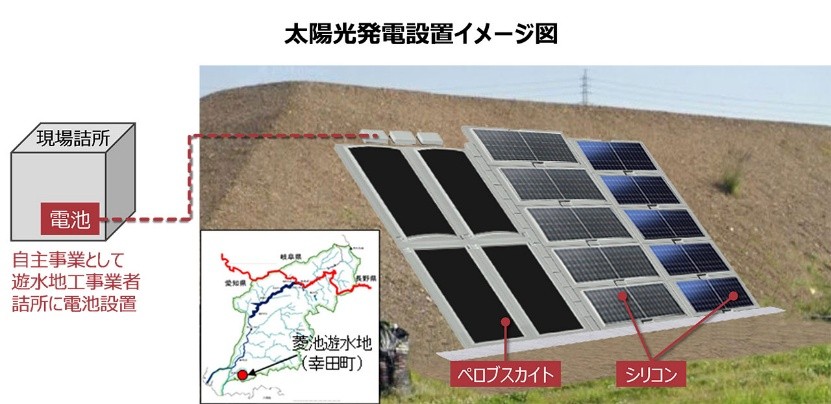
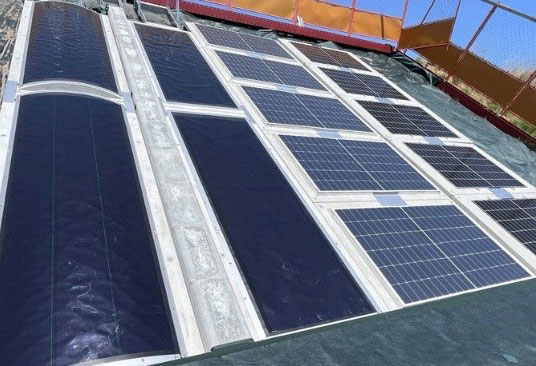
On-site photo of solar power generation block
■ Results of demonstration experiment
1. Confirm that the amount of electricity generated is equivalent to that of the simulation.
We confirmed stable power generation throughout the demonstration period. Even during the summer when Nagoya City recorded 52 days of extreme heat, no significant degradation of the solar modules was observed. Furthermore, the amount of electricity generated was consistent with the prior simulations, confirming that the expected power generation performance could be obtained even on the lavee slope.
2. Confirm the compatibility with levee function.
Although some dirt was observed on the module surface, no deterioration or electrical leakage occurred in the slope blocks or wiring. Furthermore, the lavee's cross-sectional shape was maintained, and no impact on the lavee due to the installation of the solar power generation equipment was confirmed. This confirmed that solar power generation equipment can be installed while maintaining the function of the lavee.
3. Demonstrate the potential to reduce maintenance burden through weed control.
We confirmed that weed growth was suppressed in areas where solar modules were installed compared to the surrounding areas. This suggests the potential for reduced weeding work and lower maintenance costs, demonstrating that the modules contribute to reducing the burden of maintenance in addition to power generation.
In this demonstration experiment, in order to achieve solar power generation while maintaining the function of the lavee, a structure was adopted in which the solar cell modules and slope blocks were integrated and the wiring was housed inside the blocks. This ensured safety and maintainability, as well as reducing the environmental impact by using low-carbon concrete.
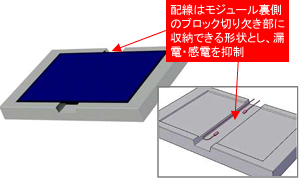
Wiring structure for slope blocks (measures against electric shock and leakage current)
■Future outlook
Based on the results of this demonstration, we will proceed with expanding the application to slopes other than lavees (such as slopes in agricultural land and public facilities) and work to build up a track record toward social implementation. Furthermore, we will also consider its use for water infrastructure such as dam reservoirs, aiming to expand its scope of application. Moving forward, we will continue to contribute to the realization of a decarbonized society through technological development and implementation in the field of social infrastructure.
―――
当社のWebサイト「INSIGHT」にてペロブスカイト太陽発電の公共インフラへの導入について解説しています。
https://en.pacific.co.jp/insight/2025/11/perovskite-solar-cell.html
Please refer to the following documents published by Aichi Prefecture regarding this demonstration experiment.
https://www.pref.aichi.jp/uploaded/attachment/605581.pdf