


We Conducted a Joint Survey with Luup on "The Actual Usage of Micro-Mobility Sharing Services in Urban Areas."
Pacific Consultants Co., Ltd.(Address: Chiyoda-ku, Tokyo; Representative Director, President Executive Officer: Osamu OMOTO) has conducted a joint survey with Luup Inc. (Headquarters: Shinagawa-ku, Tokyo; Representative Director & CEO: Daiki OKAI) to organize the actual usage and social significance of micro-mobility.
■ Background and overview of the survey
Micro-mobility sharing services, such as electric scooters and electric-assist bicycles, have rapidly spread in urban areas in recent years as a new type of transportation. However, quantitative research from an urban and transportation policy perspective on how such mobility is actually used and what role it plays has not been sufficiently conducted. As a result, it has been difficult to consider how to position and utilize micro-mobility, which will become increasingly prominent in the future, as a new mode of transportation in urban areas.
Therefore, in this joint study, we investigated and analyzed how "LUUP," a micro-mobility sharing service, is used on a daily basis as a new mode of transportation in urban areas, and how it contributes to addressing urban mobility challenges.
■Summary of survey results
The survey revealed that the micro-mobility sharing service "LUUP" is primarily used for short distances and short durations. Regarding the main purposes of use, in residential areas in particular, commuting to work and school accounts for about 40% of the total usage. In commercial and business areas, it is used in a variety of situations, such as travel during work, shopping, dining, sightseeing, and entertainment, indicating that it is useful for people's essential daily travel needs. Furthermore, while most areas are urban areas covered by train stations or bus routes, about 20% of usage is between locations where public transport is inconvenient, indicating that it plays a role in supplementing locations and times where public transport is inconvenient.
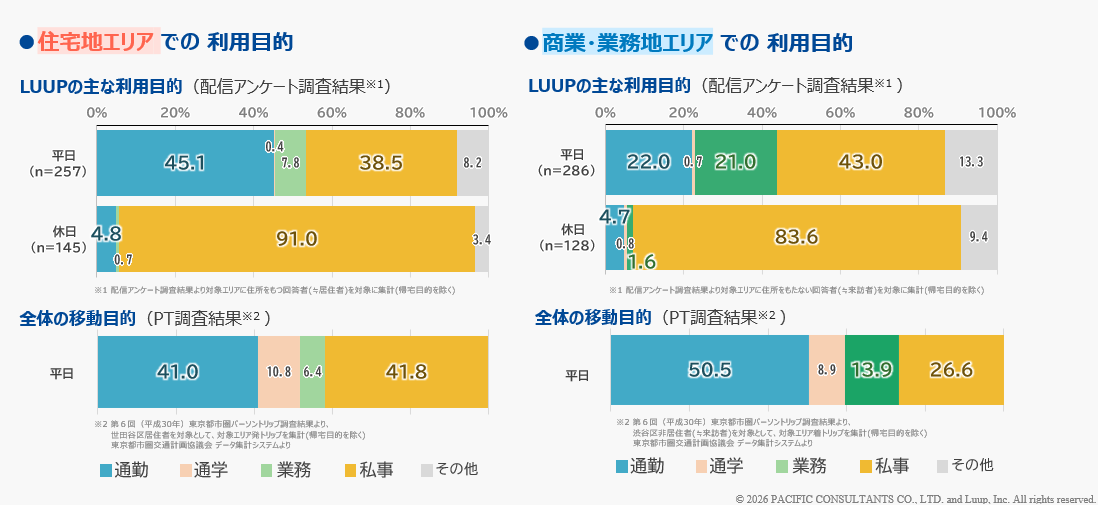
Comparison of Usage Purposes in Residential Areas and Commercial/Business Areas.
In addition, when asked "Why they chose LUUP for travel," approximately 50% of respondents answered "Because it allows them to use their time freely," about 60% of users said they have "Thought about going out because LUUP is available," and about 40% of users said they have "Decided on a destination because there is a LUUP port nearby." This revealed that the installation of micro-mobility ports may also contribute to expanding the area in which facilities can attract customers.
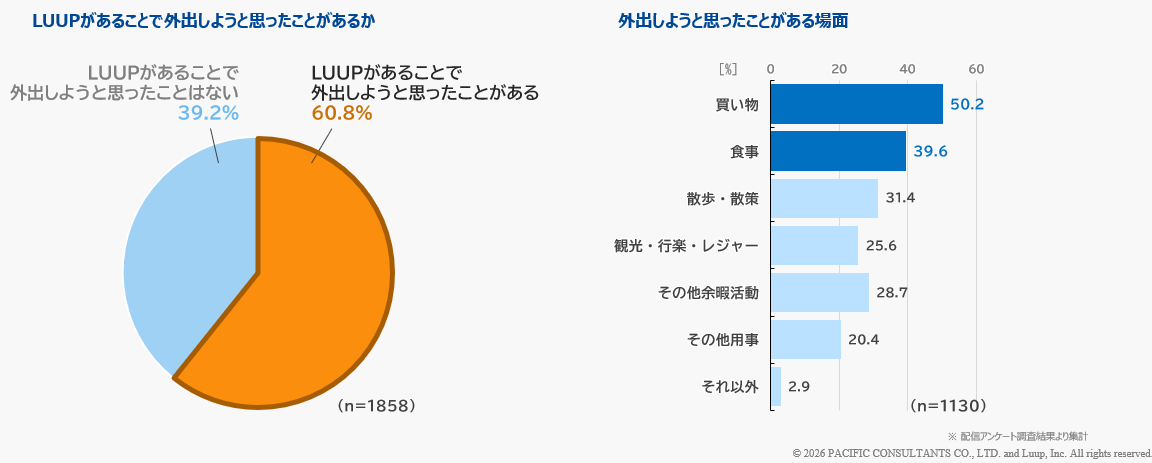
Survey Results when Asked "Have You Ever Chosen a Destination Because It has a LUUP port?"
■Summary of the survey and future prospects
This study suggests that micro-mobility sharing services in urban areas play a role as a highly flexible means of short-distance transportation that can be easily used regardless of location or time.
In the future, with the expansion of new economic activities known as the sharing economy, micro-mobility sharing services are expected to become even more widespread. On the other hand, various regions face diverse challenges related to transportation. By utilizing the insights gained from this survey regarding the usage characteristics of micro-mobility sharing services in planning for solving regional transportation challenges, such as creating cities that do not rely excessively on automobiles, we aim to contribute to the creation of sustainable cities where everyone can easily get around.
■Joint survey report

*Clicking this image will take you to the joint research report.
*Correction made on June 2, 2026: Some errors in this document have been corrected.
(Replace the graph on the bottom right of page 10 (distribution of holiday usage times in commercial and business areas))
[Summary of the survey and analysis]
■ Survey area
We selected two areas within Tokyo where usage patterns are thought to differ significantly: "Residential Areas" and "Commercial/Business Areas," and conducted the survey and analysis in these areas.
- Residential area: Areas around Shimokitazawa Station, Sangenjaya Station, and Gakugei-daigaku Station (within Setagaya Ward)
- Commercial and business area: Around Ebisu Station (within Shibuya Ward)
■ How the survey was conducted
We collected and analyzed data by combining the following three sets of information.
Table: Overview of the survey implementation
| Riding Log Data | Questionnaire | Post-Riding Survey | |
|---|---|---|---|
| Overview | This survey investigates how ports are used, including the type and time of use, when using ports in the surveyed area. | We conducted a detailed investigation into the purpose of use, including the main purpose and type of use *, attributes, and means of transportation if LUUP were not available. | By using LUUP and conducting surveys about travel purposes, etc., and linking this information with log data, we investigate purposes and usage patterns directly linked to rides *. |
| Survey Period | The period of time for the log data to be analyzed. Sataturday, June 1, 2024 - Sunday, June 1, 2025 | Survey distribution period: Thursday, May 22 - Sunday, June 1, 2025 | Survey distribution period: Monday, May 19 - Sunday, June 1, 2025 |
| Target Persons | During the survey period, all travel using ports in the target area | We will distribute a survey to users who used LUUP within the target area during the most recent two months (March - April 2025). | Users who used LUUP within the target area during the survey distribution period |
| Number of Samples | 2,752,795 | 1,858 | 5,659 |
*The usage type is categorized as either "Travel to/from the station" or "Travel using LUUP only".