

Field Survey of Tadami River Dam
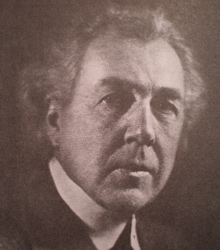
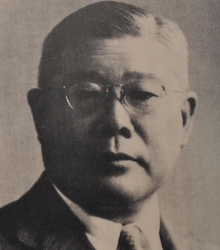
One day after the war, one of his former close friends, Tashiro SHIRAISHI, wrote to him asking if he could come to Japan to inspect a dam, given Japan's need for hydroelectric power. In 1947, he directly contacted Marshal Douglas MacArthur, the General Supreme Commander, to express his desire to visit Japan. MacArthur replied that "Raymond's architectural achievements in Japan are highly regarded as historic," and he was finally granted permission to visit.
(Hiroshi MISAWA, "The Architecture of Antonin Raymond," published by Kajima Publishing Co., Ltd.)
SHIRAISHI and I met with Shigeru YOSHIDA several times in his private office to discuss the measures and significance of the master plan.
I arrived in Tokyo with Eric Flor at the end of October 1949. Our first order of business was to visit marshal MacArthur, brief him on the Okutadami, and ask his opinion on the state of Okutadami, the feasibility of building a dam there, and on the preparation of a scientific report based on Flor's investigations. (Omitted) The marshal wore an open-collar shirt and held an unlit, empty pipe in his right hand. He invited us to sit down and listened patiently to our opinions. At times he would disagree on the issues, but judging by them, it was clear that he was well versed in the engineering problems we faced. He approved of the task and instructed us to assist him.
(Hiroshi MISAWA, "The Architecture of Antonin Raymond," published by Kajima Publishing Co., Ltd.)
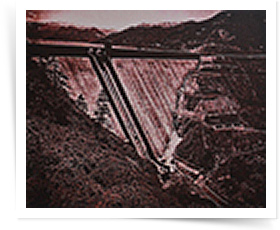
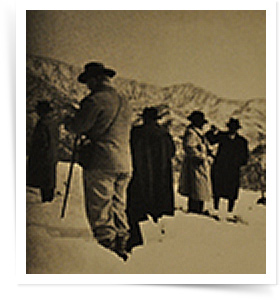
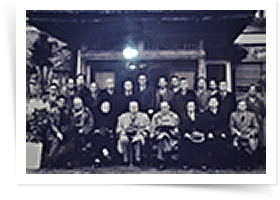
On a snowy day in November, Eric Flor, Raymond, Muneki SHIRAISHI, Yasuo KAWANO and others traveled from Niigata Prefecture to the current dam site on the Tadami River. (Omitted) Transportation was poor at the time and it was thought impossible to make the long journey over the mountain roads on foot, so a palanquin was made and Flor was carried in it.
(" PACIFIC CONSULTANTS 25-Year History" published by PACIFIC CONSULTANTS CO., LTD.)
We were carried to our destination by the mountain men. They made something like a shoulder basket using logs and chairs, placed a floor on top of it, and were carried by a dozen men. I was carried in an old palanquin carried by two men. (Omitted) They refused to accept any payment, saying that they would do so if transporting us would benefit Japan.
(Translated by Hiroshi MISAWA, Autobiography of Antonin Raymond, published by Kashima Publishing Co., Ltd.)