Skip to content
Go to site menu

# How to address climate change adaptation and mitigation measures in the face of increasingly severe weather-related disasters

Use of SAR Satellites in Disaster Prevention

The "Long-Term Assessment of the Probability of Earthquakes" by the government's Headquarters for Earthquake Research Promotion predicts a high probability of a massive earthquake, and as natural disasters become more severe and frequent due to climate change, the efficiency and sophistication of disaster prevention and mitigation measures through DX are becoming an urgent issue. As an important tool for this, commercial SAR satellites are attracting attention because of their ability to observe the ground at high frequencies regardless of time of day or weather conditions. We interviewed Mr. Toshiki YANAGIMACHI, Technical Manager of the Resilience Promotion Sec., Mr. Tsukasa MITOGAWA, Assitant Manager of the Disaster Prevention DX Promotion Sec. of Disaster Prevention Dept., Digital Service Div. and Mr. Nobukazu SASAKI, General Manager of Technology Development Sec. of Advanced Technology Center of PACIFIC CONSULTANTS, who are working on satellite applications in the field of spatial information technology.

Climate Change Adaptation Measures in Ports and Harbors

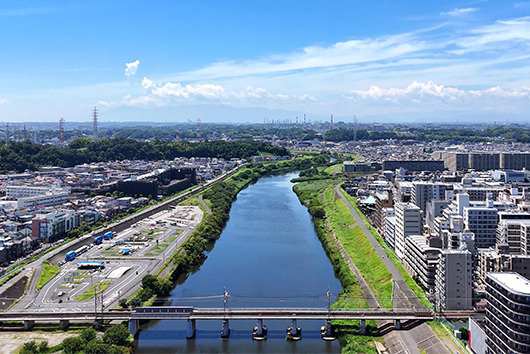
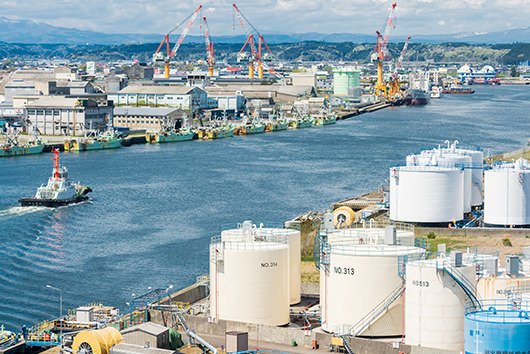
With rising sea levels and larger typhoons due to climate change, how to protect ports from flooding damage has become a major issue. However, because ports are spread across a wide area and involve a variety of public and private entities, no single entity can take effective measures alone. What is needed is "collaborative protection," in which all stakeholders work together toward a common goal. The government has also published "Guidelines for Creating Collaborative Protection Plans," and in the future, each port will begin full-scale efforts. We spoke with Takayuki Ooie, General Manager of Section of Ports and Harbors and Coast Sec. in the Port Ports and Harbors Dept. PACIFIC CONSULTANTS, and Ryunosuke Kanno Chief Project Manager of Ports and Harbors Planning Sec. about the latest trends in collaborative protection efforts.

Corporate's Climate Change Countermeasures

In recent years, extreme weather events such as extreme heat waves and torrential rains have been occurring frequently in many parts of the world, causing severe damage such as floods and landslides. These weather disasters are believed to be caused by global warming in addition to the effects of natural variability. It is "beyond doubt" ("IPCC 6th Report") that human activities have caused global warming mainly through greenhouse gas (GHG) emissions, and how to reduce GHG emissions has become an important issue not only for governments and local public organizations but also for private companies and individual citizens. We interviewed three people who are involved in the formulation of guidelines for national climate change countermeasures and at the same time provide a wide range of support for local public organizations and corporate carbon neutrality, from strategic planning to on-site implementation: Kimiko KAJII, Chief Technical General Manager and General Project Manager of ESG Sustainable Smart City, Ryota II, General Manager of GX Promotion Dept., Social Innovation Div., and Keizo IKEDA, General Manager of Climate and Resources Policy Sec., who is also a member of this department of PACIFIC CONSULTANTS, about how companies should promote climate change countermeasures.

Protecting Corporate Facilities and Factories from Landslides

In recent years, there have been many landslides caused by short periods of heavy rain, and the number of casualties per disaster has been on the rise. Protecting corporate employees, their families, facilities, and factories from landslides is a major issue for business continuity. However, when it comes to deciding specifically where to start, many people say they don't know where to start. We spoke with Takahiro Igarashi, who is in charge of supporting companies in formulating disaster prevention plans, business creation, and the development and operation of the landslide information service "Doshaburu®" in the Disaster Disaster Prevention Dept. of PACIFIC CONSULTANTS 'Digital Service Div. Headquarters, and Tatsuki Hirano of the Resilience Promotion Office in the same department.

Why is it Regional Decarbonization Now? Toward Promotion of the Regional GX

In October 2020, the Japanese government declared its goal of becoming carbon neutral by 2050 with zero emissions of greenhouse gas overall. A major key to achieving this goal is the "local area," where small and dispersed emission sources, such as small and medium-sized businesses and households, are concentrated. We asked Gen IKEMOTO of Social Innovation Div., GX Promotion Dept., Executive Consultant; Junichiro SAITO of Climate and Resources Policy Sec.; and Toru TSUNEOKA, also of Regional Decarbonization Sec., about how far regional decarbonization has progressed, what the challenges are, and how it should be promoted in the future.

When Should You Review Your BCP Measures? Introducing Examples by Company Sizes

"Is the current BCP really useful?" Anxiety is growing against the backdrop of the worsening and frequent damages caused by floods and typhoons, and the increasing urgency of large-scale earthquakes and so on. However, there are many companies that have not even reviewed their BCP since they were formulated. What and how should be reviewed to make it more practical, and what should companies consider when formulating their BCP in the future? We talked to Gou YAMAMURA, General Manager of the Resilience Promotion Sec., Disaster Prevention Dept., Digital Service Div.

What is GX (Green Transformation)?

Efforts towards GX are accelerating in order to achieve carbon neutrality by 2050. We spoke with Kumiko KAJII, Chief Technical General Manager and General Project Manager of ESG Sustainable Smart City about what the national and local governments, private companies, and citizens should each do to promote this goal, as well as the current status and challenges of the initiative.

Pacific Consultants Magazine

This is an E-mail newsletter that delivers the latest information on PACIFIC CONSULTANTS' projects, etc. We distribute it regularly to deliver timely topics such as PACIFIC CONSULTANTS's insights, project information, interviews and discussions, and the latest topics.

The information you enter will be used only for the purpose of sending you E-mail newsletters and contacting you about various information provided by PACIFIC CONSULTANTS, and will not be disclosed to third parties without your permission.
For more information, please see our Privacy Policy.