
In order to achieve carbon neutrality by 2050, the Japanese government has set a target of 40-50% of renewable energy in the energy mix by fiscal year 2040. Wind power, particularly floating offshore wind power, is expected to play a major role alongside solar power. PACIFIC CONSULTANTS has a proven track record in the wind power field since the early 2000s. We spoke with three people about the current state and future outlook for floating offshore wind power: Takehiko SANO, General Manager of the Wind Power Promotion Project Sec. in the Project Management Dept. of the Project Management Div.; Katsuhide FUJISHIMA, Chief Engineer; and Aya IWANAMI, Assistant Technical Manager at the Earthquake Resistance Center in Structural Dept., Transportation Infrastructure Div.
INDEX
- Offshore wind power generation has expanded tenfold over the past decade
- What is floating offshore wind power generation?
- Challenges for the spread of floating offshore wind power generation
- What PACIFIC CONSULTANTS can do
Offshore wind power generation has expanded tenfold over the past decade
Wind power generation, which converts wind energy into electricity, can generate electricity with high conversion efficiency both on land and offshore, and has the major advantage of being able to operate at night, unlike solar power generation. Compared to onshore systems, which are affected by the terrain, the wind blows more stably offshore, making it easier to make larger wind turbines. As such, offshore wind power generation is expected to be a key player in the future use of renewable energy, and its adoption is rapidly progressing around the world.
According to a survey by the Renewable Energy Institute, the total installed capacity of offshore wind power generation worldwide is expected to reach 83.2GW in 2024 (1GW is equivalent to the power output of a typical nuclear power plant), a nearly tenfold increase over the past decade, with approximately 9GW being added each year at a steady pace over the past three years.
However, compared to European countries and China, Japan is noticeably behind in its introduction. According to a survey by the Japan Wind Power Association, the installed capacity of offshore wind power currently in operation is 0.3GW, and even if you add the 4.8GW that has been decided upon for introduction and for which public tenders for operators are currently underway, the total still stands at just 5.1GW. For this reason, the government has set a goal of further strengthening its efforts, aiming to operate 5.7GW by FY2030 and to promote the formation of offshore wind power projects totaling 30-45GW (15GW or more for floating offshore wind power) by 2040.
What is floating offshore wind power generation?
Although offshore wind power generation is considered a trump card for renewable energy, it has not made much progress in Japan, a country surrounded by ocean on all sides and with a long coastline. One of the reasons for this is the unique topography of the coast. In many places in Japan, mountains come close to the coastline and sink into the sea at a steep angle. As a result, the sea deepens quickly, and suitable locations for construction are limited compared to Europe, where the sea is shallow. This is where floating offshore wind power generation is gaining attention.
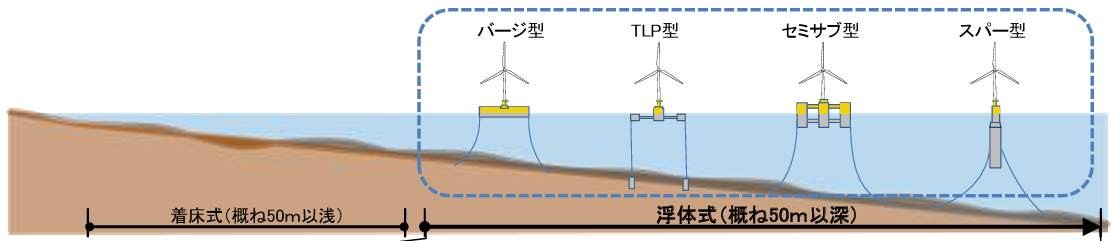
There are two main types of offshore wind power generation: fixed-bottom and floating. Fixed-bottom turbines are installed on a foundation fixed to the seabed, and can be constructed in waters up to 50 meters deep. In contrast, floating turbines are installed on floating structures on the ocean, which are then moored to the seabed with anchors or chains. Because they are not affected by the topography of the seabed and can be installed in waters over 50 meters deep, offshore wind power generation can be promoted even in areas like Japan, where there are few suitable sites near the coastline.
The Japanese government also amended the "Act on Utilization of Sea Areas for Renewable Energy" *2, which previously only covered territorial waters and inland waters *1, in June 2025, expanding its scope to include exclusive economic zones (EEZs) *3. The aim is to create a new permit system for the construction of offshore wind power plants within EEZs, thereby supporting their commercialization. Surrounded by water on all sides, Japan's territorial waters and EEZs are the sixth largest in the world, with the EEZ alone covering an area of approximately 4.05 million km2, roughly 11 times the size of the country's land area. One estimate *4 puts the total potential for offshore wind power generation in these waters at 542 GW, or equivalent to the power generated by 542 nuclear power plants.
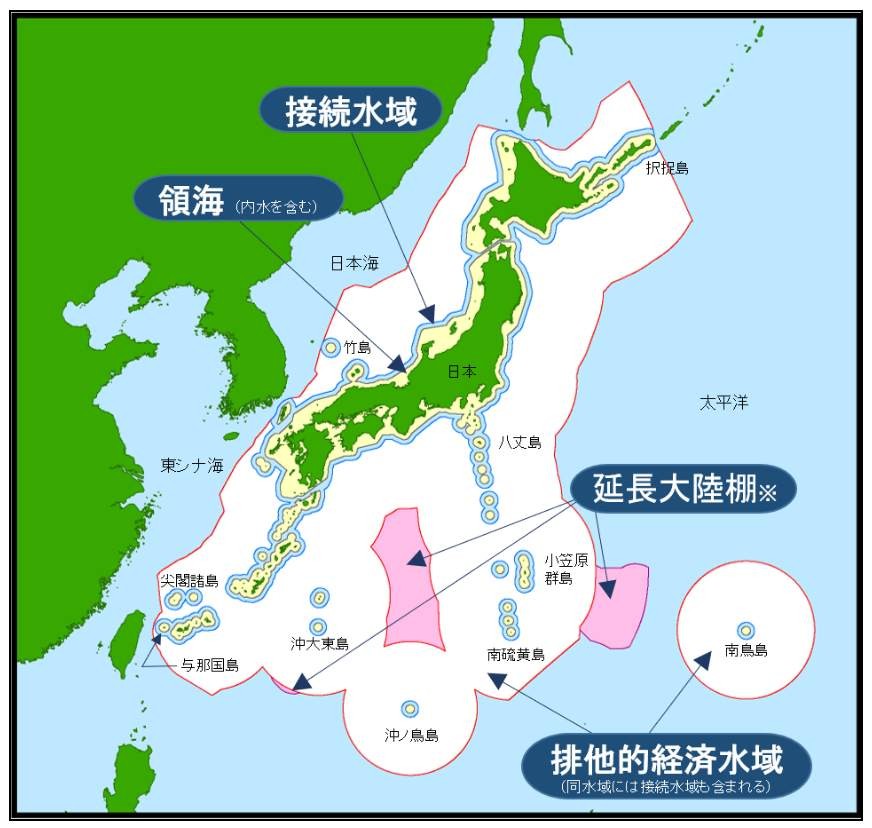
Source: "Conceptual Map of Japan's Territorial Waters, etc." (Japan Coast Guard HP)
*1 Territorial waters are the waters extending 12 nautical miles (approximately 22 km) outward from land. Foreign ships are granted the right of innocent passage. Internal waters are waters further inland than territorial waters, such as bays, inlets, and estuaries.
*2 The official name of this law is the "Act on Promoting the Utilization of Sea Areas for the Development of Marine Renewable Energy Power Generation Facilities." When installing offshore wind power generation facilities in sea areas, the government designates "promotion areas" and sets out rules for public bidding for businesses, long-term occupancy permits of up to 30 years, and coordination with fishermen to ensure the smooth implementation of the project.
*3 An exclusive economic zone (EEZ) is a water area in which a coastal state has rights, based on the United Nations Convention on the Law of the Sea, regarding the exploration, development, and management of natural resources, marine scientific research, and protection of the marine environment. It is established within 200 nautical miles (approximately 370 km) from the territorial sea baseline. Ships from other countries cannot be prohibited from sailing or overflying, nor can they be prohibited from laying pipelines.
*4 Estimate for an annual wind speed of 8.0 m/s or more, in the contiguous waters of the territorial waters and EEZ, and in waters between 50 m and 200 m deep. "Japan's Offshore Wind Power Potential," November 2023 (Renewable Energy Institute)
Four types of floating offshore wind turbines have been devised, based on the shape of the float and the mooring method, and all but the TLP type have already begun to be put into practical use, mainly in Europe.
Source: "Recent trends surrounding offshore wind power generation in Japan" (Ministry of Land, Infrastructure, Transport and Tourism)
Floating Types and Characteristics
| Shape | Characteristics |
| Purge Type | The floating body is flat and floats. It has a relatively simple structure and is inexpensive, but is susceptible to the effects of waves and wind. |
| TLP type | It is semi-submersible with tension mooring. It is still in the demonstration stage. |
| Semi-submersible (semi-sub) type | An improved version of the purge type. Most of the float is submerged, so it is less susceptible to the effects of waves and wind. |
| Spar type | The float is cylindrical and mostly submerged. The float's center of gravity is low, making it easy to stabilize. |
Challenges for the spread of floating offshore wind power generation
Offshore wind power generation is well suited to the geography of Europe, with its shallow coastlines, westerly winds, and few earthquakes, and has spread first in the region. Including those currently in operation, 10.9 GW is expected to be installed as of 2027, with plans calling for the introduction of 111 GW across Europe by 2030 and 317 GW by 2050. *5
In Europe, the industry for manufacturing core components such as wind turbines and towers has matured, and the supply chain for parts has also been established. Local companies have also gained a great deal of experience and know-how in assembly and construction. China has also been strengthening its efforts in recent years, and is expected to have 4.0GW of new offshore wind power generation capacity by 2024, accounting for approximately half of the world's total.
However, Japan's promotion of renewable energy has focused on solar power, with efforts to promote wind power lagging behind. Offshore wind power generation, in particular, has only 0.3 GW of operational capacity, accounting for just 1.1% of the total power generation mix, including onshore wind power. As a result, no domestic manufacturers of large wind turbines have emerged, and the related industry has not developed sufficiently. Japan has no choice but to rely on imports for large wind turbines, and the cost of transporting them by sea is enormous. This ultimately raises the unit price of power generation, worsening the profitability of the business and discouraging private companies from entering the market, creating a negative cycle.
Currently, the following issues are identified as obstacles to the widespread adoption of offshore wind power generation, particularly floating offshore wind power generation, in Japan:
- Developing domestic industries and supply chains responsible for the manufacture of large wind turbines
- Promoting technological development related to floating foundations and mooring systems
- Long-term, high-altitude measurement and analysis of ocean wind conditions, waves, tides, etc.
- Development and manufacturing of ships such as submarine survey vessels, heavy cargo transport vessels, and construction work vessels
- Development of ports and harbors with assembly, storage, and loading functions
- Study of offshore construction scenarios for different types of floating foundations
- Technological development related to O&M (Operation and Maintenance) after the start of operation
In the face of these many challenges, the government established a new "Floating Industrial Strategy Study Group" under the existing "Public-Private Council for Strengthening the Industrial Competitiveness of Offshore Wind Power," and in August 2025 compiled the "Offshore Wind Power Industry Vision (Second Edition)," which made clear the need to quickly develop the industry by utilizing domestic technology and promote business in the domestic and Asian markets.
Efforts are also being planned in Asia, with Taiwan, for example, planning to introduce 14GW of new wind power generation facilities, including floating types, over the next 10 years (2025-2034), and South Korea also aiming to introduce 20GW by 2030. Full-scale introduction is also expected to progress in Vietnam and the Philippines from 2030 onwards, and there is no doubt that the Asian market will continue to expand.
What PACIFIC CONSULTANTS can do
Starting with a feasibility study for introducing wind power generation at Akita Port in 1999, PACIFIC CONSULTANTS has carried out many tasks related to offshore wind power generation, including site selection, wind condition surveys, seabed geological surveys, design, environmental assessments, and base port (improvement) design. In particular, we have a proven track record based on our unique knowledge in the analysis of wind conditions, which are the most important aspects of wind power generation planning, and the design of the concrete structures that form the foundation. Regarding floating offshore wind power, we are also involved in technological development in collaboration with universities, verifying the durability of reinforced concrete floaters in the sea and examining the behavior of floaters and changes in power generation capacity.
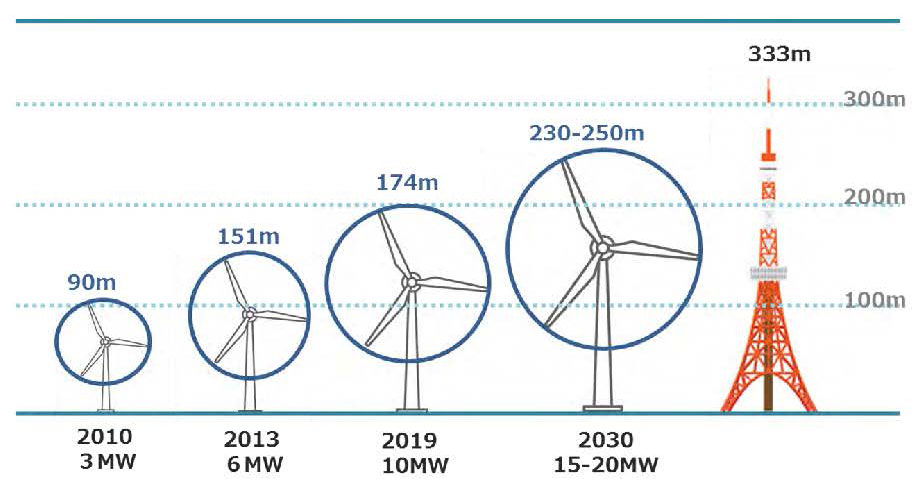
Furthermore, promoting offshore wind power generation requires consideration of how to efficiently assemble increasingly large wind turbines at each ports and harbors, ensuring the appropriate size and strength of the apron, ground improvement, and appropriate building placement. Wind turbines are becoming larger every year to improve power generation efficiency, and the floating foundations that support them, such as those used in purge-type concrete structures with heights of 10 to 17 meters and square shapes of 50 meters on each side, weigh approximately 10,000 tons. ports and harbors where these heavy objects are temporarily stored, processed, assembled, and shipped will need unprecedented functionality and strength, requiring design and renovation know-how.
Source: From the "IEA (2019) Offshore Wind Outlook" and "Materials provided by MHI Vestas" (Agency for Natural Resources and Energy)
PACIFIC CONSULTANTS not only has a specialized department for wind power generation, but also has specialized departments for seismic design of concrete structures, ports and harbors development, and infrastructure feasibility assessment, as well as numerous experts in fields such as ground, the environment, and regional development and revitalization. This comprehensive strength allows us to handle everything from wind analysis and environmental assessment to the realization of floating offshore wind power generation in one package. We will make the most of this strength and continue to contribute to the promotion of floating offshore wind power generation.