
With rising sea levels and larger typhoons due to climate change, how to protect ports from flooding damage has become a major issue. However, because ports are spread across a wide area and involve a variety of public and private entities, no single entity can take effective measures alone. What is needed is "collaborative protection," in which all stakeholders work together toward a common goal. The government has also published "Guidelines for Creating Collaborative Protection Plans," and in the future, each port will begin full-scale efforts. We spoke with Takayuki Ooie, General Manager of Section of Ports and Harbors and Coast Sec. in the Port Ports and Harbors Dept. PACIFIC CONSULTANTS, and Ryunosuke Kanno Chief Project Manager of Ports and Harbors Planning Sec. about the latest trends in collaborative protection efforts.
INDEX
- Importance of increasing climate change measures for ports and harbors
- Institutional design and support measures for supporting climate change adaptation in ports and harbors
- Increasing social demand for risk assessment
- Current status of climate change adaptation in ports and harbors, and the role of PACIFIC CONSULTANTS
Importance of increasing climate change measures for ports and harbors
Implementing measures to adapt to the various impacts of climate change on infrastructure such as ports and harbors, roads, and bridges, and maintaining their functionality is extremely important for supporting the lives of the people. In particular, ports and harbors are home to many industries, including power plants, refineries, steel mills, and chemical plants, and much of the resources and energy used there passes through ports and bays. More than 99% of Japan's trade volume is transported by sea by ship, and of course passenger ships also arrive and depart from the wharves. It is no exaggeration to say that maintaining functionality of ports and harbors is the lifeline of Japan, a maritime nation.
However, threats to the stable operation of ports and harbors are increasing. Not only are Tsunami expected to hit from major earthquakes such as the Nankai Trough earthquake, but the possibility of flooding damage is also increasing due to rising sea levels caused by global warming and increased wave heights and tidal deviations caused by larger typhoons. In the future, in order to respond to climate change, it will be necessary to protect ports and harbors from flooding by raising seawalls and other measures, and to maintain their logistics and industrial functions.
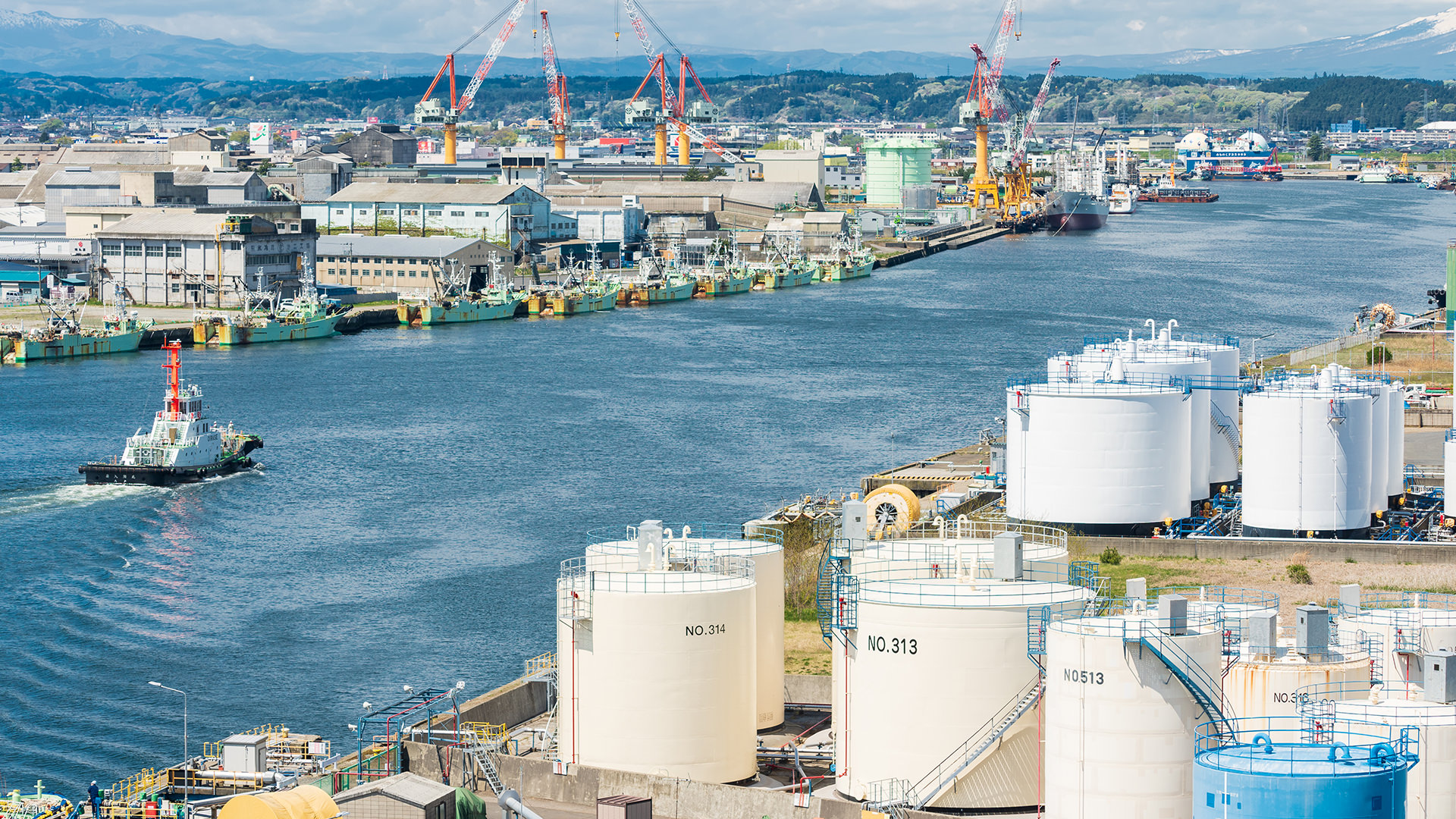
Ports and harbors are managed by local governments, such as the prefectures where they are located. Ports and harbors are also home to a variety of entities, and are used for both public purposes and private business activities. Port and harbor sites are a mixture of public and private land, and both quays (facilities for unloading goods and mooring ships) and revetments (facilities for protecting the land behind them) are public and private.
Therefore, even if one entity takes measures to protect against flooding, the effectiveness may be limited if flooding occurs from other locations. Even if the seawalls are continuous, if they are at different heights, flooding will occur from the lower parts, and if the construction dates differ, flooding will occur from the unconstructed parts. In order to improve the protective functions of ports and harbors, all parties involved must set common goals and take measures at the same time under the same construction policy. This is where the concept of "collaborative protection" was introduced.
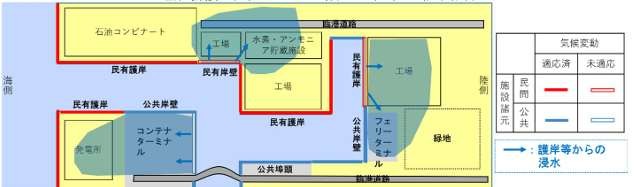
source: "Implementation Policy for Climate Change Adaptation Measures in ports and harbors" (Ministry of Land, Infrastructure, Transport and Tourism)
To achieve collaborative protection, the Port and Harbor Act was also amended (promulgated on April 23, 2025) to include the following three new points regarding "preservation of ports in response to sea level rise due to climate change."
Establishment of a collaborative protection planning system to promote public-private collaborative efforts, such as raising seawall heights.
Establishment of a collaborative protection council consisting of port administrators, companies located in the port, etc. to develop and implement the plan.
Establishment of an agreement system to promote efforts based on the collaborative defense plan
A concrete example of collaborative protection efforts is as follows:
1. Analysis and Minor Changes to Ports and Harbors Plans due to the Impact of Climate Change

Analyze the impact of climate change and consider making minor changes to ports and harbors plans, such as setting out policies to appropriately respond to rising mean sea levels due to climate change.
2. Establishment of a Collaborative Protection Council and
Consideration of Timing and Level of Adaptation

Organize a council of port administrators, facility owners, municipalities, academic experts, port users, etc. to consider the timing and level of adaptation.
3. Collaborative Protection Planning and
Implementing Measures

Collaborative Protection Plan will be created based on the results of discussions at Collaborative Protection Council, and relevant parties will implement measures.
With the concept of collaborative protection now in place, ports and harbors authorities can now call for establishment of Collaborative Protection Council based on the Ports and Harbors Act and begin considering countermeasures. Alternatively, a company considering raising the height of its seawall to strengthen its own disaster prevention measures can request ports and harbors authority to "Establish a Collaborative Protection Council," as it believes that this will not be effective unless the entire ports and harbors takes action.
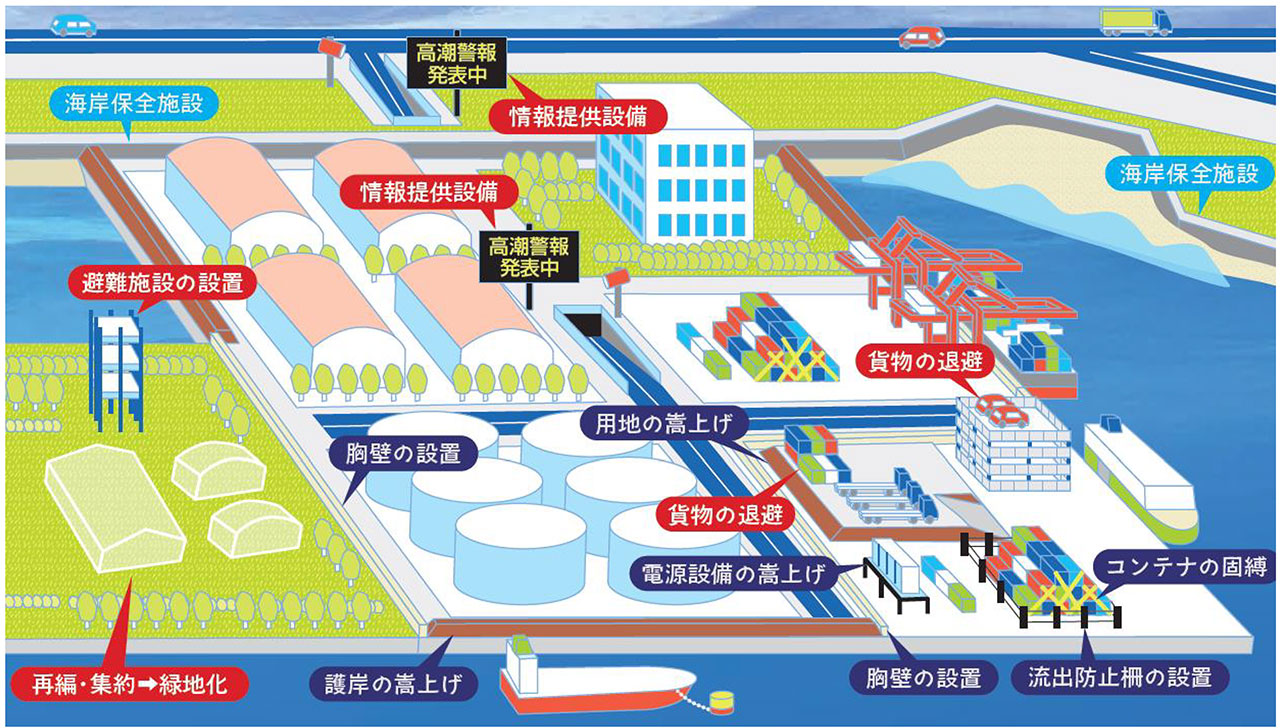
Source: "Implementation Policy for Climate Change Adaptation Measures in Ports and Harbors" (Ministry of Land, Infrastructure, Transport and Tourism)
Institutional design and support measures for supporting climate change adaptation in ports and harbors
Along with the introduction of the concept of collaborative protection, the technical standards for port facilities were also revised. The numerical values used in designing wind, tide levels, and waves were changed from "based on actual measured or estimated values" to "taking into account changes over time during the design service life of the facility." This clearly states that the impact of climate change must be taken into account.
Additionally, to support the formulation of collaborative protection plans based on the revised Ports and Harbors Act, Ports and Harbors Bureau of Ministry of Land, Infrastructure, Transport and Tourism published two guidelines in June 2025. One is the "Guidelines for the Preparation of Collaborative Protection Plans" and the other is the "Guidelines for Climate Change Risk Assessment Methods for Companies Located in Ports and Harbors."
The former is aimed primarily at port administrators and provides practical guidance on creating plans for "collaborative protection" undertaken jointly by the public and private sectors. The latter is aimed primarily at private companies located in ports and harbors, explaining specific points regarding the assessment of physical risks posed by rising sea levels and increased typhoon intensity, particularly the risk of flooding from storm surges and tsunamis, so that they can begin disclosing information about climate change. It presents methods suited to the considerations of companies located ports and harbors, from qualitative assessments to detailed assessments using numerical analysis.
*The guidelines are as follows:
Ministry of Land, Infrastructure, Transport and Tourism "Responding to Climate Change at Ports and Harbors through Collaborative Protection"
<Summary> https://www.mlit.go.jp/report/press/content/001892405.pdf
<Main Text> https://www.mlit.go.jp/kowan/kowan_fr7_000117.html
Until now, technical standards have not targeted uncertain factors such as "increased external forces due to climate change," and naturally there was no consideration that these external forces would change and increase year by year. As a result, designs that took into account external forces predicted 50 years from now, for example, had not been carried out because "it was unclear whether they would actually occur." However, with this revision of the law, it is now possible to design with specific assumptions about future external forces, and it is now also possible to adopt the concept of "adaptive adaptation," which involves responding in stages based on the assumption that external forces will gradually increase.

Source: Adapting to Climate Change in Ports and Harbors through "Collaborative Protection" (Climate Change Adaptation Information Platform)
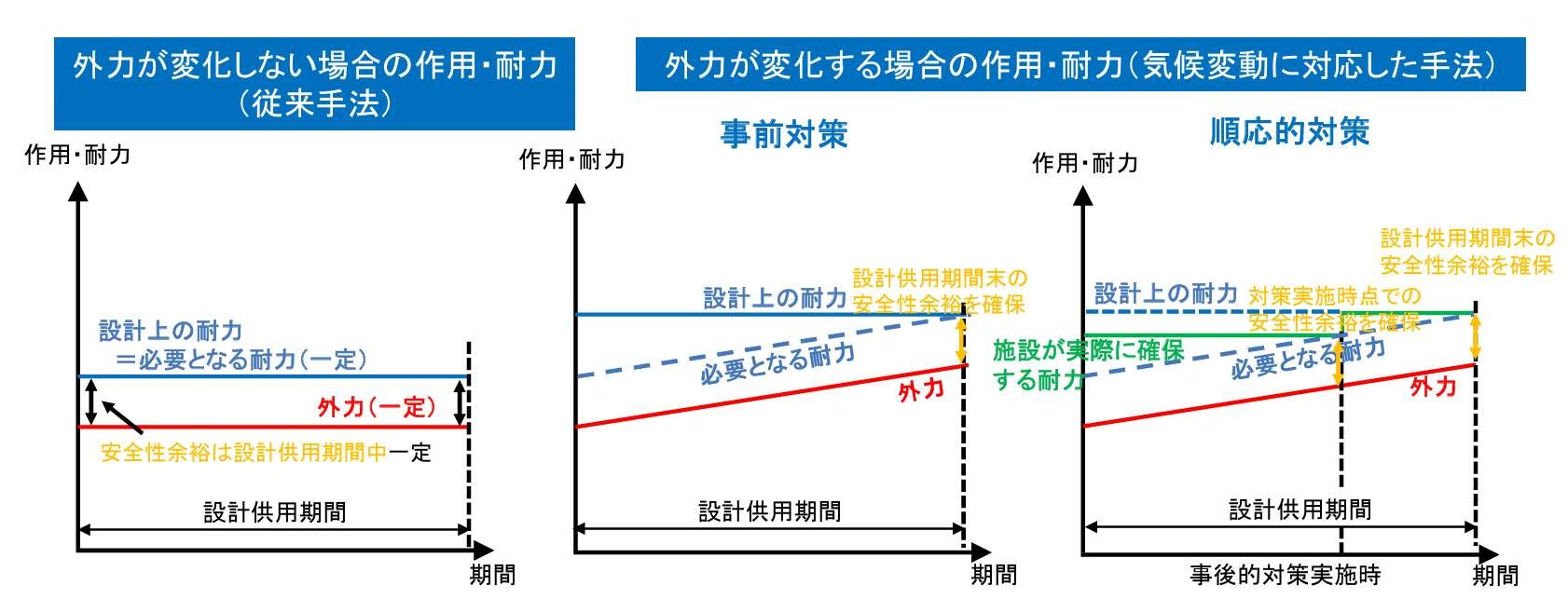
Source: Adapting to Climate Change in Ports and Harbors through "Collaborative Protection" (Climate Change Adaptation Information Platform)
The government has also made it clear that it will take budgetary measures to promote collaborative protection efforts. In addition to supporting port administrators in creating collaborative protection plans (by subsidizing the costs), measures include reducing the fixed asset tax on facilities that private business sectors acquire or improve as part of collaborative protection measures, such as seawalls and tide embankments.
Increasing social demand for risk assessment
It's not that disaster prevention measures for ports and harbors haven't been discussed at all up until now. For example, there's something called a "Ports and Harbors' Business Continuity Plan (BCP)." It's an action plan for large-scale disasters and a peacetime management plan that makes it possible. It defines response procedures to ensure that a port and harbor's essential functions can be maintained to a minimum even in the event of an earthquake, which has a low probability of occurring but is expected to cause significant damage if it does occur, and the resulting Tsunami. Following Great East Japan Earthquake in 2011, the Fundamental Plan for National Resilience was established, with the goal of achieving a 100% formulation rate for ports and harbors of a certain level or higher. Since then, guidelines have been added and revised, including measures for dealing with high tides, high waves, and strong winds in the event of a typhoon, and measures for dealing with infectious disease outbreaks following the COVID-19 pandemic.
In contrast, collaborative protection planning involves formulating climate change adaptation measures as a preventive measure against storm surges and Tsunami, which occur relatively frequently. It has been proposed as a new approach based on the establishment of methods for quantitatively predicting and assessing the impacts of global warming.
Furthermore, the market is increasingly demanding that private companies also implement such risk assessments and disaster prevention measures. Amid concerns about rising sea levels and increasingly powerful typhoons, investors want to determine how companies with ports and harbors operations assess their disaster risks and what countermeasures they are taking. If a company's disaster prevention measures are weak and its business activities stagnate for a long period despite significant investments, it could suffer significant losses. In response to these investor demands, the TCFD *1 published recommendations in 2017 calling for disclosure of the financial impacts of climate change-related "risks" and "opportunities." The Tokyo Stock Exchange Prime Market subsequently made disclosures based on the TCFD recommendations mandatory in 2022. Furthermore, in June 2023, the International Sustainability Standards Board (ISSB) *2 published the International Standard for Sustainability Disclosure (ISSB Standard), which incorporates the TCFD recommendations. This international standard requires more detailed information than the TCFD. As such, investors are increasingly calling for disclosure of risks related to climate change, and are showing a willingness to divest (withdraw investment) if they see any deficiencies in this disclosure.
*1 TCFD (Task Force on Climate-related Financial Disclosures)
*2 ISSB (International Sustainability Standards Board) is an international sustainability standards board establishment by the International Financial Reporting Standards (IFRS) Foundation.
Current status of climate change adaptation in ports and harbors, and the role of PACIFIC CONSULTANTS
Following the legal amendments and the publication of guidelines, it is expected that efforts to "adapt to climate change in ports and harbors" will progress in the future. However, for example, when creating a collaborative protection plan, it is necessary to reach an agreement among the parties involved on the level and by when measures will be implemented, but various challenges exist before reaching that consensus. In order to actually create the plan and implement the measures, it is necessary to hold repeated discussions to arrive at the optimal solution for the port as a whole, and to find ways to allocate the burden in a way that does not leave any sense of unfairness.
PACIFIC CONSULTANTS' Ports and Harbors Dept. has been involved in the surveys, planning, and design of many breakwaters, seawalls, quays, and various port facilities. We have also conducted detailed simulations to assess the risk of flooding, determining what areas would be flooded in the event of a typhoon of a certain magnitude. We have also conducted simulations that take climate change into account to determine how far the flooded area would spread if the current situation remained unchanged, and compared the amount of damage with and without countermeasures. While there are still very few examples of quantitative assessments that take climate change into account, we believe our track record is of great value in organizing and analyzing the basic information needed to develop collaborative protection plans.
Additionally, in port areas, cranes and other large machinery are often used to load and unload cargo. Such electrical equipment is vulnerable to flooding, and if damaged, there is a significant risk that the port's logistics functions will be suspended for an extended period of time. In this regard, PACIFIC CONSULTANTS, which has specialized departments related to civil engineering structures and electrical and mechanical equipment, can conduct comprehensive and realistic risk assessments. Furthermore, because collaborative protection plans involve the participation of various public and private entities, it is important to reach a consensus, and we believe this is another area where our coordination skills as consultants can be put to good use.
To support new initiatives to adapt to climate change at ports and harbors, PACIFIC CONSULTANTS will continue to utilize its unique comprehensive capabilities to contribute to the realization of climate change countermeasures through risk assessments associated with climate change and the creation of collaborative protection plans.