
One technology that is currently attracting significant attention as Japan aims to achieve carbon neutrality by 2050 is CCS, which involves capturing and storing CO2. CCS is an extremely important technology, especially for industries where decarbonization is considered very difficult, such as thermal power plants and steel mills, and is said to be a key to achieving carbon neutrality in Japan. We talked to Toyomitsu KANAI from Facility Engineering Dept., Transportation Infrastructure Div. at PACIFIC CONSULTANTS, who is working on CCS projects.
INDEX
- What is CCS?
- The specific flow of the CCS project: Selecting a suitable location and building a value chain
- Challenges in promoting the CCS project
- PACIFIC CONSULTANTS' Initiatives in Overseas Storage-Type CCS Projects
- Strengths as a comprehensive construction consultant
What is CCS?
CCS stands for Carbon dioxide Capture and Storage, a technology that separates and captures (Capture) only CO2 from gases emitted from sources such as thermal power plants and steel mills, and then stores (Storage). Japan has pledged to the world to achieve carbon neutrality by 2050 and is steadily increasing the transition to renewable energy such as solar and wind power. In modern industrial activity, there are industries that are difficult to decarbonize, such as thermal power plants, oil refineries, steel mills, and chemical plants. CCS is one of the initiatives being advanced to address these issues. There is also a technology that utilizes CO2 not for storage, but as a raw material for the manufacture of chemicals, fuels, and minerals, and this is called CCU (Carbon dioxide Capture and Utilization). CCS and CCU are collectively called CCUS (Carbon dioxide Capture and Utilization or Storage).
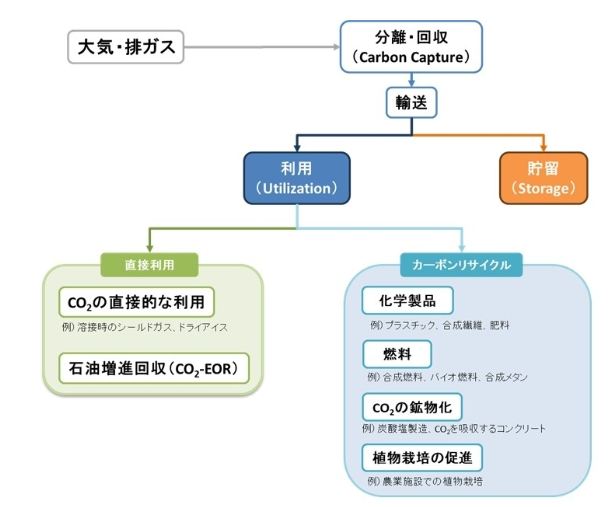
Source: "About CCUS" (Ministry of the Environment)
Because CCS can directly process large quantities of CO2 after separation and capture, it has attracted significant attention as a key technology for carbon neutrality, and research and development, demonstrations, and commercial operations are progressing all over the world. The amount of CO2 captured by CCS currently in operation or planned worldwide is expected to reach approximately 350 million tons in 2023, about seven times the amount in 2017.
According to the International Energy Agency (IEA), it is estimated that in order for the world to achieve carbon neutrality by 2050, approximately 3.8 to 7.6 billion tons of CO2 will need to be injected and stored annually through CCS. It is expected that the amount of CO2 captured will continue to increase as legal frameworks and government support for CCS are developed in countries around the world.
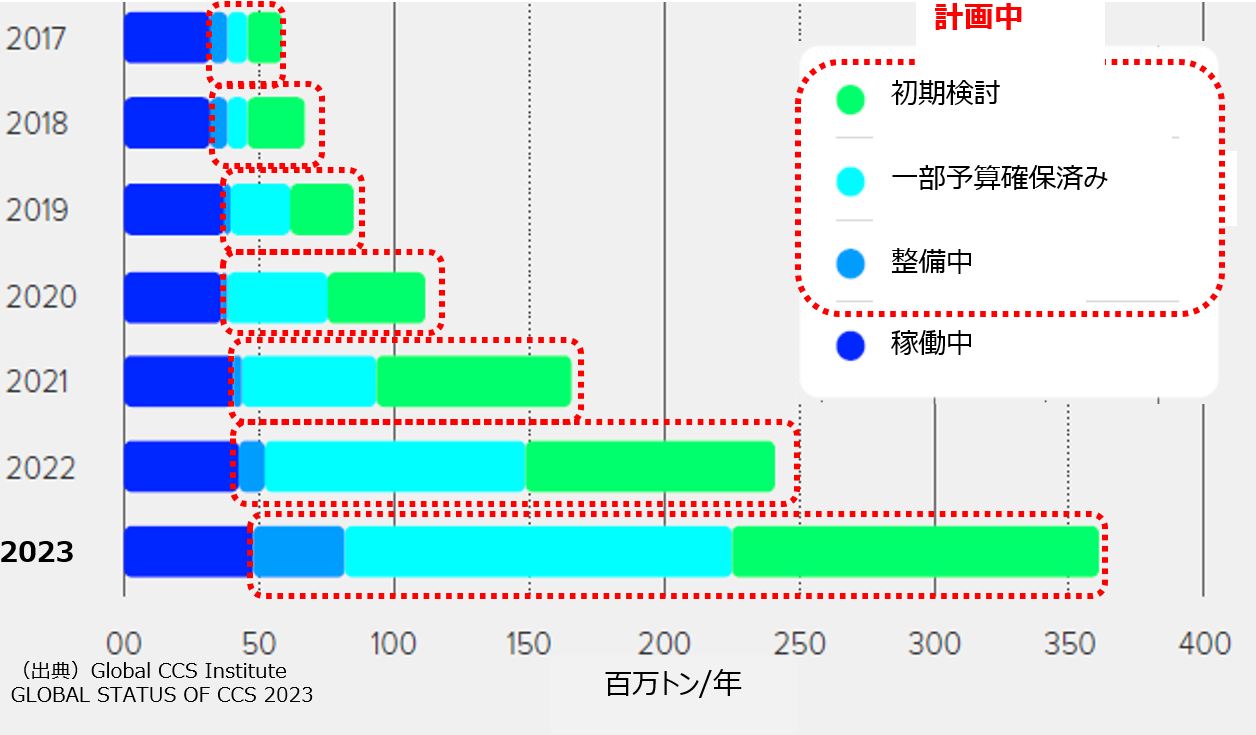
Source: "CCS technology is moving towards commercialization in Japan" (Agency for Natural Resources and Energy)
Multiplying the IEA's estimate of the amount of CO2 storage needed by 2050 by Japan's share of CO2 emissions, it is estimated that Japan will need 120 to 240 million tons of CCS per year by 2050, and efforts toward CCS are being strengthened in Japan. In May 2024, the Act on Carbon Dioxide Storage Business (CCS Business Act) was enacted, and in June 2024, the Japan Energy and Metals National Corporation (JOGMEC) decided to select and support nine CCS projects aiming to start operations by 2030 as "Advanced CCS Projects" for fiscal year 2024. Of these, five projects are planned for storage in Japan, and the remaining four projects are planned for storage in Southeast Asia and Oceania *.
* Among the "Advanced CCS" projects led by JOGMEC, the overseas storage-type CCS project is currently undergoing restructuring and review for its next phase.
Furthermore, in the 7th Strategic Energy Plan formulated in February 2025, the government clearly positioned CCS and CCUS as essential technologies for decarbonization, establishing a basic policy stating that they are "essential for simultaneously achieving stable energy supply, economic growth, and decarbonization, and that efforts will be made to consider support systems to encourage investment in CCS projects, develop technologies to reduce costs, and develop storage areas." Specifically, the plan aims to provide integrated support for "Advanced CCS Projects," including the development of storage areas through exploratory drilling and for the entire CCS value chain, with the goal of securing an annual storage capacity of 6 to 12 million tons by 2030.
The specific flow of the CCS project: Selecting a suitable location and building a value chain
CCS (Carbon Capture and Storage) projects begin with separating and capturing CO2, which is present in emissions from thermal power plants and factories at a rate of several percent to tens of percent, using various methods. Currently, detailed design work has begun on CO2 separation and capture plants targeting emissions from coal-fired power plants and oil refineries, with the aim of commencing commercial operation of CCS by 2030. Furthermore, since CO2 separation and capture planned for commercial operation requires a heat source, decarbonizing this heat source is also a challenge. In addition, the captured CO2 is injected and contained in stable geological formations located at depths of approximately 1,000 to 3,000 meters underground. However, the reservoir is not simply a matter of being deep. It must be a geological formation such as sandstone with many voids that can store gas, and a solid bedrock layer must extend above to prevent leakage of the injected gas. Since such suitable geological formations are limited, transporting and storing the CO2 in suitable locations not only domestically but also overseas is being considered.
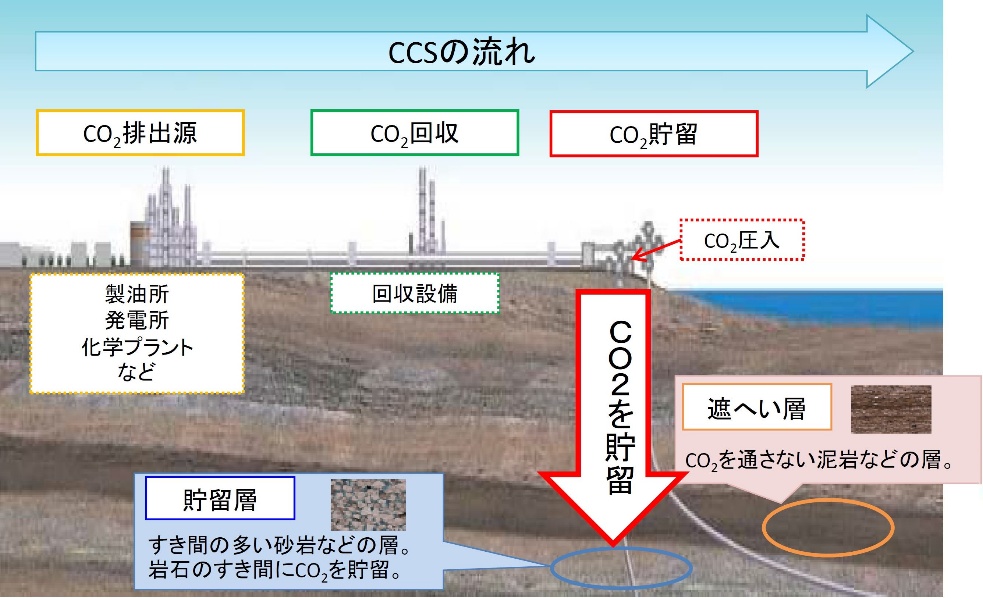
Source: "Essential Energy Terminology You Should Know - CCUS" (Ministry of Economy, Trade and Industry (METI))
CCS (Carbon Capture and Storage) allows for "local production and consumption" of CO2 if suitable geological formations for storage are located near the CO2 emission source, such as factories. However, if this is not the case, the CO2 must be transported to a distant storage site. In this case, liquefaction of CO2 is necessary to transport large quantities economically. Furthermore, to efficiently collect and transport CO2, methods are being considered to collect CO2 from multiple emission sources, accumulate it in one location, and transport it all at once in large tankers (hub port concept).
After storage is complete, continuous monitoring is necessary to ensure that the stored CO2 remains stably in the geological formation.
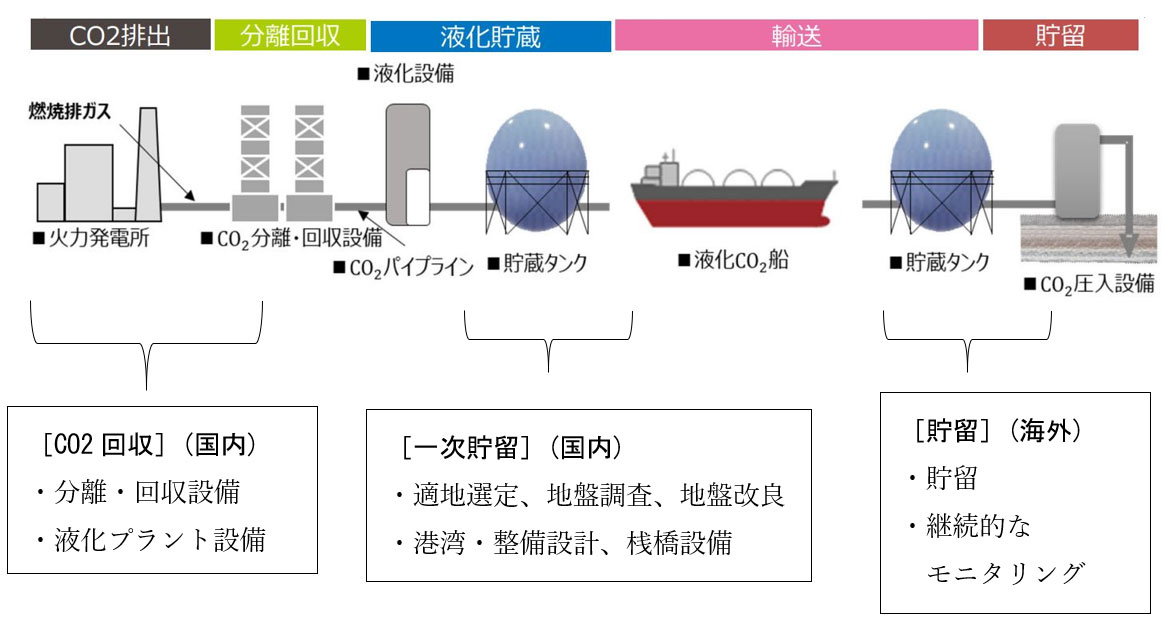
Source: Based on the diagram in "CCS technology is moving towards commercialization in Japan" (Agency for Natural Resources and Energy), PACIFIC CONSULTANTS edited it.
Challenges in promoting the CCS project
With 2030, the first milestone for reducing carbon dioxide emissions, just a few years away, efforts to implement CCS projects are accelerating, including the enactment of the CCS Business Act. However, various challenges are also emerging.
First, the construction of CCS facilities is a complex and lengthy process, requiring new, dedicated infrastructure for each facility. This includes CO2 separation and capture, CO2 transport to storage sites, injection and storage facilities, and, in the case of a hub-and-cluster system, a hub port to primary store CO2 captured from multiple emission sources and send it to the final storage site, as well as receiving facilities at the final storage site. The hub port, in particular, is a key logistics hub in the CCS value chain, consolidating liquefied CO2 captured from a wide area and handling efficient maritime transport to overseas storage sites. It needs to be designed not merely as ports and harbors, but as a complex infrastructure facility equipped with large-scale storage tanks and advanced loading equipment (loading arms, etc.), and integrated control of all of these.
Next, there's the challenge of handling massive quantities of CO2, unprecedented in conventional industrial CO2 applications. To maximize transport efficiency, it's necessary to maintain the CO2 in a stable liquid phase state, requiring strict temperature and pressure control (low temperature and high pressure management). In particular, liquefied CO2 has a density (specific gravity) equal to or greater than that of water, so continuous low temperature and high pressure management is required to maintain the liquid phase. Based on these premises, it's essential to build a safe and reliable value chain.
Furthermore, promoting CCS projects requires comprehensive engineering capabilities throughout the entire project. CCS projects necessitate the integrated development of CO2 separation, capture, and liquefaction, transportation, primary storage at hub ports, loading, final storage, and even monitoring facilities. In particular, hub ports, which play a crucial role as transit bases, are more complex integrated infrastructure facilities than conventional ports and harbors and plant facilities. From ground surveys and ground improvement for the installation of heavy tanks, to appropriate layout planning for each facility and development of access roads, a wide range of elemental technologies such as ports and harbors, roads, structures, and buildings are required. To integrate these, comprehensive engineering capabilities that combine a broad perspective to oversee the entire CO2 value chain with expertise in individual facilities and technologies are indispensable.
PACIFIC CONSULTANTS' Initiatives in Overseas Storage-Type CCS Projects
PACIFIC CONSULTANTS conducted a feasibility study for a hub port that forms the core of the supply chain in an overseas storage-type CCS project promoted by a consortium of domestic and international companies.
This project involves capturing CO2 from multiple domestic CO2 emission sources, transporting it to a hub port using small CO2 transport vessels, temporarily storing it in tanks, and then transferring it to larger CO2 transport vessels for transport to overseas storage sites for injection and storage. Although this is a feasibility study preceding the basic design, the accuracy of the analysis will greatly affect the project's viability, making it an extremely important phase.
This study focused on a detailed examination of the core facilities of the hub port, namely "storage and shipping facilities" and "civil engineering and building facilities."
Organizing tank capacity and operating conditions to achieve annual handling volume
At the hub port, CO2 recovered and liquefied from exhaust gases is transported by ship and temporarily stored in tanks. In this study, we compiled and calculated the tank capacity, number of tanks, and operating rotation rate required to achieve the annual handling volume target.
On the other hand, the CO2 storage tanks were still in the development stage, and there was a constraint that the detailed specifications were not yet finalized. Therefore, in this study, we conducted repeated interviews with the plant engineering company responsible for the tank design, organized the expected specifications and conditions, and then formulated an optimal placement plan within the existing ports and harbors site. In addition, we conducted boring surveys to understand the ground conditions and considered the necessity and methods of ground improvement.
Safety assessment of ports and harbors facilities supporting ship docking and transshipment
At hub ports, CO2 is received from small CO2 carriers into tanks and loaded onto large CO2 carriers, making it essential to ensure the safety of ports and harbors facilities that support ship docking and transshipment. This study examined the installation plan for loading arms for loading and the piping plan to the tanks, as well as the strength and specifications of fenders required when large CO2 carriers dock at the pier. Furthermore, the load-bearing capacity of the pier foundation (steel pipe piles) was calculated considering the mooring force of the ships, and the safety of ports and harbors facilities as a whole was verified.
A key feature of this study is that, while the large CO2 transport vessel itself is still under design, we proceeded with the examination of the overall safety and structural integrity of the pier facilities, taking into account the latest information and assumed conditions.
Feasibility study of the entire hub port, including architectural and equipment planning
In addition, to ensure the feasibility of the hub port as a whole, we conducted comprehensive studies from the perspective of architectural and equipment planning, including the layout plan for the administration building and electrical/instrumentation control rooms, the required width of the on-site work roads, the organization of piping and wiring routes, the drainage plan for the entire apron, security measures, and the plan for connection to external roads. In this study, in order to control overall costs, we assumed that existing ports and harbors facilities would be renovated and utilized, and given only the basic requirement of "necessary functions," we examined what kind of architecture and equipment should work together to achieve them. A distinctive feature of this study is that specialist engineers from the fields of civil engineering, architecture, geotechnical engineering, ports and harbors and plant engineering collaborated, integrating their respective knowledge to comprehensively illustrate the feasibility of the project.
Strengths as a comprehensive construction consultant
PACIFIC CONSULTANTS has extensive experience in the basic design of ports and harbors facilities, sewage treatment plants, and other infrastructure projects. In the CCS field, where the business model is still unclear, our ability to conduct feasibility studies and create an environment conducive to moving on to the next basic design stage is a unique strength of our comprehensive construction consulting firm.
CCS projects, particularly the development of hub ports, involve a complex interplay of multiple specialized fields, including civil engineering, architecture, geotechnical engineering, ports and harbors and plant engineering. Planning and designing these projects cannot be completed by a single plant engineering company or a general construction company handling ports and harbors construction alone. PACIFIC CONSULTANTS, through comprehensive consulting on infrastructure supporting the entire CO2 value chain, plays a "hub" role, connecting the technical, institutional, and on-site constraints of complex CCS projects. This supports the new development of CCS projects and contributes to achieving carbon neutrality by 2050.
Our efforts regarding the CCS business are also introduced in a video.