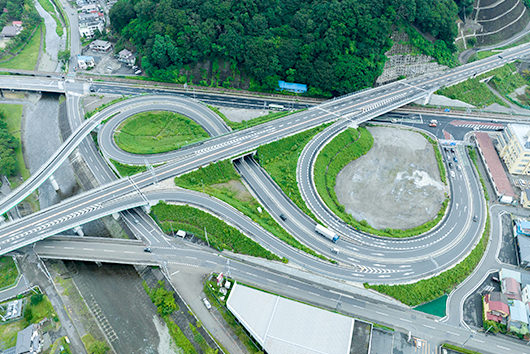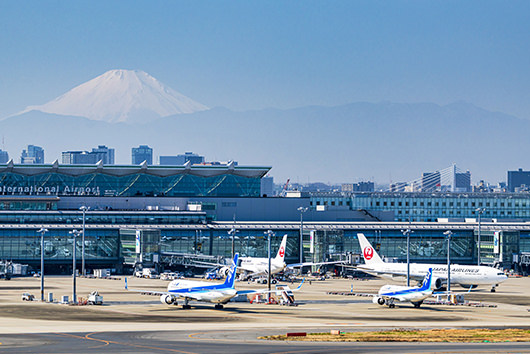

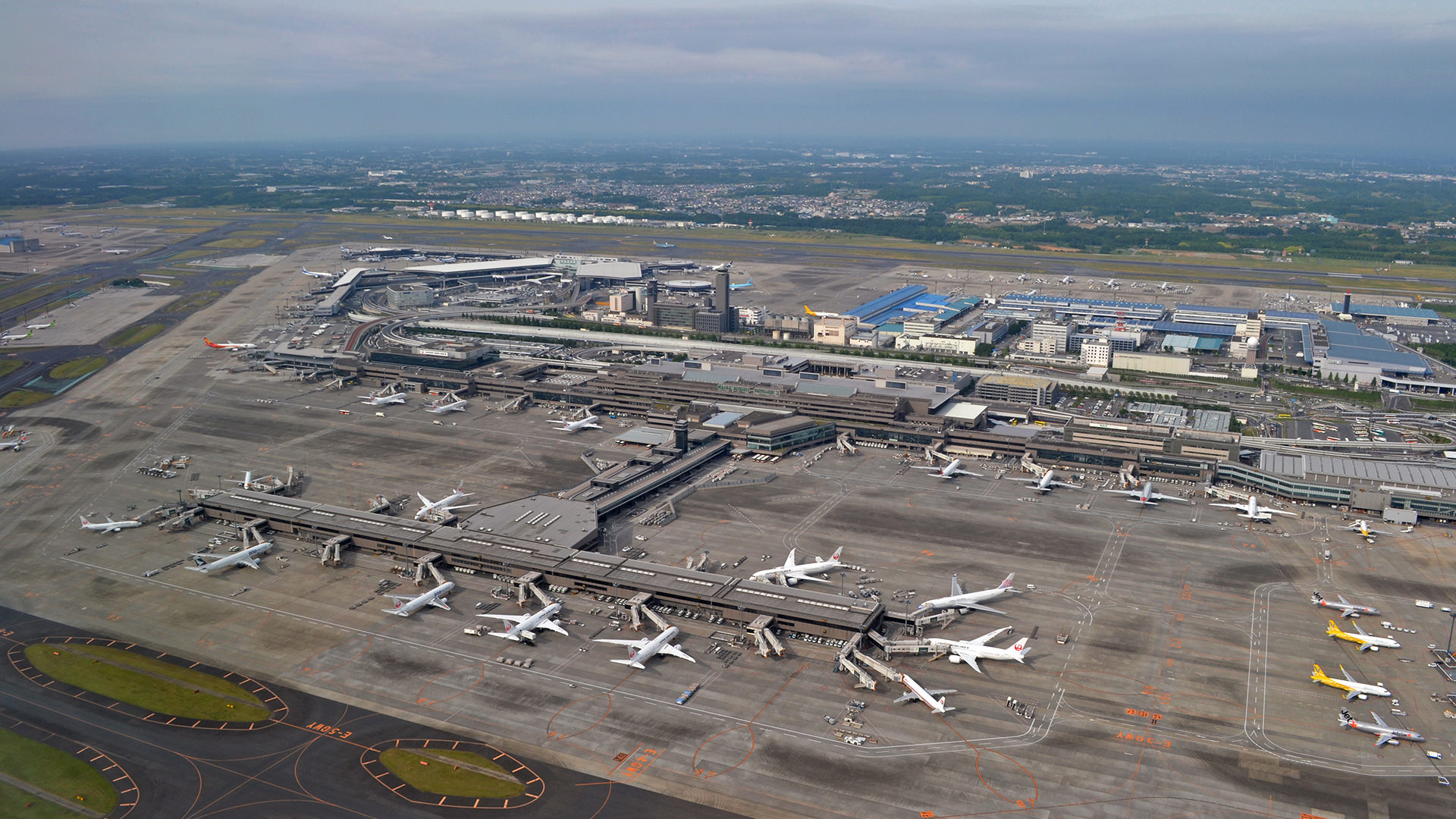
This is the first large-scale "Further Functional Enhancement Project" for Narita Airport since 1978. For over 10 years, PACIFIC CONSULTANTS has been involved in a wide range of tasks, including environmental assessment surveys and surveys, planning, and design related to infrastructure development. Currently, more than 100 people from various technical fields, mainly from Aviation Dept., are participating in the project team. We spoke with the team's General Project Manager, Kiyotsugu Nagai, along with Naoto Futamata and Mifuyu Kurosaki from Aviation Dept., Hiroyuki Nagai from Tunnel Dept., Yoshio Namiki from the Watershed Planning Department, Tomoki Sakata from Road & Highway Dept., and Shunichiro Kaneko from Geotechnical Engineering Dept..
Overview of "Further Functional Enhancement of Narita Airport"
In a 2013 national review, it was predicted that the combined processing capacity of Narita and Haneda airports, approximately 750,000 flights per year, would reach its limit in the early 2020s. Therefore, regarding Narita Airport, a four-party council consisting of the national government, Chiba Prefecture, nine municipalities surrounding the airport, and Narita International Airport Corporation (NAA) began discussions in 2015 on strengthening airport functions, primarily through the extension of existing runways and the construction of new runways, and a final agreement was reached in March 2018. Subsequently, following permission for airport changes based on the Aviation Act from the Minister of Land, Infrastructure, Transport and Tourism on January 31, 2020, construction work is currently underway.
• Project objective: To increase Narita Airport's annual takeoff and landing capacity to 500,000.
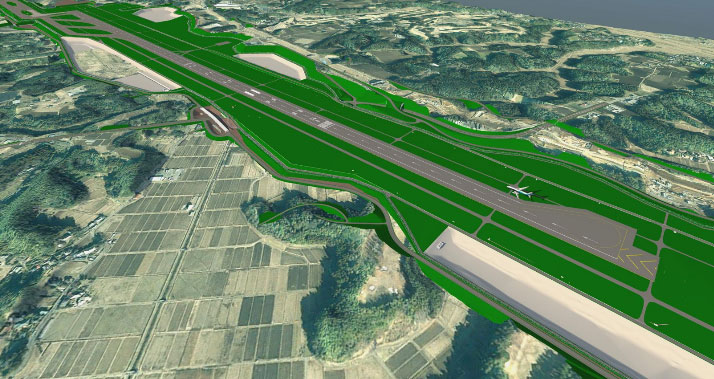
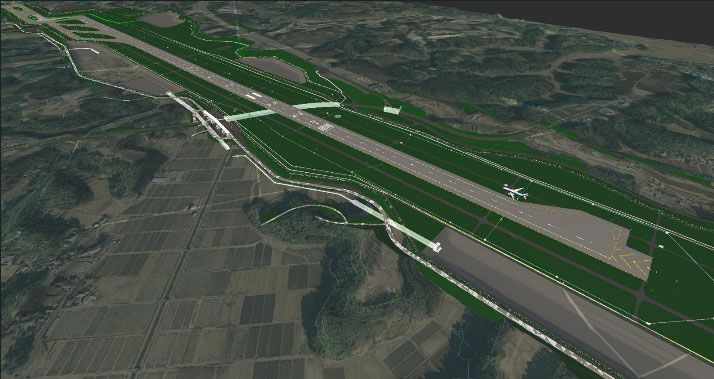
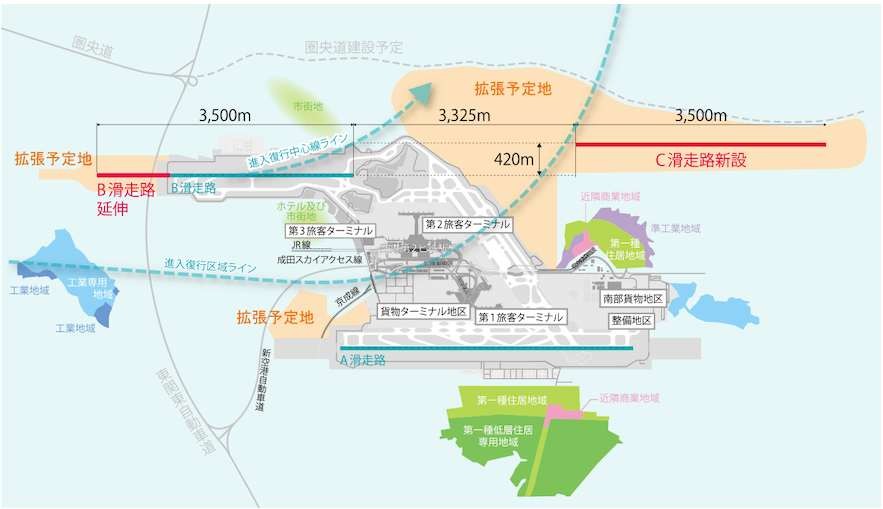
• Construction details: Extension of Runway B (runway length 2,500m ⇒ 3,500m) / Construction of new Runway C (runway length 3,500m) / Construction of new taxiways (7,471m) / Expansion of airport grounds by 1,099ha (current 1,198ha ⇒ 2,297ha)
INDEX
- A massive project comparable to the construction of a new airport.
- We handle all aspects of research, planning, and design across multiple fields.
- We are considering land development and soft ground improvement plans.
- The Higashi-Kanto Expressway will be built under the runway.
- Develop a retention pond with a capacity of 1.5 million cubic meters.
- Aviation Dept. played a key role in the project team's administrative functions.
A massive project comparable to the construction of a new airport.
The "Further Functional Enhancement Project" involves constructing a new 3,500m Runway C and extending Runway B by 1,000m (to 3,500m). Combined with the current 4,000m Runway A, the airport will have three long runways capable of handling large international jet aircraft, making it truly worthy of the name "Japan's gateway to the skies." In addition, along with the runway expansion, a "New Narita Airport" concept has been put together, which includes the restructuring of the passenger terminal (to a single terminal), the redevelopment of the international cargo area to enhance air logistics functions, and improvements to airport access. Project planning is currently underway. As these projects involve expanding the airport site to twice the size of the current airport, the scale of the project is enormous.
Furthermore, Chiba Prefecture, the local government, has established the "NRT Design Center" with Narita International Airport Corporation (NAA) to begin concrete discussions, aiming to realize an "airport city where urban and rural areas harmonize with the airport at its core, and which is establishment as a base for living and industry." The "further enhancement of Narita Airport's functions" is progressing as a grand project that will determine the future of the country and the region.
We handle all aspects of research, planning, and design across multiple fields.
It is said that airport construction is equivalent to building an entire city. Even at the current Narita Airport, 40,000 people are employed, and an average of 120,000 people pass through it every day. From the master plan to the planning, design, and construction, environmental impact assessments are necessary, as well as a wide range of technologies and knowledge from various fields, as various buildings and infrastructure structures for different purposes, such as runways and other basic facilities, passenger terminals, cargo terminals, railways, roads, parking facilities, air traffic control and aviation security facilities, aircraft hangars and maintenance facilities, fuel supply facilities, and commercial facilities, all converge. Moreover, this development project involves various initiatives proceeding in parallel, including the relocation of existing expressways, national and prefectural roads, and municipal roads, the relocation of rivers and irrigation canals, and the construction of numerous tunnels and bridges that accompany these projects.
Kiyotsugu Nagai, who has been involved in this project for over 10 years at PACIFIC CONSULTANTS and currently leads it as General Project Manager says:
"Large-scale airport expansion projects require comprehensive and integrated technical capabilities, as well as extensive consultation and coordination with diverse stakeholders, including the national government, local municipalities, public utilities, and local residents. In this regard, we have engineers in a wide range of technical fields, including aviation, roads, tunnels, railways, bridges, rivers, geology and ground engineering, architecture and facilities, as well as environmental issues, decarbonization, and digital technologies, allowing us to work closely together within the company. We believe we can contribute to NAA, the client, not only by cooperating and supporting all aspects of planning, design, and project management related to infrastructure, but also by consolidating the point of contact through our company and efficiently and effectively managing and implementing many tasks. We are proud that we have been able to continuously receive orders for a wide range of services packaged together over the long term, thanks to the appreciation we have received for these aspects."
In fact, since the start of discussions at the four-party council (Ministry of Land, Infrastructure, Transport and Tourism, Chiba Prefecture, 9 surrounding cities and towns, and NAA), our company has been commissioned to handle many of the projects. Since the formal agreement on further functional enhancements was reached in March 2018, we have been responsible for the basic plan, basic design, and detailed design related to these further functional enhancements. Currently, in addition to the detailed design including revisions, we are continuing to work on the basic plan and basic design of airside areas such as taxiways and aprons related to the "New Narita Airport" concept.
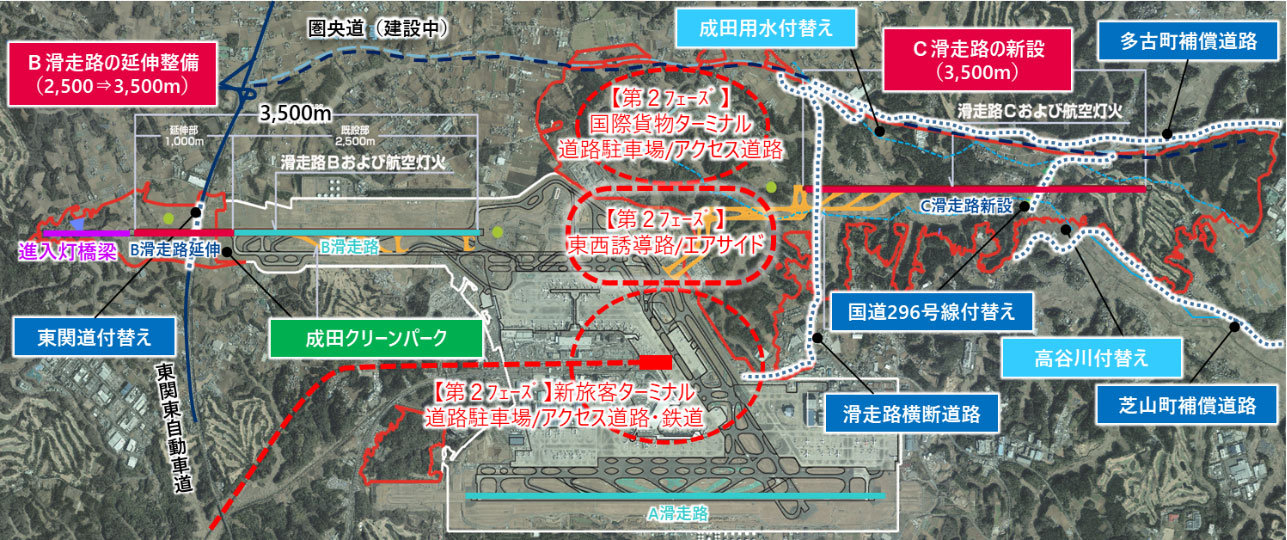
Created by PACIFIC CONSULTANTS based on NAA materials.
We are considering land development and soft ground improvement plans.
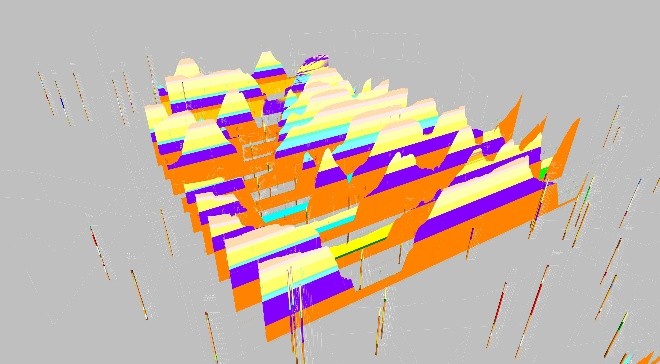
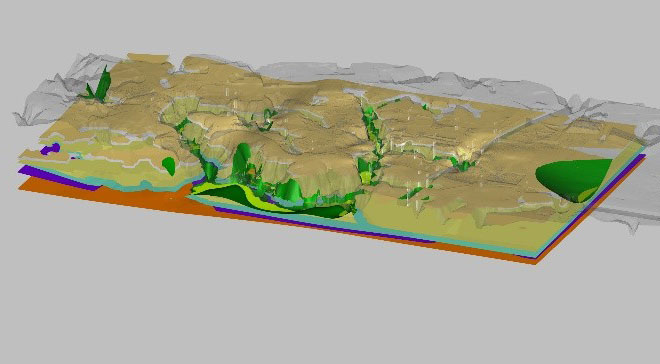
At PACIFIC CONSULTANTS, where a cross-Dept. project team was launched, Aviation Dept. took the lead in coordinating the team, with specialist engineers from each technical Dept. joining the team as the planning and design progressed. A crucial starting point was the geotechnical investigation. The project site was vast, requiring not just 10 or 20 boring surveys, but a significant number. Detailed coordination with the designers responsible for each structure was undertaken regarding the selection of locations and implementation schedules for the boring surveys. Shunichiro Kaneko of Geotechnical Engineering Dept. recalls:
"For roads and railways, you only need to examine the ground along narrow lines, but airports have runways and taxiways, as well as various buildings, tunnels, and roads. It was necessary to investigate a vast area from various perspectives. However, we couldn't just increase the number of boring survey points indefinitely. As a geotechnical engineer, I selected survey points while considering the topography and geology, and also taking into account the relationship with the structures to be built above, and after listening to the opinions of the designers, we ultimately set approximately 200 survey points."
Moreover, the Narita area is known for its soft ground with a high proportion of organic soil. Based on the survey, deciding how to proceed with ground improvement was a major theme. "Even in the areas where runway extension and new construction were planned, the natural terrain is uneven, so it was necessary to cut and fill the soil. There was a particular concern about settlement in the reclaimed areas, so we held a review committee with experts to discuss the design and construction methods for how to improve the ground," said Kaneko. The details were then passed on to Aviation Dept. and used in the design of the construction and paving work.
The Higashi-Kanto Expressway will be built under the runway.
The extension of Runway B and the construction of Runway C will require crossing the currently operating Higashi-Kanto Expressway, Narita City roads, National Route 296, prefectural roads, and many town roads. Although it is a national project, it is unacceptable for the runways to disrupt traffic and have a major impact on social activities and residents' lives. However, it is unrealistic to run all roads under the runways while maintaining their current alignment. Detailed consideration was needed to determine which roads should be tunneled, which roads should be rerouted, or where compensation roads should be built. Tomoki Sakata of Road & Highway Dept. explains.
"The Higashi-Kanto Expressway, which runs through the extension area of Runway B, is a national expressway with approximately 30,000 vehicles passing through it daily. We decided to construct a tunnel approximately 430 meters long that will pass under the runway while maintaining its current alignment. From the perspective of minimizing the impact on current traffic, the temporary detour road to be used during tunnel construction will also be prepared to the exact same specifications as the current main road. Even though it is a temporary detour road, a high degree of precision was required in its design, and detailed coordination with the tunnel construction, which is aligned with the runway extension work planned by Aviation Dept., was also necessary."
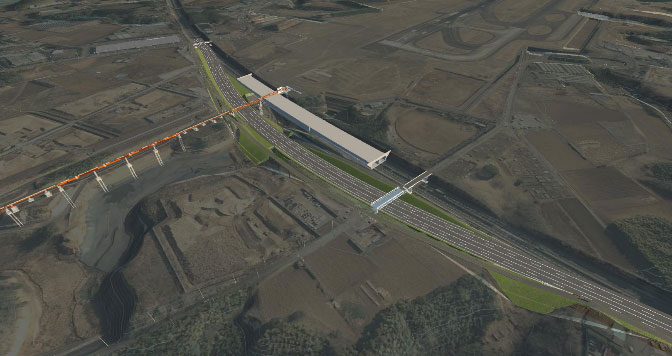
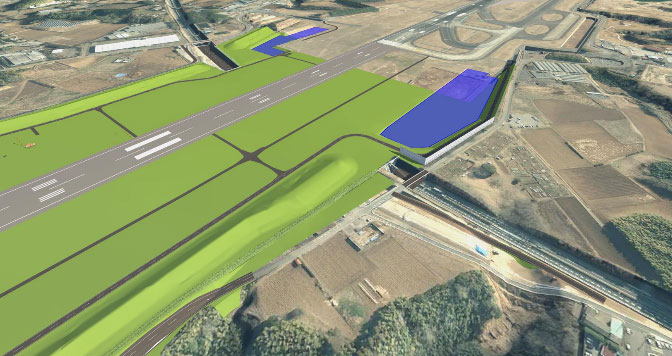
Of course, the performance requirements for a tunnel passing under a runway are extremely high. Hiroyuki Nagai of Tunnel Dept. joined the project team as an expert and worked with Road & Highway Dept. on the considerations.
"In addition to the tunnel under Runway B, we also decided to construct two replacement roads that cross under Runway C via tunnels. However, it is extremely rare to construct multiple road tunnels for general traffic, rather than tunnels for airport maintenance vehicles or utility tunnels, under an airport runway. A runway is a track where aircraft weighing up to 580 tons frequently take off and land at speeds of nearly 300 kilometers per hour. Although it looks no different from a typical road tunnel, the loads acting on it are large, and the required performance level is high. The impact can be reduced by increasing the overburden under the runway pavement, but this would lower the road alignment and make the gradient steeper. We needed to ensure drivability while satisfying safety and performance requirements. We conducted repeated studies to ensure the thickness of the tunnel members, place appropriate reinforcing bars, and reinforce the ground beneath the tunnel with ground improvement, and designed a tunnel that passes under the runway with the thinnest possible overburden."
Furthermore, for Narita city roads that would intersect with the extension of runway B, a compensatory road is planned that will bypass the end of the runway and go around to the other side. For town roads in the runway C area, new maintenance roads and runway perimeter roads will be constructed, and along with other compensatory roads, measures will be taken to minimize the impact on residents' lives. "Naturally, the prefecture and each city and town had their own wishes and opinions when deciding on the route. We held numerous meetings with NAA, the project owner. Selecting a route that would satisfy all stakeholders was not easy, but we considered all aspects, including technical difficulty, construction period, and cost, and made the final decision on the road plan," said Sakata of Road & Highway Dept..
Develop a retention pond with a capacity of 1.5 million cubic meters.
Expanding airport functions across a vast area requires meticulous planning, including rainwater drainage. Yoshio Namiki of the Watershed Planning Department joined the project team to formulate the plan.
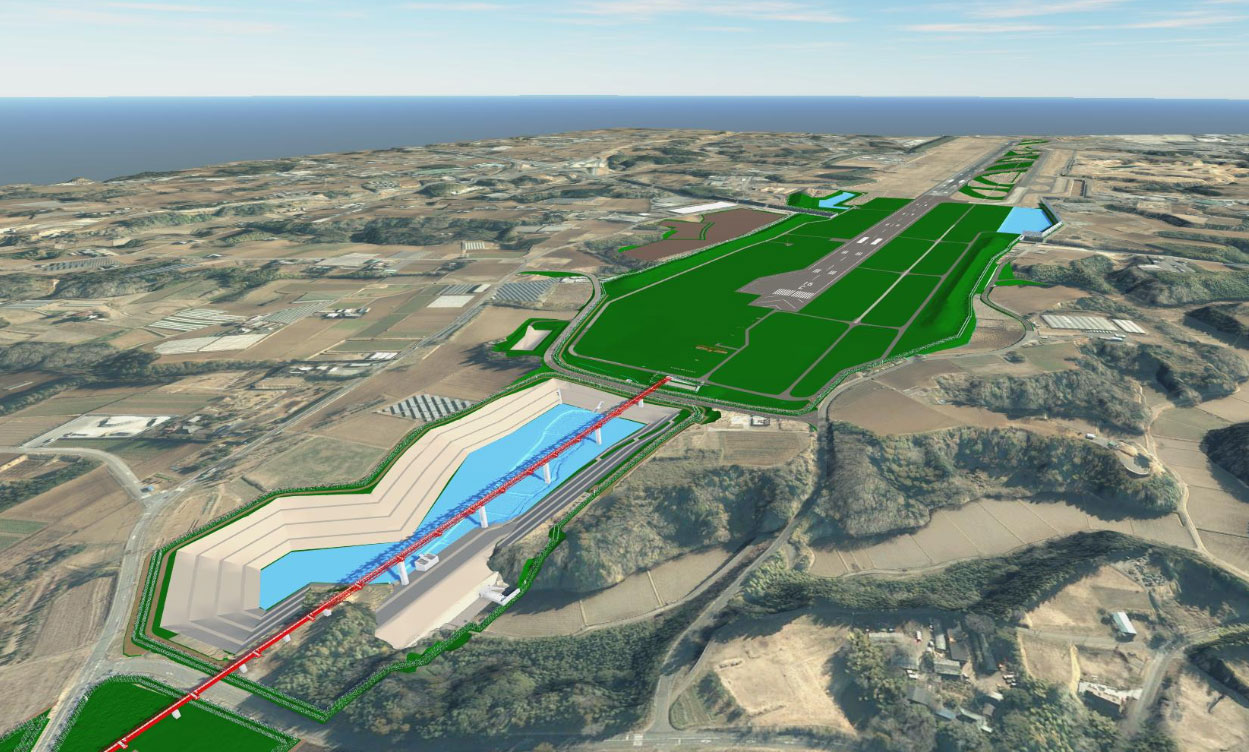
"Since a vast area will be paved, a large amount of rainwater will flow out. This will flow into two small to medium-sized rivers in the surrounding area, but if the flow rate is not regulated, it will overflow, so it was necessary to create a retention pond within the airport to temporarily store the rainwater."
However, it was not that simple. First of all, detailed calculations were needed to determine how much rainwater would flow out, how much could be discharged into the river, and in relation to that, what capacity of retention pond would be necessary. However, since the overall plan was still in progress, the final areas for paving and grassing could not be determined. In addition, coordination with river administrators and local municipalities was necessary from the perspective of not causing inconvenience to surrounding residents and farmers. Namiki worked closely with Aviation Dept., making repeated adjustments to grasp the final figures and reflect them in the plan. Ultimately, it was concluded that a retention pond of 200,000 m³ was needed in the B runway extension area to cope with a torrential downpour that occurs once every 50 years, and a retention pond of 1,300,000 m³ was needed in the C runway construction area. But then, where on the site to place them was another difficult problem.
"The basic principle is to utilize the natural topography and undulations of the terrain, rather than digging new soil, so that water can accumulate in the low-lying areas. We took the airport's drainage plan into consideration, analyzed the terrain, and decided to create several sections, and also planned waterways to the river. Furthermore, even in the event of rainfall exceeding the once-in-50-year rainfall, we have devised a design for the construction within the airport so that as much water as possible can be stored within the airport grounds."
Aviation Dept. played a key role in the project team's administrative functions.
Representatives from various departments, including those responsible for ground engineering, roads, tunnels, and rivers, gathered in the project team and worked closely together to carry out a variety of tasks. The role of coordinating these efforts was that of Aviation Dept.. Naoto Futamata, while working on the design of the construction and paving, as well as the drainage plan for the airport grounds, which was the responsibility of Aviation Dept., kept an eye on the overall work that was proceeding in parallel.
"The role of Aviation Dept. was to keep an eye on everything, checking for any problems or difficulties the client might be facing, and to move the project forward comprehensively. It was a challenging job, involving a large scale and various plans and designs progressing simultaneously, but this overall management was precisely where our company, which handles a wide range of projects, could demonstrate its value, and it was also very rewarding."
Mifuyu Kurosaki, who joined this project five years ago from the same Aviation Dept., spoke about her enthusiasm for her work, which will now begin in earnest.
"I have been involved in the 'New Narita Airport' project from the very beginning, specifically regarding the development of the new passenger terminal area and the new cargo area. We are now finally moving into the concrete work of developing the foundational infrastructure, and I have participated in discussions about what kind of airport the client envisions for the future. I would like to utilize the knowledge I have gained there, and also grow as a person along with the execution of this project."
Nagai, who has been active in the aviation field for a long time since joining the company and has been involved in the Narita Airport project since 2016, concludes with the following:
"I believe PACIFIC CONSULTANTS is the only company capable of handling a national project of this magnitude on its own. Furthermore, I hope that young people will join us and use this experience as an opportunity for their own growth. I expect that many of the next generation of leaders for our company will emerge from here."
—The "Further Functional Enhancement Project" is finally entering a new stage as construction begins in earnest.