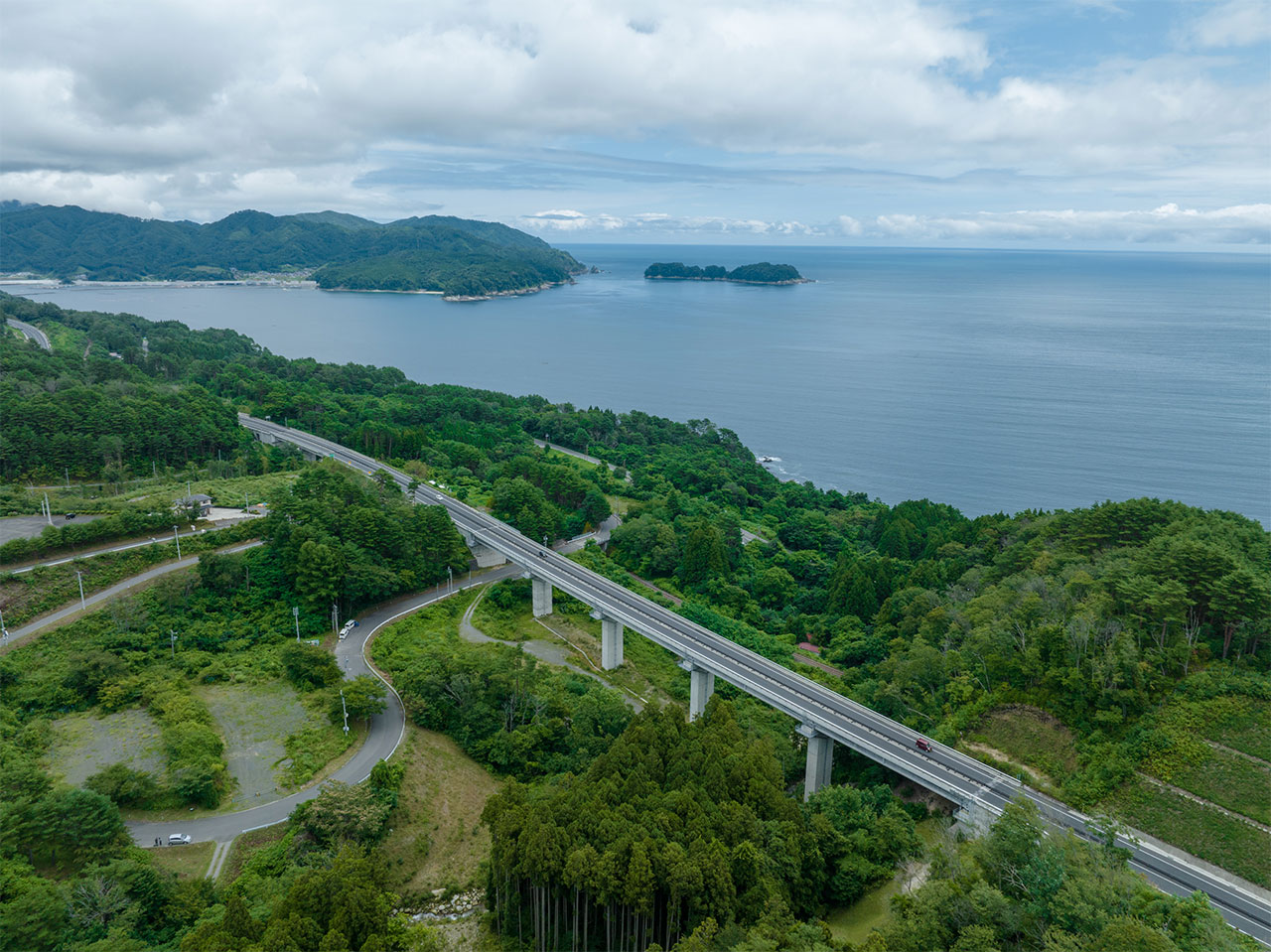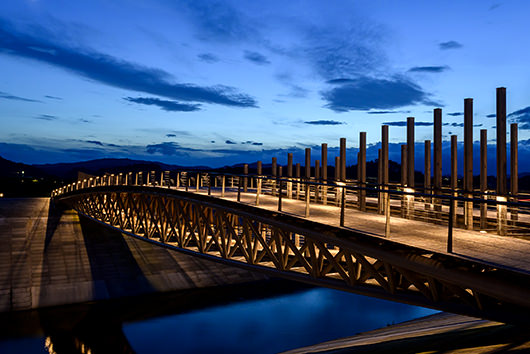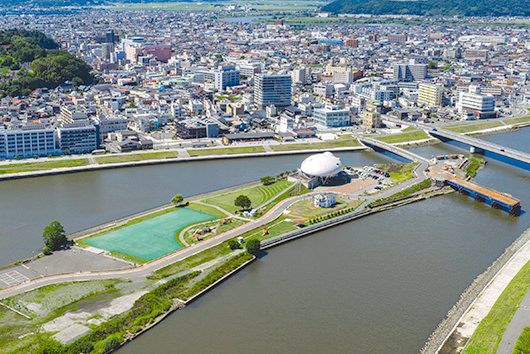

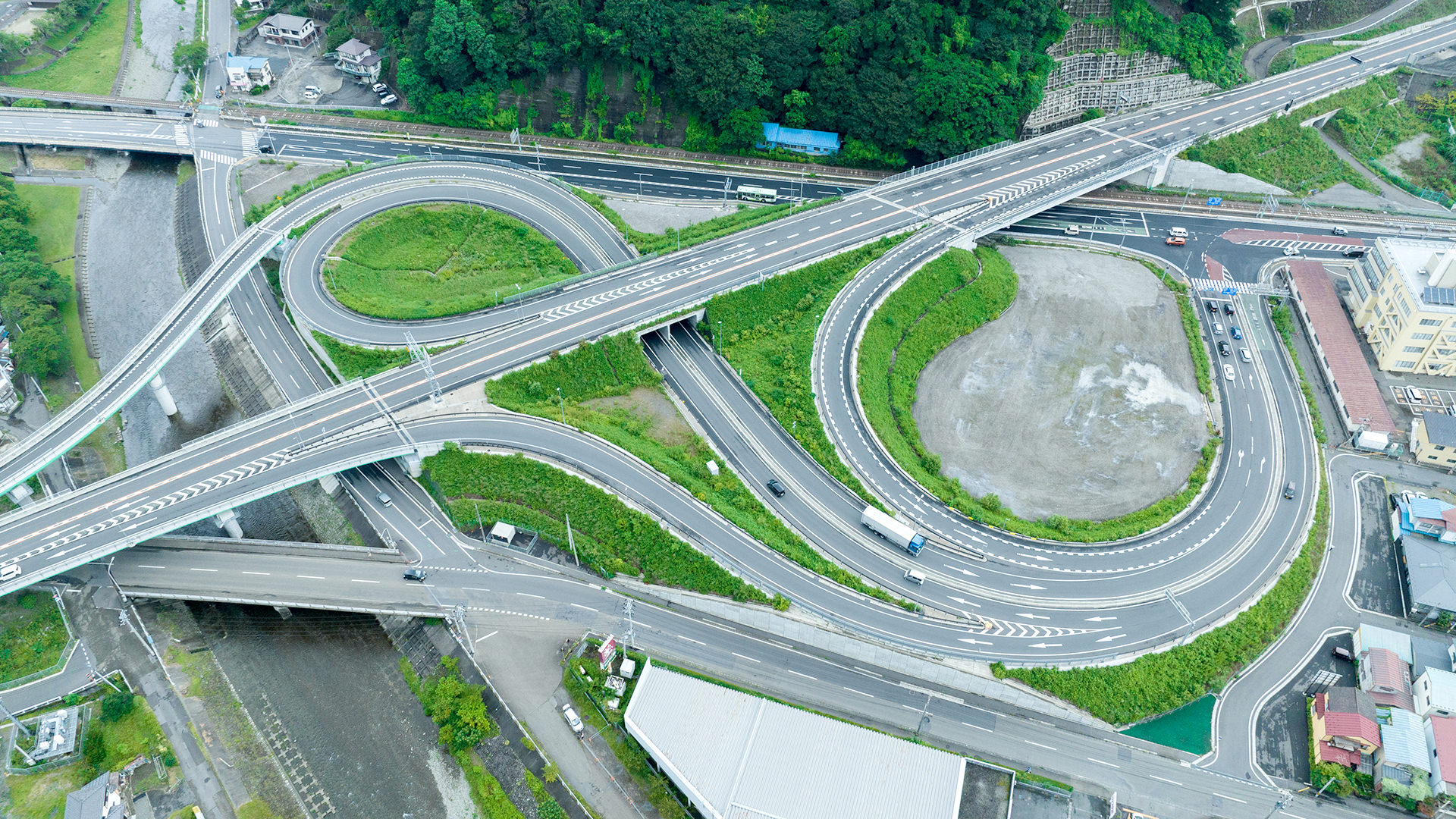
The Sanriku Coastal Road (Sanriku Road), which runs along the coast of the Tohoku region and connects Sendai City, Miyagi Prefecture, and Hachinohe City, Aomori Prefecture, had been under construction before the earthquake, but only a portion of it was open. National Route 45, which also runs along the coast, suffered extensive damage in various parts from the Tsunami. The early reopening of the Sanriku Road was essential for the restoration from the earthquake. In order to advance this project at the exceptional speed of approximately 10 years, the government introduced a PPP to expedite the project, a first in the country. PACIFIC CONSULTANTS was awarded the contract for this work in the Kamaishi-Yamada construction section, making a significant contribution to the early completion of the road. Four people who played a central role in the project - Amane TOMATSU from the Structural Sec., Tohoku Transportation Infrastructure Dept. of the Tohoku Branch Office, Osamu YAMAKAGE, Masato SHIRAISHI, and Tomohiro OYAMA from the Roads Sec. of the same department - look back on that time.
INDEX
- Sanriku Road positioned as a leading project
- Introduced Japan's first business promotion PPP
- Received an order for the difficult Kamaishi-Yamada construction section
- Acted as a link between the government, related organizations, and residents
- Also look for temporary housing place for landowners
- It is necessary to take a bird's-eye view of business in both vertical and horizontal dimensions
- The importance of human connections is reaffirmed
Sanriku Road positioned as a leading project
Two roads connect the Pacific coast of the Tohoku region from north to south: National Route 4, which runs inland, and National Route 45, which runs along the coast. However, National Route 45 runs along the winding coastline of a ria-shaped coastline. A 359-kilometer-long Sanriku Coastal Road (Sanriku Road) was planned as a replacement highway. While construction had begun on some sections, progress was slow. Before Great East Japan Earthquake, only about 129 kilometers of the road, primarily inland Miyagi Prefecture, were open—about 30% of the entire route. *1 Furthermore, damage from the earthquake resulted in 22 sections of National Route 45 being closed to traffic, and the superstructures of five bridges, including the Kesen Ohashi Bridge in Rikuzentakata City, were washed away. *2
As an emergency measure, the government made emergency efforts to reopen National Route 45, and at the same time, decided to accelerate the development of the Sanriku Coastal Road, positioning it as a leading project for early restoration from the earthquake disaster.
*1 Source: Towards the early construction of reconstruction roads – Introduction of business promotion PPP – (Tohoku Regional Development Bureau, Ministry of Land, Infrastructure, Transport and Tourism)
*2 Source: Looking back at 10 years of reconstruction policy (Website for inheriting lessons from Great East Japan Earthquake, Reconstruction Agency)
Introduced Japan's first business promotion PPP
However, no matter how urgent it may be, the procedures that must be followed for road construction remain unchanged. The national road office responsible for construction had to carry out a huge amount of work, including briefing information sessions for related organizations and local residents, design consultations, land negotiations, various surveys, and construction management. Since staff alone would be significantly short of human resources, the national government adopted a PPP (Public-Private-Partnership) approach, in which the national government and a team of private sector's engineers collaborated to manage the project. Unlike traditional PPP, this was the first time in Japan that a business promotion PPP had been introduced into road construction management operations. Ministry of Land, Infrastructure, Transport and Tourism and Tourism's Tohoku Regional Development Bureau explained the introduction of the business promotion PPP to the Sanriku Road's construction project as follows:
- In the newly developed sections, a huge amount of work (surveys, design, consultations, adjustments, land acquisition, etc.) will need to be carried out over the next two to three years until construction begins.
- It will be difficult for the client to carry out the scope of work on its own as before.
- For the first time, we have introduced the use of private sector resources for upstream work that has previously been carried out by the client.
*Source: Business Promotion PPP Explanatory Materials (Ministry of Land, Infrastructure, Transport and Tourism), Business Promotion PPP Overview (Tohoku Regional Development Bureau, Ministry of Land, Infrastructure, Transport and Tourism)
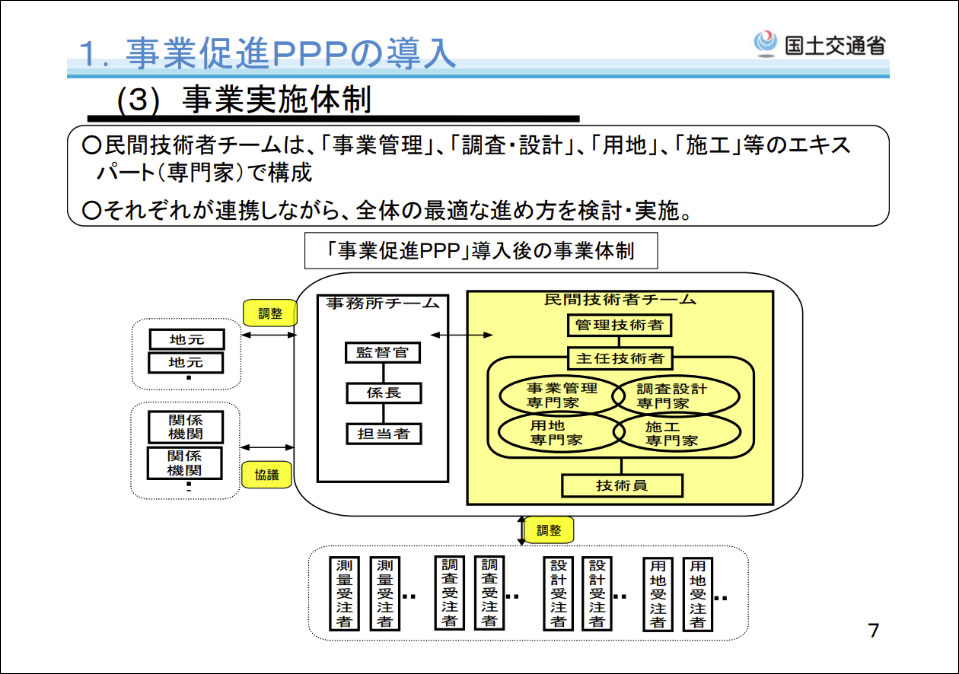
<Business Promotion PPP Operational Structure>
A business promotion PPP is a partnership between an office team (national government) and a private sector's engineers team consisting of experts in four fields: project management, investigation and design, site acquisition, and construction. Specifically, a mixed team including construction consultants and general contractors will be formed to take on tasks that were previously handled by the national government. The actual work of survey and investigation, design, etc. will be carried out by contractors other than the private sector's engineers team, with the private sector's engineers team focusing on management tasks.
Received an order for the difficult Kamaishi-Yamada construction section
Following a public call for proposals for a business promotion PPP, PACIFIC CONSULTANTS was awarded the Kamaishi-Yamada section (Kamaishi-Yamada Road) of the Sanriku Road's 13 sections in fiscal 2014, and served as the managing engineer or Chief Engineer for the private sector's engineers team for six years, spanning three two-year periods, until the end of fiscal 2019 (March 2020). During the first phase, Tsuyoshi SUZUKI, currently Technical Advisor of Hokkaido Branch Office worked hard as the managing engineer, coordinating both internal and external matters. This marked the beginning of the challenge of a new initiative known as a business promotion PPP.
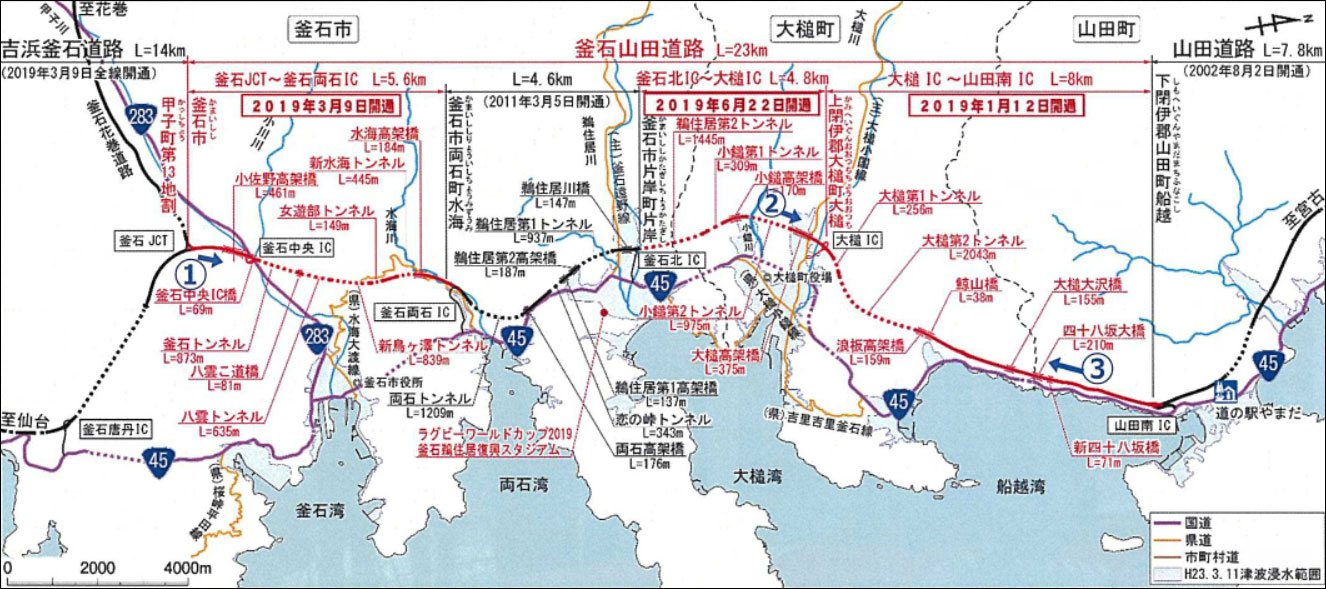
"The Kamaishi-Yamada Road has a total length of 23 km, but the middle 4.6 km was opened on March 5, 2011, exactly six days before the earthquake, leaving a net construction section of 18.4 km," says TOMATSU, who served as the supervising engineer for the third and final phase of this construction work. The 4.6 km section that opened just before the earthquake is remembered alongside the so-called "Miracle of Kamaishi," when, on the day of the earthquake, children evacuated to higher ground on their own accord and were carried to a safe evacuation shelter by a passing truck, escaping disaster.
"This construction section was deemed extremely difficult even before work began. First of all, the tunnel section was 8km long and the bridge was 2km long, totaling 10km, which accounted for 43% of the entire construction section. Furthermore, five interchanges (ICs) were planned, and the ICs would be located immediately after exiting the tunnels. The ICs had to be compactly located in the narrow, flat areas between the mountains."
What made this construction section even more difficult was the fact that the planned site contained many residential units and commercial facilities, recalls OYAMA, who was appointed as the first phase project management expert. "This construction section runs through the center of the city, passing by commercial and residential areas. That's why there are five interchanges, and there are so many landowners. What's more, although Kamaishi City suffered major damage from the Tsunami, the area where the roads were planned was far from the Tsunami-inundated areas, and the homes and shops remain as they were before the disaster. I think it was difficult for the residents to accept that they had to move out to make way for the construction of roads and interchanges, even though they had escaped the disaster."
Acted as a link between the government, related organizations, and residents
Not only was this a challenging construction section, but the project promotion PPP was awarded last, meaning the time to complete the project was shorter than for the other sections. Furthermore, the Sanriku Road was scheduled to be fully opened in 2021, 10 years after the earthquake, but the Rugby World Cup in Japan had already been scheduled for September 2019, with Kamaishi City being one of the venues. This meant that construction of the Kamaishi-Yamada Road had to be completed early in 2019, further shortening the already short construction period. Furthermore, this was a business promotion PPP, something none of us had ever experienced before. OYAMA, who was involved from the very beginning, reflects: "We set up a prefabricated office on the government building grounds and were stationed there to work. There was a huge amount of work to be done, and we were still trying to figure out how to divide the roles between the National Road Office and the private sector's engineers group, and who would do what. For the first year, we were making adjustments as we went. Personally, I'd mainly worked on investigation and design, so I had no experience in project process management. I didn't know where to start."
OYAMA also participated in discussions with Kamaishi City and local residents, but says that this was also extremely difficult. "Traditionally, when it comes to meetings with related organizations, you would simply accompany a national government official. However, with this PPP, we were required to explain on behalf of the government what kind of design we wanted, discuss it, and gain their consent. However, there were times when we were turned away from the people we were discussing with because we were a private company. We simply had to persevere and hold discussions. As the meetings continued, we gradually became more open, and conversely, people began to say that it was easier to talk to me because I was a private sector's person, and they also asked me to explain to the government what they wanted us to do, and finally, operations began to run smoothly."
Also look for temporary housing place for landowners

Kamaishi Chuo IC, close to the city
After two years of hard work during the first phase, during which OYAMA made various adjustments, construction finally got underway in earnest for the second phase. SHIRAISHI was appointed as the investigation and design specialist, and YAMAKAGE as the supervising engineer. However, problems continued to arise even after construction began. "In some areas, the design was carried out without sufficient investigation, such as when the slope of the long main slope was determined based on boring data from a single location. As a result, once construction began, we would sometimes encounter extremely hard bedrock that we had not anticipated," says YAMAKAGE. "In such cases, design adjustments were necessary, such as changing the road height or the cut slope. However, construction could not be stopped. We routinely made design changes while continuing construction to the extent possible." SHIRAISHI was the one who worked hard to adjust the design. "If the road design changes, then of course the designs of the tunnels, bridges, and facilities that connect to it also need to be changed. Consultations with the roads, rivers, and railways that pass underneath are also necessary. A huge amount of coordination work occurred. The actual design work is carried out by a specialized design company, and the final decision is made by the national government, but we had to proceed carefully, despite the limited time, to ensure that we shared information and considered policies up to that point without making any mistakes."
YAMAKAGE, who was also in charge of the second phase, also worked to secure temporary housing place for those being relocated in order to resolve the areas where construction had not yet begun. "I had heard that land acquisition had almost been completed, but in reality, many landowners had not yet relocated. For example, near Kamaishi Chuo Interchange, there were approximately 60 residential units and stores remaining on the planned construction site. What's more, the situation was not such that they could be evacuated immediately due to delays in land development and housing construction at the relocation site. So, I visited real estate agents and made a list of properties that could be used for temporary housing place, and had in-depth discussions with the landowners about which properties would be best for them to rent. Naturally, this type of activity was outside the scope of my duties, but I believe it was something that could only be done through a business promotion PPP."
It is necessary to take a bird's-eye view of business in both vertical and horizontal dimensions
TOMATSU served as the managing engineer for the final two years of the third phase, where he dealt with various issues at the end of construction, while also working to compile the results of the six years and close the site office. "The business promotion PPP has vertical continuity as a project, from investigation to design, construction, and maintenance, and also has a broad scope that includes tunnels and bridges, centered on roads, so it requires a broad perspective both in terms of time and space, which was a new learning experience that was not available in traditional individual consulting work," he recalls. He also shares another unforgettable episode.
"We're moving out of our office, so we'll be throwing away a lot of paperclips and binders. Someone in the office suggested donating them to city and town halls, so we called them. Both Kamaishi City Hall and Otsuchi Town Hall said they would be grateful for even a single paperclips, so we brought them over. The staff bowed deeply and said, 'Thank you so much.' Rather than being grateful for the paperclips, we felt they were thanking us for our efforts in the project over the past six years, and our hearts were filled with joy." TOMATSU says that this was also the result of working hard together with the people involved in the business promotion PPP.
The importance of human connections is reaffirmed
On June 22, 2019, the final construction section of the Kamaishi-Yamada Road, between Kamaishi-Kita IC and Otsuchi IC, was opened, completing the entire 23km stretch. The 359km Sanriku Road connecting Sendai and Hachinohe also reopened on December 18, 2021, just over 10 years after the earthquake. Completing the construction in such a short space of time would have been impossible without the efforts of the business promotion PPP. Facing the enormous task, they continued trial and error every day, but all four of them recall that it was extremely rewarding.
"When I joined in the first phase, there was nothing, so it's very moving to see the progress that has been made in urban development," says OYAMA. He has gained a lot from the PPP, and has since been involved in the same business promotion PPP for the Kumamoto reconstruction project. "I think business promotion PPP will continue to increase, and I would like young people to have the opportunity to experience them," he says.
SHIRAISHI, who worked hard on design adjustments during the second term, said, "My specialty is roads, but here we had to look into tunnels, bridges, and facilities in detail. I also had many opportunities to see construction sites, and by observing them while considering the design, I learned a great deal. I would like to use the knowledge and skills I gained in my future work and in passing on my skills to younger employees." YAMAKAGE, who also served as a supervising engineer during the second term, reflected on his own work, saying, "I felt that the most important thing was the connection between people." "We are good at technical theory. Technical problems can be solved eventually. But in both design and construction, the most important thing is the connection between people. I learned once again the importance of building good relationships with the client, residents, contractors, and all the other parties involved."
Finally, TOMATSU, who oversaw six years of the business promotion PPP in the Kamaishi-Yamada section, had this to say about the completion of the project: "Of course, I'm happy that the road has opened, but I'm also happy to see stores and houses being built along the road and a town being developed. The road is still new, and we're still worried about unexpected disasters like heavy rain, but the compact interchange, the gradient of the road, and the positioning of each pier are all packed with a lot of thought, pride, and cooperation, and they feel like rugged yet beloved monuments created by hardware engineers. I'm very happy to have been able to play a part in this. That's a shared feeling among the four of us, and we'd like to use this experience to further enhance the overall capabilities of PACIFIC CONSULTANTS and contribute to solving social issues."
The opening of the entire Sanriku Road in 10 years was also of great value as it established a new form of PPP known as a business promotion PPP.