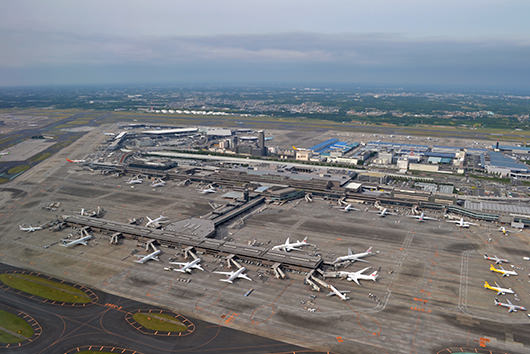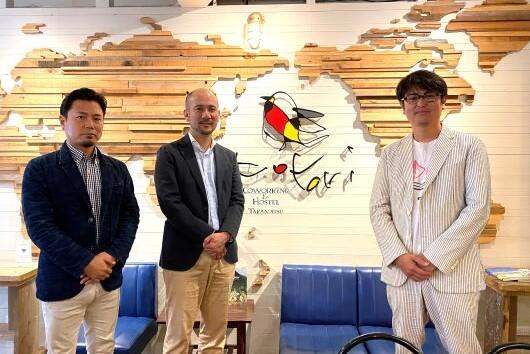

The ongoing construction project to further enhance the functionality of Narita Airport is a large-scale undertaking that aims to nearly double the existing airport area through runway extensions and new construction, and increase the annual takeoff and landing capacity (the maximum number of safe takeoffs and landings per year) to 500,000. Environmental impact assessment is essential. PACIFIC CONSULTANTS has been commissioned to conduct survey work since the planning stage, which dates back more than 10 years, and has supported the creation of the environmental impact assessment report published in September 2019. They are currently continuing their efforts to protect the environment. We spoke with three people from Yuji HIRONAKA of Geotechnical Engineering Dept. Land Infrastructure Div., Hiroo WATANABE and Tomonori FUCHIZAWA of Environmental Symbiosis Dept. Social Innovation Div., about environmental impact assessment.
Overview of "Further Functional Enhancement of Narita Airport"
The combined processing capacity of Narita and Haneda airports, approximately 750,000 flights per year, was expected to reach its limit in the early 2020s. Therefore, since 2015, a four-party council consisting of the national government, Chiba Prefecture, nine surrounding municipalities, and Narita International Airport Corporation (NAA) has been considering ways to enhance airport functions, primarily through extending existing runways and constructing new ones. A final agreement was reached in March 2018. Following project approval by the Minister of Land, Infrastructure, Transport and Tourism on January 31, 2020, construction work is currently underway.
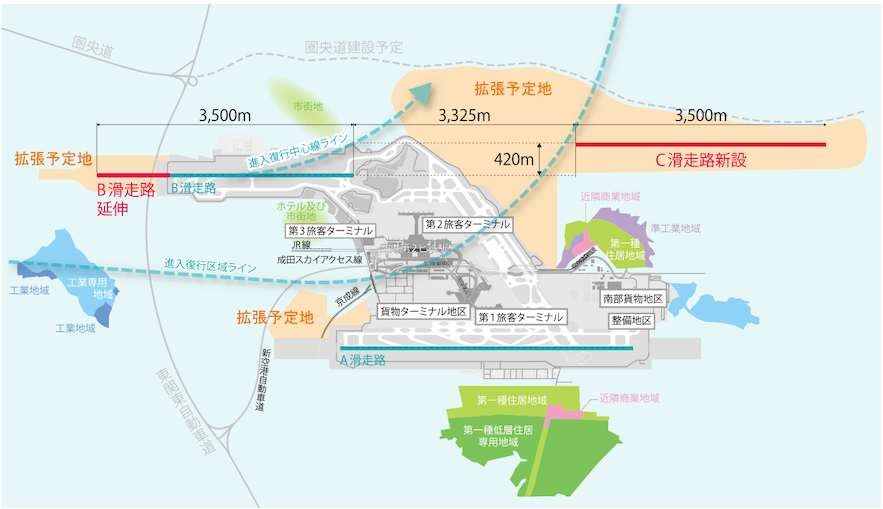
• Project objective: To increase Narita Airport's annual takeoff and landing capacity to 500,000 times.
• Construction details: Extension of Runway B (runway length 2,500m ⇒ 3,500m) / Construction of new Runway C (runway length 3,500m) / Construction of new taxiways (7,471m) / Expansion of airport grounds by 1,099ha (current 1,198ha ⇒ 2,297ha)
INDEX
- Environmental impact assessment is the starting point of the project
- Working to clarify the points to note during the survey and to consider the survey methodology
- Predicting the impact that how the groundwater level will change during construction work?
- Surveying ecosystems across a vast area
- Compensating for the inevitable disappearance of rural landscapes
- Also expanding the area affected by the noise
- Enhancing the value of the rural landscape and connecting it to the coexistence of the airport and the local community
Environmental impact assessment is the starting point of the project
In July 2014, Ministry of Land, Infrastructure, Transport and Tourism released an interim report from the "Subcommittee for Technical Study on Strengthening Airport Functions in the Tokyo Metropolitan Area," which for the first time mentioned the extension and expansion of Narita Airport's runways. The construction of new runways exceeding 2,500 meters in length is subject to the Environmental Impact Assessment Act. The Act stipulates that the impact assessment must be conducted on how the project will affect the environment, including its impact on air, water, and soil, animals, plants, and ecosystems, changes in the landscape and the relationship between humans and nature, and the degree of burden on the global environment. It also requires that opinions be heard from residents, local public organizations, and the national government regarding the results of the assessment and reflected in the project plan. Therefore, in promoting the strengthening of Narita Airport's functions, an environmental impact assessment was conducted at the planning stage of the project, followed by project approval and then construction.
Environmental impact assessment items for "Further functional enhancement of Narita Airport"
| Maintaining the good condition of the natural components of the environment | Air environment | Air quality (nitrogen oxides, dust, suspended particulate matter) |
| Noise (construction noise, road traffic noise, aircraft noise, airport work noise) | ||
| Low-frequency sound | ||
| Vibration (construction work vibration, road traffic vibration) | ||
| Water environment | Water quality (turbidity and pollution of water due to sediment) | |
| Hydrological environment (groundwater level, water use, etc.) | ||
| Ensuring biodiversity and systematic conservation of the natural environment | Animals (important species and notable habitats) | |
| Plants (important species and communities) | ||
| Ecosystems (ecosystems that characterize a region) | ||
| Ensuring rich interaction between people and nature | Landscape | |
| A place for activities that foster interaction between people and nature | ||
| Evaluating based on the degree of environmental impact | Waste materials (by-products from construction work, waste materials from the operation of airport facilities) | |
| Greenhouse gas etc. | ||
Working to clarify the points to note during the survey and to consider the survey methodology
The environmental impact assessment process is not a one-time event. First, an "Environmental Consideration Document at the Planning Stage" is compiled at an early stage of project planning to clarify what points need attention. Next, methods for investigation and other procedures are considered, and an "Environmental Impact Assessment Methodology Report" is created. The results of investigations, predictions, and evaluations conducted in accordance with this document are then compiled into an "Environmental Impact Assessment Draft Report." Further opinions and requests for revisions are received, and finally, an "Environmental Impact Assessment Report" is compiled. Our company was commissioned by Narita International Airport Corporation (NAA) to conduct investigation work from the very beginning of the consideration of enhancing the airport's functions, and was responsible for creating the "Consideration Report," which is the first stage of the environmental assessment. Furthermore, we were primarily responsible for creating the methodology report and draft report, subsequent explanations to local governments, holding and managing public briefings, and making revisions based on the opinions of the Minister of Land, Infrastructure, Transport and Tourism, which led to the creation of the final version of the "Assessment Report" published by NAA in September 2019.
Predicting the impact that how the groundwater level will change during construction work?
At the start of the investigation, a detailed business plan for enhancing the airport's functions had not yet been decided. Without presenting the results of an investigation into how to minimize the environmental impact and what measures should be taken to address any remaining impacts, NAA could not formulate a business plan, and the discussions of the four-party council could not move forward. In particular, the layout of the new Runway C was an extremely important point as the starting point for the planning considerations. This consideration required understanding the details of the land development plan, which was expected to involve extensive land alteration and soil transportation, and the resulting impact on groundwater. Our Environmental Symbiosis Dept. and Geotechnical Engineering Dept. collaborated to conduct the investigation in order to understand these aspects. HIRONAKA from Geotechnical Engineering Dept. recalls:
"Airport sites, including runways and taxiways, must be completely flat. Newly prepared land for expansion also needs to be developed to roughly the same level as the currently operating airport site. However, the area around the airport has gentle undulations, requiring excavation and embankment. Furthermore, to keep the scale of the construction work manageable, it was decided beforehand that no soil would be brought in from outside the site, nor would any soil be removed. We investigated the two runway candidate sites, examining what kind of excavation and embankment would be necessary for each, how much the soil would move, and how this would affect the groundwater level. Also, this region uses groundwater not only as a supplement to agricultural water but also as drinking water. Considering changes in water quality and level was extremely important. However, accurately predicting groundwater fluctuations is very difficult, so we developed a plan for continuous monitoring while making certain predictions."
Surveying ecosystems across a vast area
Chiba Prefecture, despite being part of the Tokyo metropolitan area, boasts a rich Satoyama (traditional rural landscape) environment. The prefecture has established its own Satoyama ordinance, defining Satoyama as "a habitat for diverse living creatures, a major role in landscape formation, disaster prevention, and weather mitigation, and a cornerstone of the original Boso Peninsula landscape," and is promoting policies for its conservation, development, and utilization. Ecosystem impact assessments were one of the central themes of the environmental assessment. WATANABE from Environmental Symbiosis Dept. recalls:
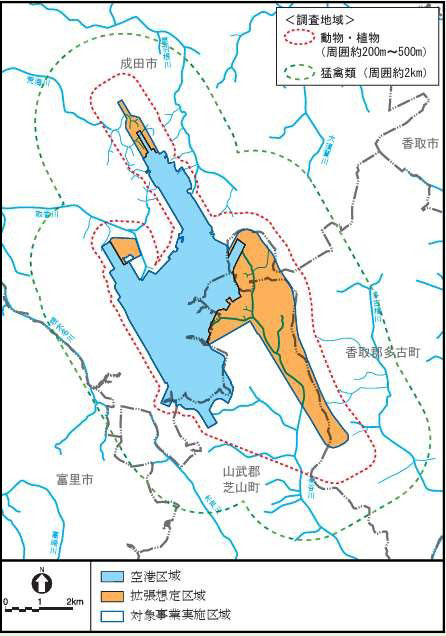
"It was an extremely difficult survey. First of all, the scope was very large. The planned airport site after expansion is approximately 2,300 hectares. However, the impact of the airport expansion had to be considered not only for the decrease in animal populations due to the alteration of their habitats, but also for the impact on animals living around the airport due to the resulting decrease in food resources. Therefore, the survey area was very wide, including the area around the airport, taking into account the range of animal movement. And it was required to comprehensively check the flora and fauna living within that wide area. This included not only birds, fish, and insects, but also plants and fungi. Just deciding on the survey method, how many personnel were needed and what schedule they would follow, and planning and managing the work was a huge challenge. Environmental impact assessments involve not only the air and water environment, but also the ecology of plants and animals, which fluctuates greatly with the seasons, so it is necessary to look at it over at least a year to grasp the reality. For some birds of prey such as the Northern Goshawk, the survey required two nesting seasons, or two years. If we did not start early, we would not be able to complete the overall assessment report in time."
Compensating for the inevitable disappearance of rural landscapes
As the investigation progressed, it was discovered that despite being located near an international airport with frequent aircraft takeoffs and landings, the number and variety of species and their populations were far greater than expected.
"I was able to truly appreciate the richness of Chiba Prefecture's rural landscape, and at the same time, I was reminded that we must seriously consider conservation measures," said WATANABE. It is inevitable that some rural landscapes will disappear as a result of the airport expansion, but it is necessary to proactively create areas to compensate for that loss.
"We call this mitigation, and it's necessary to take measures to mitigate and reduce the impact on the natural environment. We decided to make efforts to maintain the remaining Satoyama environment even after the project is completed. While Satoyama regeneration is being undertaken in many regions, I think it's rare to see it undertaken on such a large scale as part of an environmental assessment. NAA owns land that is currently unused due to noise control measures, so we decided to actively utilize that land as we proceed with the plan. We are going into detail about the design, considering what kind of creatures will come if we create a certain environment."
Moreover, for it to be an effective compensatory measure, the Satoyama environment being worked on must be sustainable. WATANABE continues.
"It's not enough to just do the maintenance once and be done with it. We need to continue mowing the grass and managing the wetlands and forests. As a new asset for the community, we must work together as a community to make it something valuable. I believe we need to finalize the implementation program for that in the future."
Also expanding the area affected by the noise
The environmental impact extends beyond the biological ecosystem to include significant changes in the lives of local residents. These include changes in noise levels, the water environment, and opportunities and locations for interacting with nature and the surrounding landscape. Noise, in particular, is a major concern for those living near the airport. FUCHIZAWA from Environmental Symbiosis Dept., who managed the overall progress of the environmental impact assessment and was mainly responsible for items related to the impact on the living environment, explains:
"The number of takeoffs and landings at Narita Airport is expected to increase to approximately 500,000 times per year. There are also plans to ease nighttime flight restrictions. In the future, we have compiled an assessment report outlining the courses taken during takeoffs and landings from runways A, B, and C, the extent and level of noise generated, the areas where environmental standards are expected to be exceeded, and the measures that will be taken to address these issues."
Enhancing the value of the rural landscape and connecting it to the coexistence of the airport and the local community
Based on the environmental impact assessment conducted by our company, the NAA published its final "Environmental Impact Assessment Report" in September 2019. The main report alone, divided into three volumes, is a massive 2,500 pages in total. Of course, the process doesn't end with creating the assessment report. FUCHIZAWA explains:
"Continuous monitoring and evaluation are essential to ensure that the environmental impact is as initially assessed and that conservation measures are functioning effectively. This is all part of environmental impact assessment, and I believe this is where the real work begins."
WATANABE, who has long been involved in research and policy-making regarding ecosystem conservation, expressed a sense of urgency while also mentioning the potential of this initiative.
"The Satoyama is a unique form of natural capital that replenishes groundwater, supports people's lives, and has shaped Japan's rural landscape. However, they are rapidly disappearing. In this context, Narita is conducting a large-scale survey in conjunction with its airport function enhancement plan, aiming to maintain the existing Satoyama environment in a different form. If Narita Airport's efforts can serve as a catalyst for a renewed appreciation of the value of Satoyama and lead to a major movement for its regeneration, I, as someone who participated in the environmental assessment, would be delighted."
The goal of PACIFIC CONSULTANTS, which is involved in the airport's environmental assessment, is not only to strengthen the airport's functions through initiatives aimed at a "second opening" of the airport, but also to foster coexistence with the local environment and society.