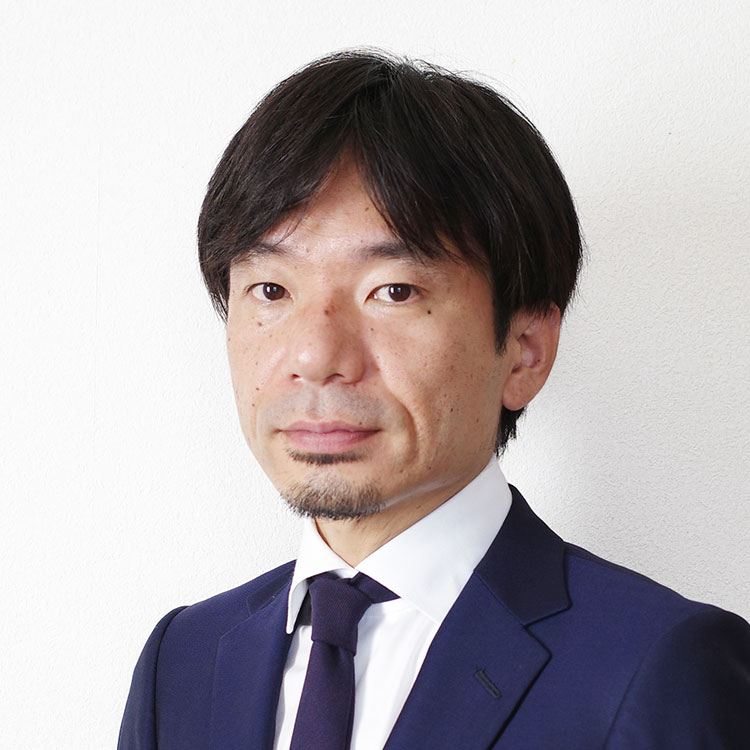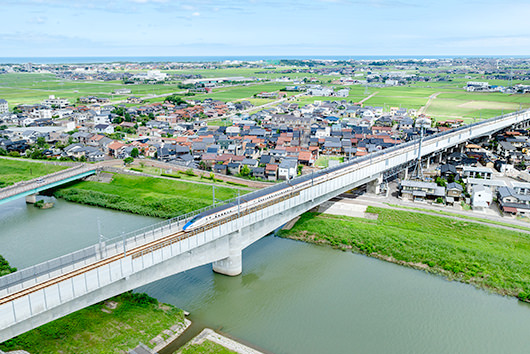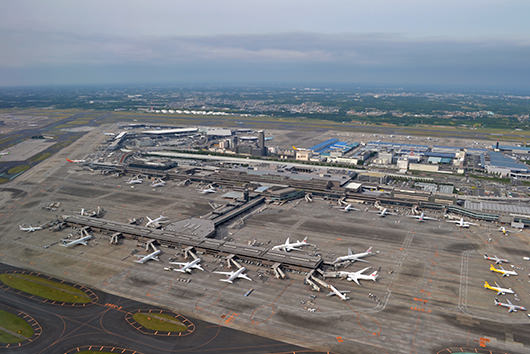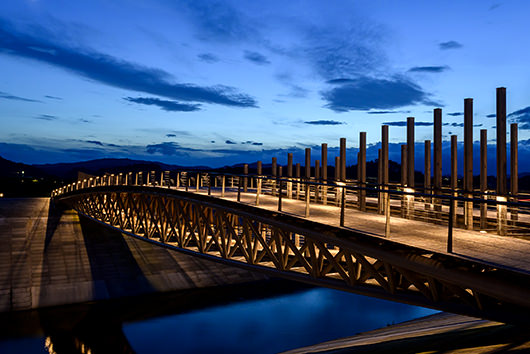

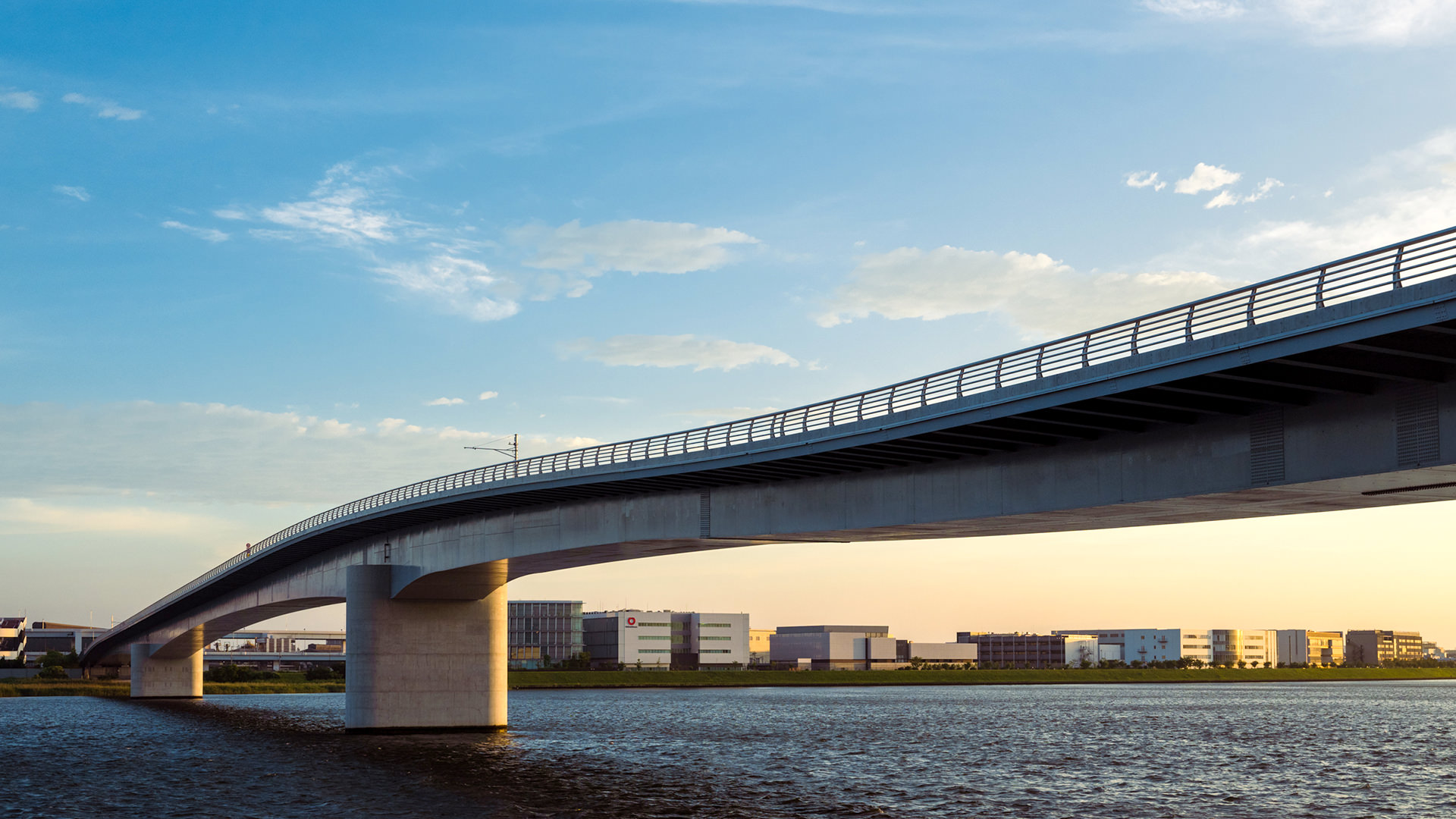
The "Tamagawa Sky Bridge" opened in March 2022. Designing and constructing it under challenging conditions, such as airspace restrictions at Haneda Airport, preserving the tidal flat ecosystem, and maintaining the horizontal landscape unique to the estuary, presented many difficulties. However, PACIFIC CONSULTANTS spearheaded the detailed structural studies of the bridge. They contributed to the realization of a slender and beautiful girder bridge with the longest span in Japan at 240m. We talked to Daisaku ISHIHARA from the Bridge Section 2, Structural Dept., Transportation Infrastructure Div., PACIFIC CONSULTANTS who played a central role in the project.
INDEX
- A bridge of hope connecting the two special zones
- Various difficulties unique to the estuary of Tama river
- The challenge of achieving the longest span in Japan
- The girder height is a maximum of 7m, and the fascia line is also slender and beautiful
- Utilizing every possible construction method to realize the design
- The bridge space also features a clean and uncluttered design
- The joy of the job lies in translating the basic design into construction
A bridge of hope connecting the two special zones
There were high expectations from both the government and industry for the newly planned Haneda Connector Road (later named the "Tamagawa Sky Bridge") at the estuary of the Tama River. On the Tokyo side, the land created by the offshore expansion of the airport was named "Haneda Global Wings," and the national and local governments were working to develop industrial exchange facilities and accommodations. Meanwhile, on the opposite riverbank, in the Tonomachi district of Kawasaki City, Kawasaki City was leading a redevelopment project known as "King Skyfront," aiming to create a world-leading research and development area in the life sciences field. The two areas on either side of the river were designated as a national "Urban Regeneration Emergency Development Area," with the goal of "Creating the world's most business-friendly environment... and forming a growth strategy hub equipped with business functions, functions for creating and disseminating new industries for the Tokyo metropolitan area." The Tamagawa Sky Bridge, connecting both riverbanks, was an essential infrastructure indispensable for creating Japan's new growth strategy hub.
● Haneda Global Wings (former Haneda Airport Site)
"HANEDA INNOVATION CITY" (opened in November 2023) brings together leading companies in the fields of healthcare, robotics, and mobility, and also features an event hall with a maximum capacity of approximately 3,000 people. "Haneda Airport Garden," a large-scale hotel and commercial facility directly connected to Terminal 3, also opened in January 2023.
● King Skyfront (Tonomachi Area, Kawasaki City)
This open innovation hub, primarily located in Kawasaki City, aims to create new industries through world-class research and development in life sciences fields such as cutting-edge medicine and cancer treatment technology development, as well as in the environmental field. As of May 2024, approximately 80 research institutes and companies have already established a presence there.
Various difficulties unique to the estuary of Tama river
The new bridge connecting the two riverbanks will dramatically increase the potential of Haneda Airport as a new growth strategy hub, leveraging its network capabilities that currently connect not only cities throughout Japan but also 52 cities in 25 countries (regions) worldwide. However, the construction of the bridge had to proceed under extremely strict constraints. There were three main constraints. First, because of its proximity to the airport, height restrictions were imposed by the Civil Aeronautics Act. Second, the lower reaches of the Tama River form a tidal flat in Tokyo Bay, and in principle, human access is prohibited in some areas as an ecosystem preservation space. Third, the bridge had to be harmonized with the horizontally-oriented landscape unique to the estuary.
A "Study Group on Bridge Structure of Connecting Road," was formed, composed of experts and experienced individuals, and as a result of discussions, the basic policy was decided as follows: It will be a girder bridge without structures on the road surface such as arches or cables. In addition, the number of bridge piers in the river will be limited to a minimum of two, and it will be a composite rigid frame structure with a steel superstructure and reinforced concrete bridge piers rigidly connected. This will reduce the girder height, minimize the area that obstructs the flight of birds, and at the same time, create a less oppressive feel and blend in with the landscape. The total length of the road is approximately 840m (approximately 602m for the river crossing). The longest central span is calculated to be 240m. There are no examples of girder bridges spanning 240m. The Tsukiji Ohashi Bridge over the Sumida River, completed in November 2018, is a 245m long arch bridge with three spans. The Tamagawa Sky Bridge aims to achieve almost the same length in the central span alone, and with a slender girder bridge. It was truly a challenge to the limits of girder bridge construction.
The challenge of achieving the longest span in Japan
Based on the basic policy outlined by the review committee (a three-span continuous steel deck box girder bridge), environmental survey, preliminary design, and basic design were carried out, after which the baton was passed to the detailed structural study work. Since the next steps, detailed design and construction, were to be awarded to a construction joint venture using a design-build method, whether the basic design envisioned by the review committee could actually be realized depended on this detailed structural study. ISHIHARA of PACIFIC CONSULTANTS, who was primarily in charge of the work, had worked on the basic and detailed designs of many bridges since joining the company, but he was feeling a difficulty he had never experienced before.
"Girder bridges have a simple structure where the girder bears all the load, and there is a clear proportional relationship between the span length and the girder height. Typically, the girder height is said to be 1/20 or 1/25 of the span. Normally, calculations would suggest that a girder height of 10m would be necessary to support a span length of 240m. However, such a massive girder bridge cannot be built. Moreover, there is a shipping lane set up near Haneda Airport, where the girder height must be reduced to 4m. With such a length, and being located by the sea where wind has a significant impact, and furthermore, height restrictions under aviation law that prevent the use of tall cranes, and the inability to enter any areas where ecosystems are protected, the construction methods are also limited. I thought it would be a huge challenge to achieve the conflicting requirements of structural strength and a slender silhouette under these conditions. I even felt anxious about whether it could really be done, but on the other hand, it was a challenge to build a girder bridge unlike any that had ever been built in Japan before. I felt a great sense of determination to 'do it'."
The girder height is a maximum of 7m, and the fascia line is also slender and beautiful
The preliminary design had assumed a maximum girder height of 6m. However, this would not allow for a span length of 240m. ISHIHARA set a limit of 7m and proceeded to consider box girders with high strength and durability through various measures such as using high-performance, high-strength steel and full-section welding. It seemed that 7m could be achieved.
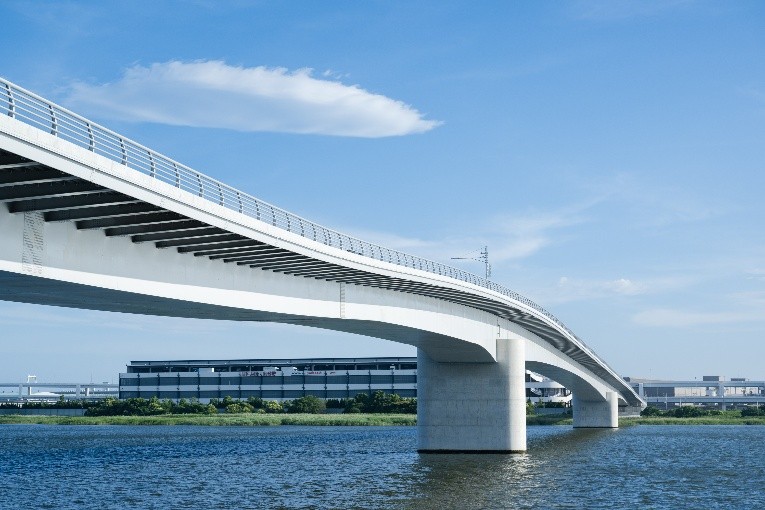
Furthermore, ISHIHARA employed various techniques to create a simple and slender appearance. One example is the fascia line.
"The light and airy impression of this bridge is not only due to keeping the girder height to a maximum of 7m, but also to minimizing the cross-section of the box girder as much as possible, and to the shape in which the steel deck slabs that rest on top are extended 4.5m on each side and supported by long brackets. Furthermore, the horizontal line created by the curb section on the side of the girder, known as the fascia line, is emphasized by narrowing the visible width of the brackets by 10cm inward, creating a shaded area."
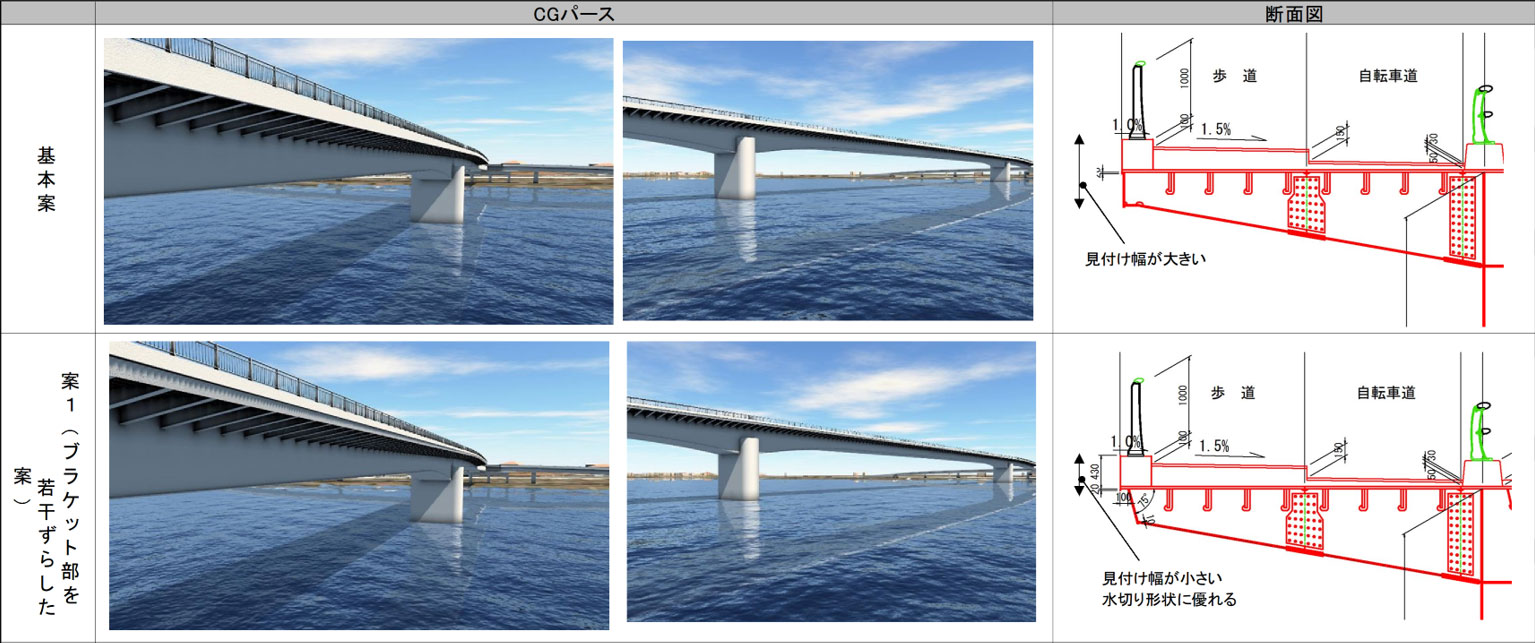
By making the fascia line appear thinner, the horizontal line is emphasized.
Utilizing every possible construction method to realize the design
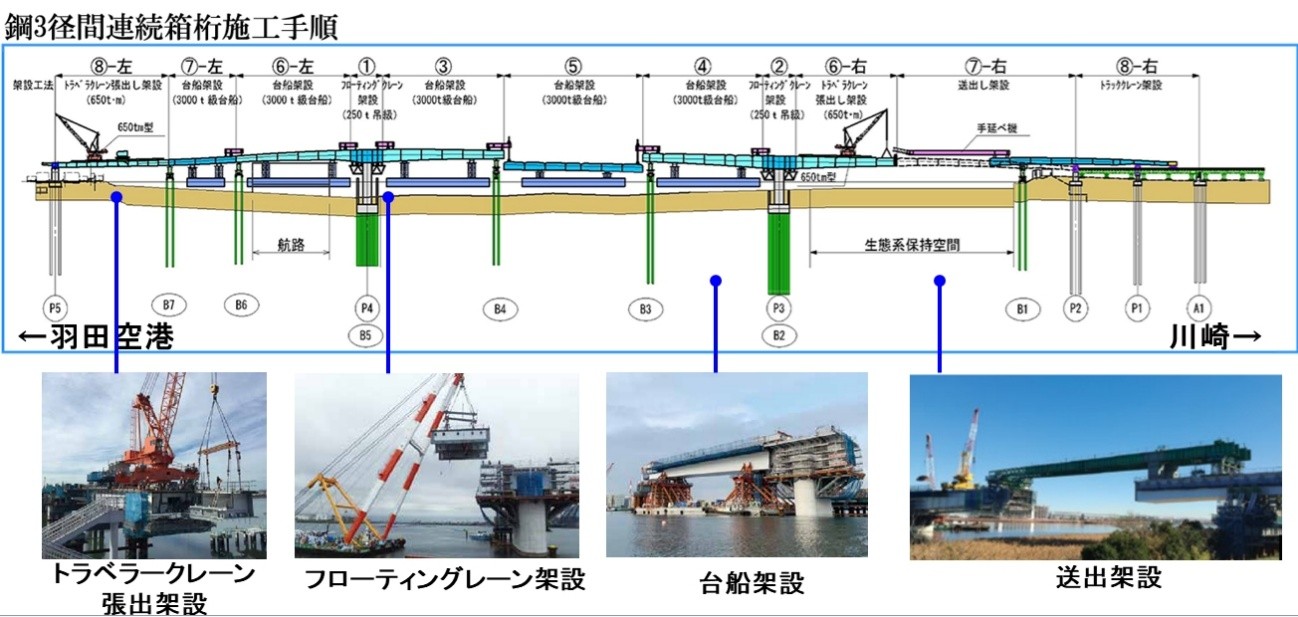
However, no matter how much ingenuity is put into the structural details, it will all be for naught if the construction method is not realistic. In particular, large cranes could not be used due to height restrictions imposed by Civil Aeronautics Act, and temporary supports could not be erected, or people could not enter the ecosystem preservation area, so it was necessary to consider construction methods that were possible under these circumstances. Of course, the order of construction was also important. Because it is a composite rigid frame structure, it is not as simple as erecting the piers and then placing the girders on top once that is finished, but rather the method involves rigidly connecting the girders to the piers and extending them from there as a starting point. Naturally, during erection, sectional forces corresponding to each step will be applied, so it was necessary to design with this in mind from the beginning. How to extend the girders smoothly while maintaining balance with the piers required careful design consideration not only of the construction method but also of the order in which it was done. ISHIHARA also recalls that considering the construction method was actually the most difficult part.
"We combined four different methods for constructing the bridge. We used every bridge construction method currently available. The rigid connections of the bridge piers were erected using floating cranes, the Haneda Airport side was erected using cantilevered traveler cranes, the waterway and river sections were erected using barges that utilize the tidal range, and the ecosystem preservation area was constructed using a combination of launching from land and traveler crane erection to prevent people and objects from entering the river space. We handed over the baton to them, instructing them to use these methods and in this order."
The bridge space also features a clean and uncluttered design
Regarding the design of the bridge space, the "Landscape Review Committee," which was organized separately from the aforementioned study group, had decided on the basic policy, but ISHIHARA added various ingenious ideas to realize it. For lighting, instead of the common method of erecting poles and illuminating from above, it was decided to use low-position lighting incorporated into the railings. This was because it was necessary to take care to prevent light from falling onto the river surface, both for landscape design and for the preservation of the ecosystem. He designed the details of this, and also adopted a horizontal railing system for the handrails to match the horizontal lines of the bridge, adding features such as a railing width that is difficult to grip and a gentle inward slope to make it difficult to climb. In addition to the roadway, this road also has a bicycle path and a pedestrian walkway, but the pedestrian walkway was raised by one level and a steel drainage ditch was incorporated underneath. This eliminated the need for attachments such as horizontal pipes that are often attached to the sides of the girders, contributing to the realization of a slender design. Furthermore, this also improved the ease of cleaning the drainage ditch, and maintenance could be carried out without measures such as closing the road, leading to improved maintenance performance.
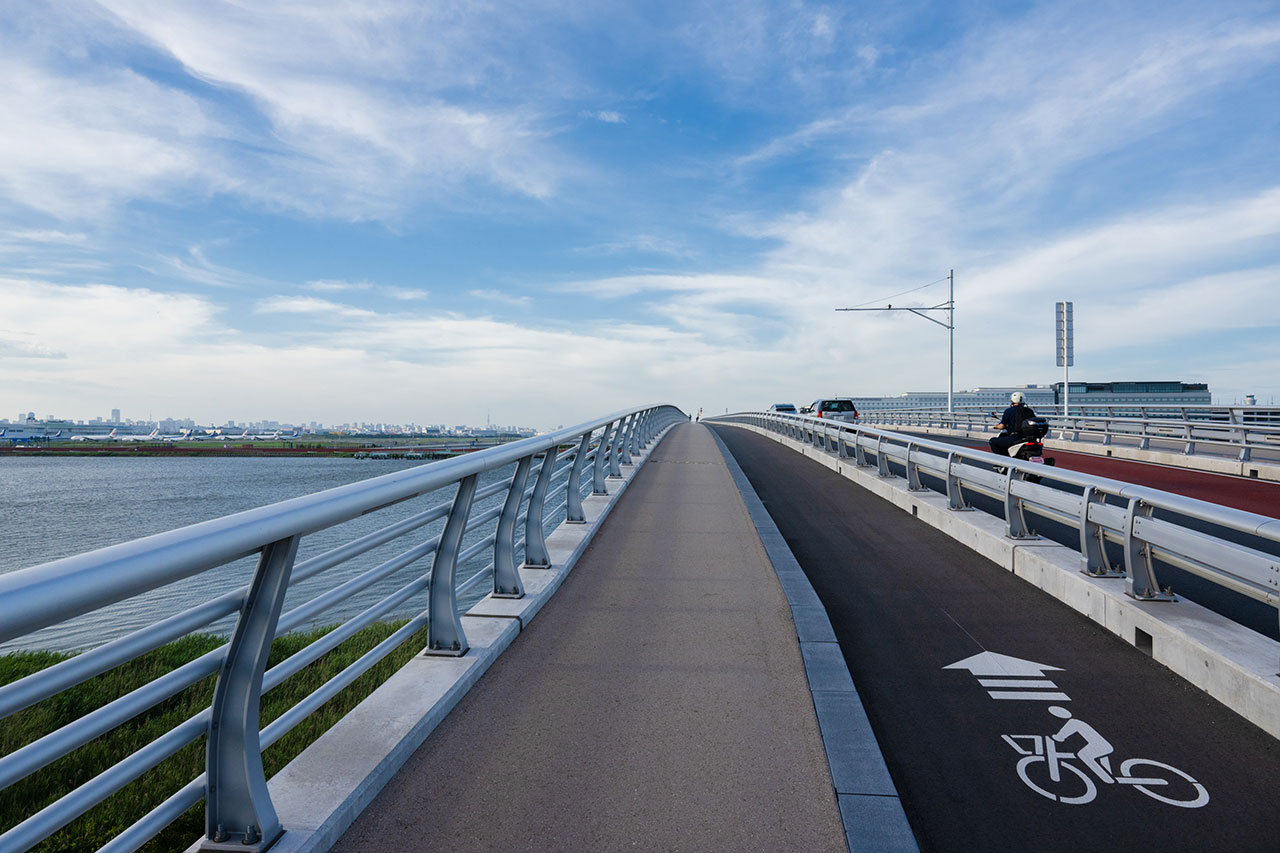
The joy of the job lies in translating the basic design into construction
It is impossible to describe here every detail of the detailed structural study work, including the design of the box girders to achieve a maximum height of 7 meters, the detailed design of the rigid connections to increase strength, the measures to improve maintenance performance, and the tests and wind tunnel experiments conducted to verify and determine these aspects. However, it goes without saying that this series of tasks played a crucial role in connecting the ideal design envisioned by the study committee to the detailed design and construction. ISHIHARA also reflects on this.
"Detailed structural study acts as a 'Bridge' connecting the basic design to construction, but I actually think it's the most creative and rewarding part of bridge design. No matter how good an idea or design is, it can't be realized unless the performance is ensured, the details of the design and fittings are determined, and a final answer can be reached that says, 'This can be done,' including the construction method. In that sense, it was extremely challenging because of the limited time, but it was a very rewarding job."
Construction began approximately six months after the basic design was received, and despite the challenges of the COVID-19 pandemic, the Tamagawa Sky Bridge opened in March 2022 after a remarkably short construction period of four years and nine months. It has received high praise, including Japan Society of Civil Engineers' Tanaka Prize (Works Award) in 2021 and an Excellence Award in Japan Society of Civil Engineers' Design Prize in 2025.
The project has also facilitated traffic flow in the surrounding area and improved disaster prevention capabilities in the region. Furthermore, a survey conducted by Kawasaki City showed that approximately 90% of visitors arriving on foot or by bicycle, and approximately 60% of local residents, responded that "The scenery at the estuary of the Tamagawa River has improved or somewhat improved" due to the construction of the Tamagawa Sky Bridge*.
*FY2022 Kawasaki City Public Works Evaluation Committee: "Post-Evaluation of the International Competitive Hub Urban Development Project (Haneda Airport-South, Kawasaki Tonomachi, and Daishigawara Areas)"
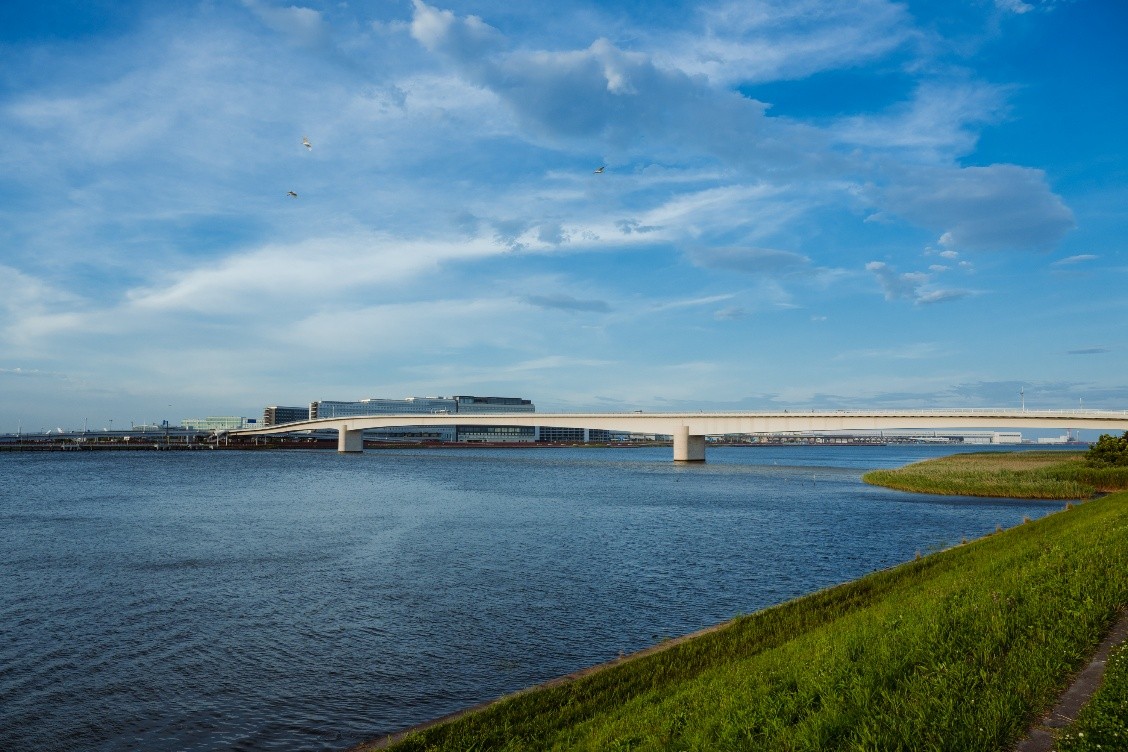
Furthermore, on January 1, 2024, the first New Year's Day since the bridge's opening, the downstream sidewalk was bustling with people who came to watch the first sunrise of the year from the bridge, creating a huge buzz as a new landmark.
"It's incredibly rewarding as a designer to see how the bridge has improved traffic and how many residents are enjoying it. While there's a certain appeal to being able to design freely from scratch, I find it more interesting to overcome various constraints through technical ingenuity and teamwork to bring things to fruition. Also, during this project, my superior at the time took on all the important but complicated tasks, such as coordinating and negotiating with stakeholders, and entrusted me as a junior colleague with the creative design aspects. As a result, I was able to concentrate on the design work and gain valuable experience. From now on, I want to take on a role like this senior colleague and provide learning opportunities for younger people," said ISHIHARA.
The beautiful silhouette of the Tamagawa Sky Bridge highlights the value of detailed structural study work and adds a new chapter to the history of bridge design and construction in Japan.