Skip to content
Go to site menu

# "15 Years Since Great East Japan Earthquake": Understanding the Current State of Disaster Resilience

Working as a Private Sector's Engineers Team to Quickly Complete the "Kamaishi-Yamada Road"

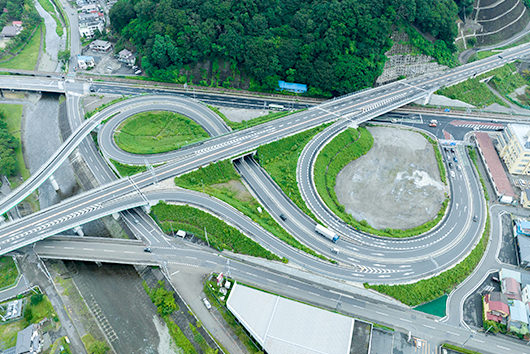
The Sanriku Coastal Road (Sanriku Road), which runs along the coast of the Tohoku region and connects Sendai City, Miyagi Prefecture, and Hachinohe City, Aomori Prefecture, had been under construction before the earthquake, but only a portion of it was open. National Route 45, which also runs along the coast, suffered extensive damage in various parts from the Tsunami. The early reopening of the Sanriku Road was essential for the restoration from the earthquake. In order to advance this project at the exceptional speed of approximately 10 years, the government introduced a PPP to expedite the project, a first in the country. PACIFIC CONSULTANTS was awarded the contract for this work in the Kamaishi-Yamada construction section, making a significant contribution to the early completion of the road. Four people who played a central role in the project - Amane TOMATSU from the Structural Sec., Tohoku Transportation Infrastructure Dept. of the Tohoku Branch Office, Osamu YAMAKAGE, Masato SHIRAISHI, and Tomohiro OYAMA from the Roads Sec. of the same department - look back on that time.


Former Kitakami River Estuary Restoration and Reconstruction Project

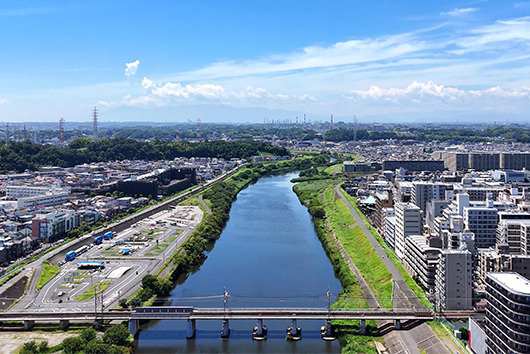
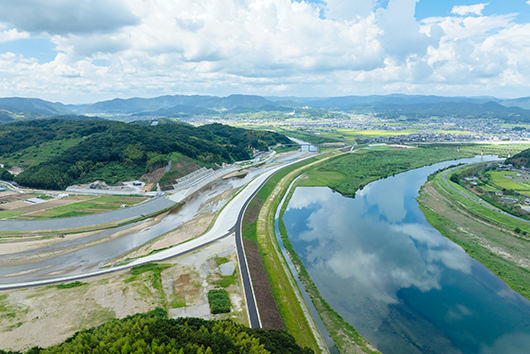
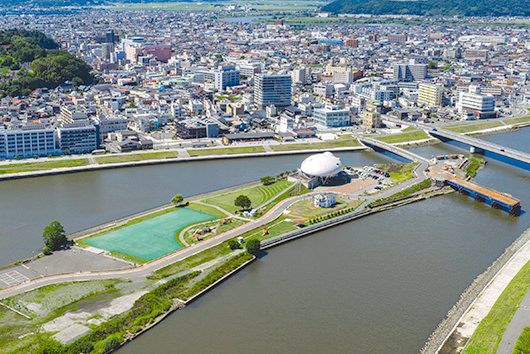
Ishinomaki City, which has long thrived as an river port centered around the former Kitakami River estuary, suffered severe damage in Great East Japan Earthquake. New embankments are essential to protect the city from Tsunamis, storm surges, and flooding. However, building new embankments in a city that has developed a unique lively atmosphere in harmony with its waterfront precisely because it lacked embankments is no easy feat. How could an embankment be constructed to protect the lives and property of residents while maintaining the close relationship between the river and their daily lives? PACIFIC CONSULTANTS was deeply involved in the restoration and reconstruction project for the former the Kitakami River estuary, a difficult challenge. Takahito AMADA from the River Structure Sec., Watershed Structure Dept., Land Infrastructure Div., and Kiyoto TSUKA from the Waterworks Sec., Hokkaido Land Infrastructure Dept., Hokkaido Branch Office who were central contributors to the project, look back on the work, which spanned more than 11 years.

Design of "Nakahashi Bridge" in Minamisanriku Town

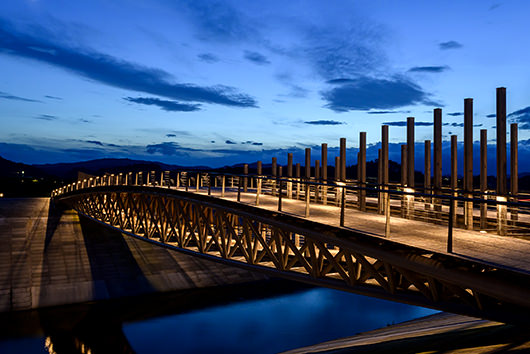
The roadside station "Sansan Minamisanriku," which was developed in the new urban area, with the earthquake reconstruction memorial park built on the opposite riverbank. The bridge was designed by a joint venture between PACIFIC CONSULTANTS and Kengo Kuma & Associates. Based on Kuma company's image perspective, PACIFIC CONSULTANTS was responsible for the design and construction of a bridge that would be a fitting symbol of the town's reconstruction, balancing delicate design with a high level of structural safety. Completed in 2020, Nakahashi Bridge won Tanaka Prize from Japan Society of Civil Engineers in the same year. We talked to Norio SAITO from Structural Dept., Transportation Infrastructure Div. who was responsible for the design work as the managing engineer.

What is Area Resilience?

In August 8, 2024, the Japan Meteorological Agency (JMA) issued a Nankai Trough Earthquake Advisory (warning of a massive earthquake) following a magnitude 7.1 earthquake that occurred in the Hyuga Sea, Miyazaki Prefecture. This event reminded us once again of the national-level disaster that is said to be "coming someday". Once a major disaster occurs, we cannot rely on government support alone. This is why area resilience is now attracting attention through PPP and collaboration among companies. We interviewed Shinji IIDA, General Manager of Watershed Disaster Prevention Sec., Disaster Prevention Dept., Digital Service Div. about area resilience and what kind of preparations are necessary.

What is Disaster Resilience?

Since Sendai Framework for Disaster Risk Reduction 2015-2030, adopted at the United Nations World Conference on Disaster Risk Reduction, called for "strengthening resilience against disasters," resilience has become an important keyword in disaster prevention. We talked to with Takashi ITO, General Manager of the Disaster Prevention Dept., Digital Service Div., about what resilience is, which is said to be a step forward from conventional thinking of disaster prevention and reduction, and how it can be realized.

Key Points for Formulating and Reviewing Disaster Waste Disposal Plan

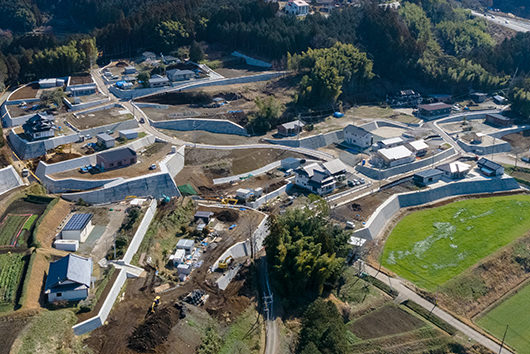
Following the Great East Japan Earthquake, the formulation of a "Disaster Waste Disposal Plan" became mandatory. It is said that approximately 80% of municipalities and 100% of prefectures have already formulated such plans, but to make the plans more effective, it is essential to review them regularly. We spoke to Junya UEDA, chief consultant of the Regional Environment Development Sec., Resource Circulation Management Dept., and Kosuke NOZUE, an engineer in the same Section, about the key points of the update.

Pacific Consultants Magazine

This is an E-mail newsletter that delivers the latest information on PACIFIC CONSULTANTS' projects, etc. We distribute it regularly to deliver timely topics such as PACIFIC CONSULTANTS's insights, project information, interviews and discussions, and the latest topics.

The information you enter will be used only for the purpose of sending you E-mail newsletters and contacting you about various information provided by PACIFIC CONSULTANTS, and will not be disclosed to third parties without your permission.
For more information, please see our Privacy Policy.