Lunar exploration activities are becoming more active in various countries, including China and India, centered around the US-led Artemis program. In Japan, various initiatives are underway through collaboration between industry, academia, and government, including participation in the Artemis program. Pacific Consultants has also formed a project team to work on technological development related to the construction of lunar infrastructure. We interviewed seven people leading the project: Kenichiro MIYASHITA of Ports and Harbors Design Sec., Ports and Harbors Dept., Land Infrastructure Div.; Takahiro YAMAMOTO of Geotechnical Engineering Dept., National Land Infrastructure Business Headquarters; Tomoki SAKATA of Road & Highway Dept., Transportation Infrastructure Div.; Shu NISHIMURA of the Road Promotion Office, Transportation Infrastructure Business Headquarters; Hirohito MIZUSHIMA of the Road Office, Transportation Infrastructure Business Headquarters, Hokkaido Branch Office; and Kenichi SAKAI and Taro KADOKURA of Area Value Creation Sec., Integrated Project Dept., Social Innovation Div..
INDEX
- Lunar activities are becoming more active in countries around the world.
- Japan plays a part in the Artemis Project
- Japan's own efforts toward lunar exploration are also progressing.
- Seeking water in craters – The importance of developing lunar roads –
- Civil engineering design methods are the foundation of all infrastructure construction.
- PACIFIC CONSULTANTS' Initiatives
Lunar activities are becoming more active in countries around the world.
Leading the way in lunar exploration is the Artemis program, spearheaded by the National Aeronautics and Space Administration (NASA). NASA's Apollo program, launched in 1961, sent 12 people to the moon in six landings starting in 1969. However, since the program ended in 1972, no one has set foot on the moon in the 54 years since. NASA decided to aim for the moon again in 2017, coinciding with the start of the first Trump administration.
The Artemis program is a comprehensive lunar exploration program that aims to send humans to the lunar surface, establish bases, conduct sustainable activities, and lay the groundwork for future Mars exploration. In April 2026, a crewed lunar orbit flight carrying four astronauts from the United States and Canada was conducted as part of this program. Currently, a crewed lunar landing is planned for 2028.
India also successfully landed an unmanned probe on the moon in 2023. Furthermore, China, which had already successfully landed an unmanned probe in 2013, succeeded in collecting the world's first samples from the far side of the moon in June 2024, indicating that lunar activities are becoming more serious in countries around the world.
Japan plays a part in the Artemis Project
In 2020, Japan also compiled "Our Approach to Manned Space Exploration," outlining its proactive efforts to "acquire highly advantageous technologies and foundational technologies with significant future ripple effects, while expanding participation from diverse private companies, including startups and non-space industries, and researchers from different fields." Furthermore, Japan is participating in the Artemis program, and in October 2020, signed the "Artemis Accords," which clarified that all programs will be conducted for peaceful purposes. Japan is also responsible for the Lunar Polar Exploration Expedition (LUPEX) project, an international joint mission with the Indian Space Research Organisation (ISRO), and the development of a manned pressurized rover that will enable long-distance travel on the lunar surface.
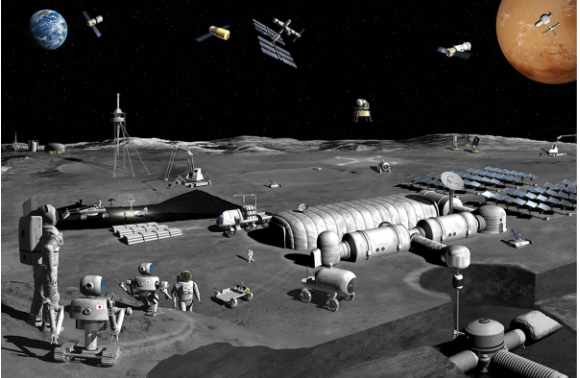
source: "International Space Exploration Initiatives" (Japan Aerospace Exploration Agency)
@JAXA
In particular, manned pressurized rovers are generating great expectations as a means of mobility on the lunar surface, providing long-distance travel and habitation capabilities. In April 2024, the Japanese Minister of Education, Culture, Sports, Science and Technology and the NASA Administrator reached an agreement on the implementation of a pressurized rover for lunar exploration, the first such agreement among international partners in the Artemis program. This agreement not only stipulated that Japan provide a pressurized rover, but also that the United States provide two lunar landings for Japanese astronauts. The joint statement at the time of the agreement declared the common goal of "Japanese people becoming the first non-Americans to land on the moon."

source: "International Space Exploration Initiatives" (Japan Aerospace Exploration Agency)
@JAXA/TOYOTA
Japan's own efforts toward lunar exploration are also progressing.
Japan's efforts toward lunar exploration extend beyond participation in the Artemis program. One such effort is the establishment of highly precise lunar landing technology. Since long-distance travel on the lunar surface is still difficult to anticipate, landing sites must be pinpoint locations with favorable conditions, such as good sunlight, few obstacles, and nearby resources like water or scientifically valuable geological formations and rocks. In January 2024, Japan's Small Lunar Lander Demonstrator (SLIM) achieved the world's first pinpoint landing on the lunar surface with 100m accuracy. Furthermore, it also succeeded in "overnight operation," continuing operations through the harsh temperature environment of night after landing. These are considered to be extremely useful technologies for future lunar exploration.
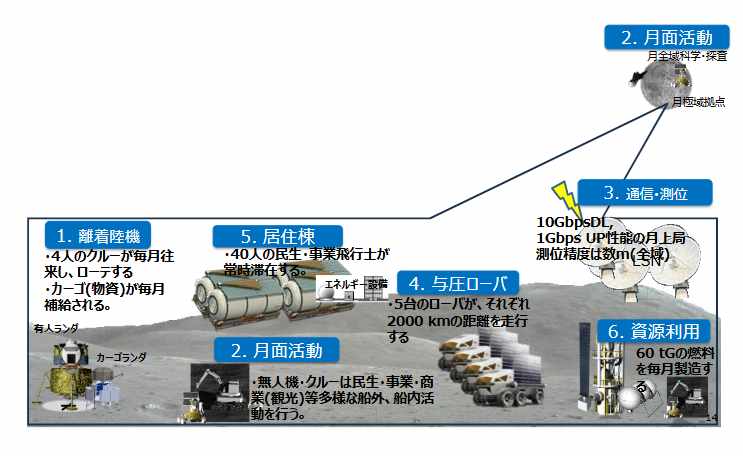
source: Japan's Draft International Space Exploration Scenario 2025 (November 2025, Japan Aerospace Exploration Agency, International Space Exploration Center)
@JAXA
Seeking water in craters – The importance of developing lunar roads –
The Apollo program's primary objective was to land humans on the moon, and it succeeded in bringing back regolith, the fine sand covering the lunar surface, as research samples. However, half a century later, lunar activities have advanced to a new stage, with plans for long-term human stays on the moon to conduct various lunar activities and developments. Crucial to supporting this are manned pressurized rovers and the securing of water.
Previous observations suggest that ice exists in the lunar polar regions, where sunlight does not reach. By collecting this ice, it can be used not only as drinking water or for domestic purposes, but also to produce hydrogen and oxygen through electrolysis. As a result, oxygen can be used as an oxidizer for life support and as fuel for propelling rockets, etc., while hydrogen can be used as fuel itself.
While the basic principle for sustaining life is the cyclical use of water and oxygen through a regenerative Environmental Control and Life Support System (ECLSS), securing and utilizing water resources is essential for stable long-term lunar activities without relying on supplies from Earth. The first thing needed for this is a road that the rover can travel on. To retrieve ice believed to be at the bottom of polar craters, excavation equipment needs to be transported. Furthermore, to transport the retrieved ice, the rover must descend a steep terrain of approximately 4,000 meters in a straight line from the crater rim, with a gradient of 25% to 35%, and then climb back up. In areas with steep gradients, it is anticipated that the road will need to be constructed using embankments and cuts. Durability is also required, as the rover will make multiple round trips, and it's necessary to consider how much the ground deforms when the rover travels, how much centrifugal force is applied when turning, and how deep the regolith is deposited, as well as its deformation and strength characteristics. And unless we figure out how to solidify that, we can't select or design a route.
Furthermore, generating fuel from water or ice requires at least a fuel production plant and a power generation and transmission system. At the same time, a living environment for the personnel responsible for operations must be established. In addition, it is necessary to select a location where rockets can easily take off and land, but naturally, regolith and other debris covering the surface will be scattered around, so an appropriate distance must be ensured from it. Moreover, it is necessary to place various facilities in optimal locations while considering the gradual expansion of the base over a long period of time. Unlike the Earth's surface, which has been smoothed by wind and rain, the lunar surface has a rugged and complex terrain with many craters and steep slopes formed by meteorite impacts. In such an environment, it is important to optimize both the placement of lunar bases and the alignment and routes of the roads connecting them.
Civil engineering design methods are the foundation of all infrastructure construction.
Now, with the need to develop and design roads and structures to support various lunar activities, including water extraction and utilization, rather than simply landing on the moon, just as with infrastructure development on Earth, investigations into the ground and geology, and the elucidation of civil engineering design methods based on those findings, are essential. This field has not received much attention, but if we want to do anything on the moon, the development of lunar-specific elemental technologies related to civil engineering is a prerequisite.
The Ritsumeikan University's Center for Space and Earth Exploration Research has once again drawn attention to the importance of developing civil engineering technologies on the lunar surface. The center has conceived a research project (Principal Investigator: Taizo Kobayashi) aimed at "establishing surveying and ground investigation technologies to realize the construction of lunar bases" as a key technology contributing to the construction of lunar infrastructure. In October 2025, the project was selected for funding under the Space Strategy Fund Program *.
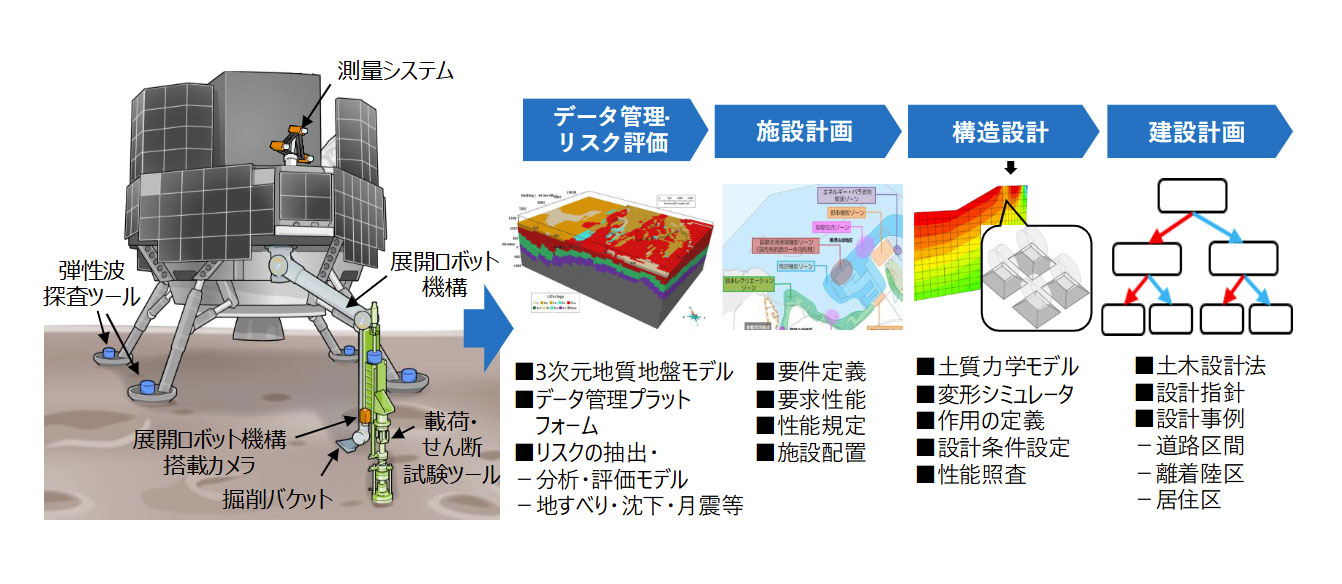
Image provided by: Ritsumeikan University
Specifically, we are developing a “surveying and geotechnical investigation system” to acquire the high-precision topographic data necessary for construction and resource development on the Moon, as well as to understand the soil properties and stratigraphic structure of regolith.Furthermore, the project aims to “contribute to the realization of lunar base construction” by establishing a design framework for civil engineering structures, including land grading, site preparation, road construction, and ground improvement.Under the leadership of Ritsumeikan University, the lead institution, a total of nine organizations—including Shibaura Institute of Technology, the Keio University, the Pacific Consultants Co., Ltd., Komatsu Ltd., and Kajima Corporation—are collaborating on this project. Among these, the our company is responsible for developing “lunar civil engineering design methods.” Development is underway at each institution toward a lunar demonstration scheduled for around 2030.
* Space Strategy Fund: Established at JAXA through collaboration between four government ministries (Cabinet Office, Ministry of Internal Affairs and Communications, Ministry of Education, Culture, Sports, Science and Technology, and Ministry of Economy, Trade and Industry (METI)). It supports advanced technology development, technology demonstration, and commercialization in the space field by private companies and universities over multiple years (up to 10 years).
PACIFIC CONSULTANTS' Initiatives
For our company, the only comprehensive construction consulting firm participating in a project with Ritsumeikan University, space is an unknown field. However, the fundamental concepts required for road design and construction are common to both Earth and the lunar surface. Currently,
① Development of an automated route selection method between bases that takes into account ground risk on the lunar surface.
② Proposal of a road geometry suitable for the low-gravity environment of the lunar surface
③ Development of ground analysis technology that can represent the soil characteristics of regolith
We are working on three themes. Through this research and development, our goal is to establish a civil engineering design method for the lunar surface and systematize the results as a "Lunar Civil Engineering Design Manual." The project team includes not only experts in geotechnical engineering and roads, but also urban planning and architectural engineers. In addition to developing a lunar civil engineering design method, we are also considering ways to realize lunar development, including conceptual placement plans for bases such as landing zones, residential zones, fuel production zones, and mining zones.
Prior to the Ministry of Land, Infrastructure, Transport and Tourism University project, our company was promoting the "Development of innovative technologies for unmanned space construction In the "Project," we were awarded the contract in 2024 for "Consideration of Conditions for Lunar Base Construction Applying Ground Construction Technology." We have been at the forefront of information gathering and conceptual design regarding earthwork design on the lunar surface. Furthermore, in 2025, we are participating in a working group to consider the ideal form of Next Generation Spaceport (NSP: New Space Port) that will support the high-frequency space transportation services essential for lunar development. Survey on the ideal approach to standardization and regulation of space transportation technology We have jointly been commissioned to undertake the project, and are working to innovate and create space transportation technologies and services that utilize not only lunar activities but also the Earth and outer space as an integrated whole.
Moving forward, under our vision of "Producing the Future," our company will continue to support Japan's industry-academia-government collaborative space development through the development of civil engineering design methods for the lunar surface.