Since the enactment of the "Basic Act on Promotion of a Tourism-Oriented Country" in 2007 and the establishment of the Japan Tourism Agency the following year, various initiatives have been undertaken to promote tourism. One of these is the development of statistics on the number of tourists. This data serves as an indicator that is relevant not only to tourism but also to urban development and disaster prevention measures, but the compilation of this data is a heavy burden on local governments, and low data accuracy makes the data difficult to utilize. This is where human flow data has begun to attract attention. The Japan Tourism Agency has also approved its use, and its implementation has begun in various parts of the country. What is human flow data, and what changes will its introduction bring? We spoke with Kengo IMAI and Yuki HODA of the DX Business Promotion Dept., Digital Service Div.
INDEX
- Challenges in tourism visitor statistics
- Using human flow data to improve survey efficiency and accuracy
- Changes in tourism and urban development policies driven by human flow data
- How Pacific Consultants can help
Challenges in tourism visitor statistics
To address variations in the definitions of terms and survey methodologies used for tourism visitor statistics across regions, the Japan Tourism Agency established common standards in December 2009, shortly after its establishment. The standards set out methods for selecting tourist sites, survey methodologies, and procedures for conducting parameter surveys, and require local governments to compile data on a quarterly and annual basis in accordance with these standards. Municipalities survey the number of tourism visitors at selected tourist sites within their jurisdictions. Japanese visitors are classified into four categories: day-trippers and overnight visitors, each further divided into residents of the prefecture and visitors from outside the prefecture. Foreign visitors to Japan are also classified as either day-trippers or overnight visitors. In addition, parameter surveys are conducted through targeted questionnaire surveys and other methods focusing on specific groups. The aggregated results are then reported to the prefectural governments, which compile the data and submit it to the national government.
However, many municipalities find the surveys burdensome. Although the current surveys require significant time and expense, the data collected is often not accurate enough to be effectively used in developing future policies and initiatives.
The survey requires tourist facilities and attractions to report visitor numbers and respond to questionnaires, yet provides little benefit to those supplying the data. As a result, data collection and aggregation methods often vary among providers, making it difficult to ensure consistent data quality. Furthermore, when compiling the statistics, it is essential to convert, for example, the cumulative number of visits to multiple locations into an estimate of the actual number of unique visitors. However, the methods used for this process are inconsistent, and because much of the work is performed manually, errors in data entry and aggregation are difficult to avoid.
Furthermore, the accuracy of data on foreign visitors to Japan is even lower. While accommodation facilities can determine the number of guests by country through passport checks, obtaining detailed data at individual tourist sites remains difficult unless the facilities themselves proactively implement measures to collect information on visitor attributes.
Using human flow data to improve survey efficiency and accuracy
As a solution to these challenges, the use of human flow data held by private companies has been considered.
Human flow data refers to information that records the movement of people. It enables organizations to quantitatively understand when and where people are located, who they are, and how many people are present. This data is mainly collected using location information data obtained from mobile devices such as smartphones, as well as communication data with base stations, or logs from the use of GPS-enabled apps such as maps, weather forecasts, and searches for nearby restaurants. The data is collected with users' consent, with personal information anonymized. Based on this location information, the number of people and their attributes can be analyzed within user-defined geographic areas, such as specific municipalities or tourist sites. It is also possible to understand movement patterns, including where people travel from and to and the means of transportation they use. Furthermore, since this data can be collected automatically, there is no need for manual interviews at each facility, data entry, aggregation, and compilation previously required, making it possible to obtain highly accurate information efficiently.
The Japan Tourism Agency has also recognized the effectiveness of human flow data and revised the "Common standards for tourism visitor statistics" in 2023, explicitly stating that human flow data may be used to determine the number of tourism visitors.
Key differences between conventional surveys and the use of human flow data
| Conventional surveys | Human flow data | |
| Data collection method | Individually collected manually | Collectively collected from smartphone location data |
| Survey period | Survey day only | Any period (including retrospective periods) |
| Time and effort | Time-consuming manual aggregation | Rapid automated aggregation |
| Available information | Primarily tourism visitor and overnight guest numbers | Tourism visitor and overnight guest numbers, as well as length of stay, travel patterns, modes of transportation, and other information |
Transforming tourism and urban development with human flow data
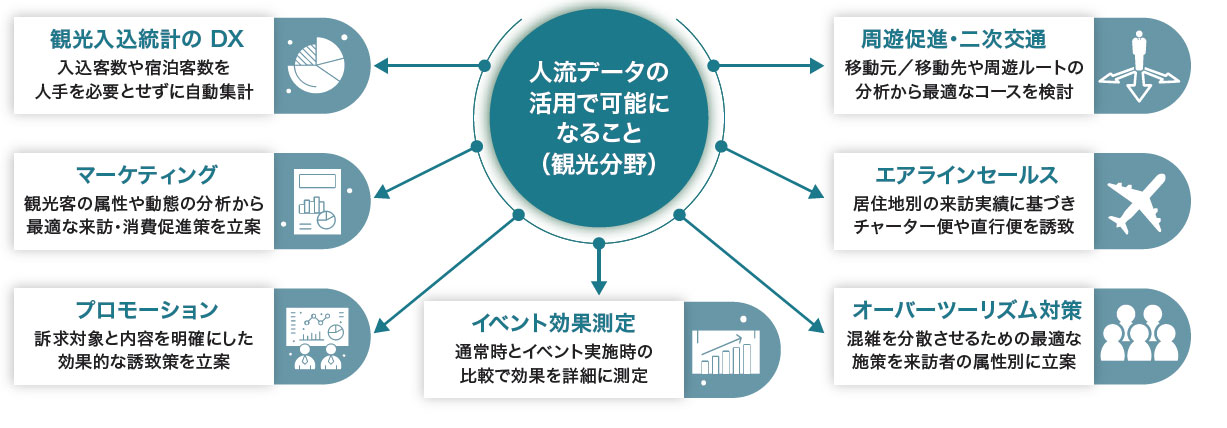
Human flow data provides a detailed view of tourist movements within a region, enabling the development of various evidence-based initiatives. For example, it can be used for marketing to encourage visits and spending, and to develop effective promotional campaigns targeting specific audiences. It can also be used to promote travel within the region and secure secondary transportation based on actual tourist movements. If a municipality has an airport, it can also be used to attract airlines based on the number of visitors by country or region of origin. Furthermore, it can be used to measure the effectiveness of events, consider measures to mitigate overtourism, and support a wide range of tourism initiatives.
Even among inbound tourists, there are often differences between Asian and Western tourists in terms of destinations, time of day, length of stay, and duration of visits. For example, if it becomes clear that East Asian tourists are more active in the evening and at night, while Western tourists are more active during the daytime, measures such as extending closing times and providing multilingual support could be considered to further stimulate consumption among East Asian tourists. Furthermore, human flow data can be used for urban development and for disaster prevention and mitigation measures, such as the formulation of evacuation guidance plans. Insights revealed by human flow data can provide valuable clues as to how a region can be revitalized and help shape future tourism and urban development initiatives.
What the use of human flow data enables (in the tourism sector)
How Pacific Consultants can help
Pacific Consultants, which had recognized the potential of human flow data even before the COVID-19 pandemic, launched the human flow statistics data service "Nation-Wide Movement Statistics" in December 2020 through a collaborative effort with SoftBank Corp. (service provided by SoftBank Corp.). This service combines data from tens of millions of mobile phones, collected through SoftBank's mobile phone base stations, with Pacific Consultants’ knowledge and expertise in infrastructure, including urban and transportation planning. By combining data on the use of various modes of transportation estimated from location information with statistical data such as population statistics, the service provides highly accurate movement data scaled up to represent Japan's entire population of 120 million.
Furthermore, in January 2024, we released "National Inbound Statistics" as one of our company services.
This service utilizes GPS location data obtained from smartphone app usage by over 1.6 billion users worldwide and over 60 million users in Japan, provided by Azira, one of the world's largest providers of human flow data. Based on this vast amount of human flow data, the service provides added value through our company's proprietary logic. Covering data for approximately half of the Japanese population and approximately one-third of inbound tourists, it provides highly accurate information on visits, stays, overnight stays, and travel patterns.
Rather than simply providing data, our strength as a leading construction consulting company lies in our ability to interpret the results of data analysis and provide comprehensive end-to-end support across a wide range of related fields, including tourism, transportation, urban development, disaster prevention, and energy. Furthermore, the data provided by our company is managed under user-friendly licensing arrangements, with due consideration given to the protection of personal information. This allows local governments to make the data available to the private sector and draw on a wide range of private-sector expertise when considering regional development strategies.
Our company has been commissioned by the Hokkaido Prefectural Government to conduct the "Hokkaido Tourism Inbound Survey Project," which utilizes human flow data. We are carrying out tasks such as holding explanatory meetings for all 179 municipalities in Hokkaido that will be responsible for the actual survey reporting, creating tourism inbound survey reports for previous years using human flow data, and analyzing the differences and comparisons with survey results using conventional methods. Currently, we are supporting the preparation for switching to human flow data from fiscal year 2027 onwards, and we are expanding similar initiatives nationwide.
Our company will continue to leverage human flow data to help streamline and accelerate the compilation of tourism visitor statistics, while contributing to data-driven policymaking and implementation in tourism and other areas.