
Shikaoi Town in Hokkaido, which promotes itself as "Shikaoi, a town focused on the environment," is committed to local energy production and consumption. In addition to its existing biogas plant, the town planned a solar power plant utilizing idle land, but the challenge was how to secure a recipient for the renewable energy generated. Pacific Consultants proposed a new thermal and electrical energy system, including the construction of private transmission line network, and supported the maximum introduction and utilization of renewable energy. We spoke with Hiroomi ONO of Social Innovation Div. 's GX Promotion Dept. and Daiki YAMASHITA of the Energy Business Development Support Sec., who spearheaded the project.
INDEX
- Things that had to be overcome in order to expand the introduction of renewable energy
- Plans to supply electricity to public facilities via private lines.
- Store surplus electricity as heat for effective use.
- The energy management system controls the whole system.
- The operation of private transmission line network will increase revenue by approximately 10 million yen per year.
- It won the Grand Prize at the Ministry of Economy, Trade and Industry's "Northern Region Energy Conservation and New Energy Grand Award".
Things that had to be overcome in order to expand the introduction of renewable energy
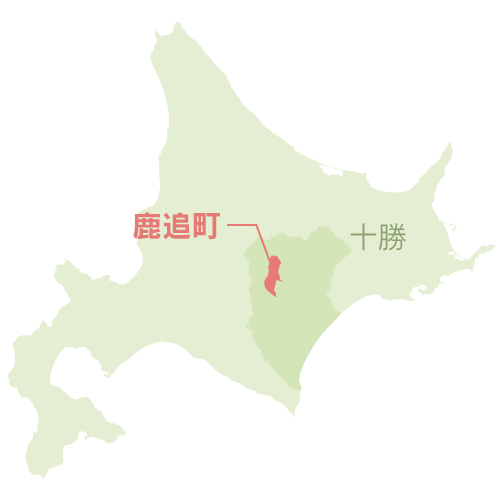
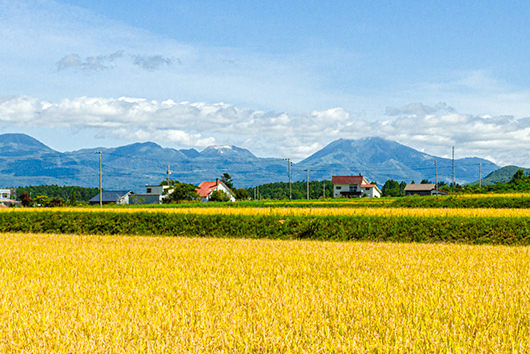
Shikaoi Town is located almost in the center of Hokkaido.
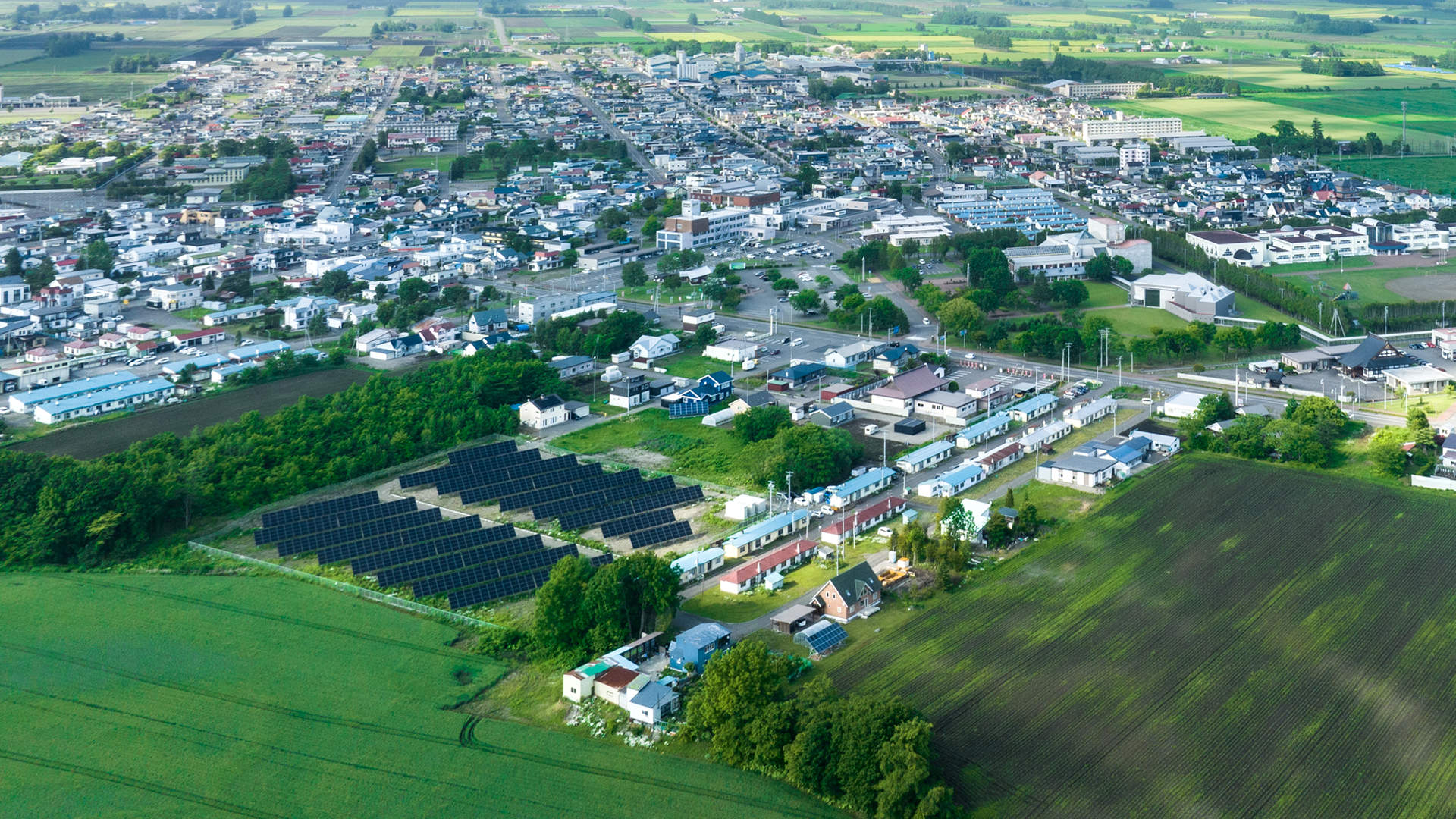
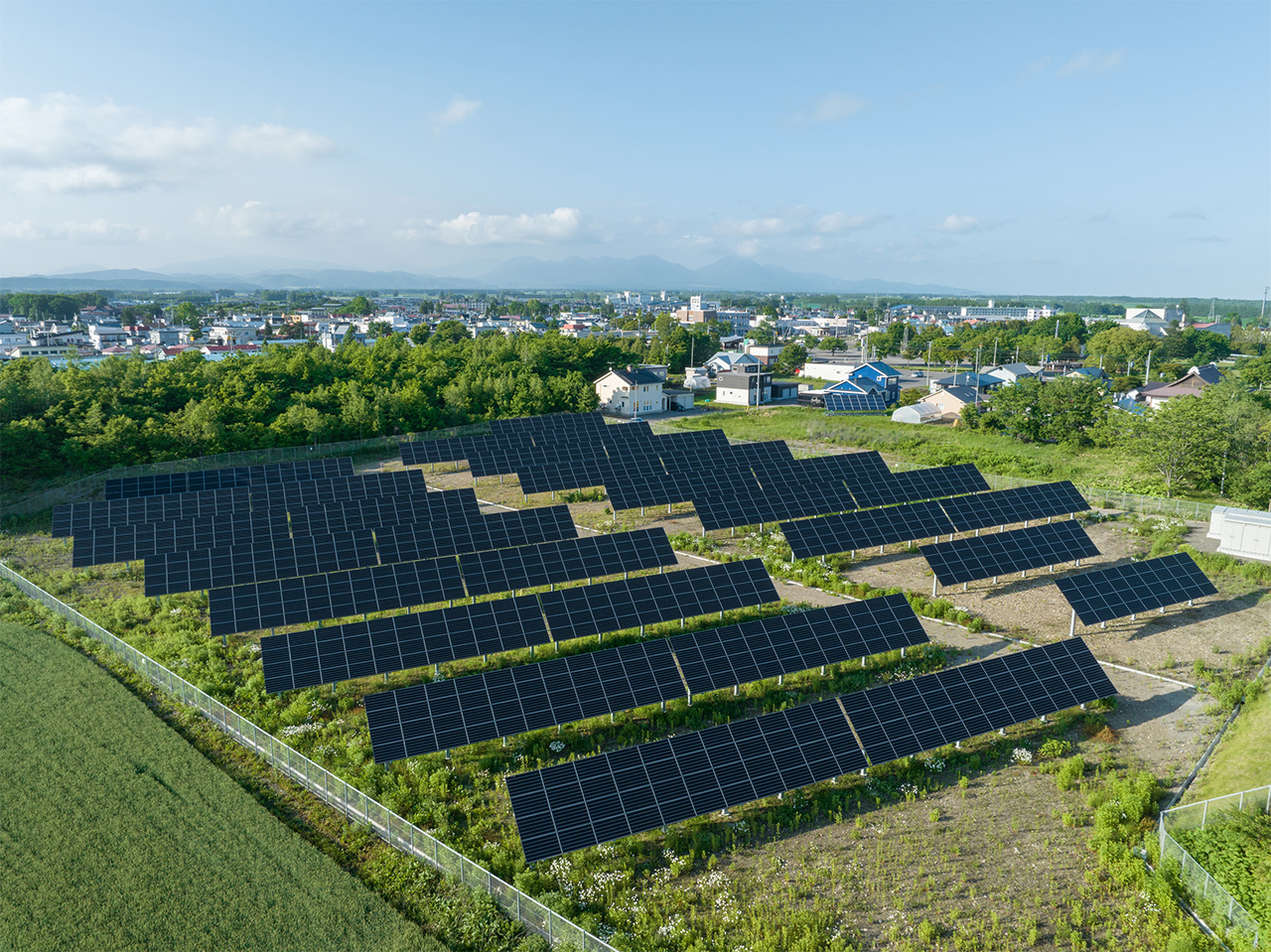
Shikaoi Town is located in the northwestern part of the Tokachi Plain, at the southern foot of Daisetsuzan National Park, which is in the heart of Hokkaido. It is a small town with a population of about 5,000 people and 2,200 households, but based on its thriving dairy farming, it is promoting "community-based circular town development that is friendly to the town, its people, and the environment through biomass," such as power generation using livestock manure and food waste. Two biogas plants are already in operation. In order to further promote the use of renewable energy, the town has considered constructing a solar power plant on a vast, unused plot of land owned by the town hall, right next to the town hall. The town had been struggling to find an effective use for the land, which was formerly a cemetery, but a solar power plant would further advance local energy production and consumption, and would be a fitting initiative for "Shikaoi, the town of the environment."
However, they encountered a major problem. Due to the large size of the land, the solar power plant would be large in scale, and the supply of electricity derived from renewable energy sources would expand significantly in addition to the electricity generated by the existing biogas plant. Securing suitable uses for this increased supply was necessary.
Generating electricity from renewable energy sources isn't simply about increasing the amount produced. Even with battery storage, there are limits, and securing demand that matches the amount generated is necessary. While there's the option of feeding the electricity into the existing grid and selling it, Shikaoi Town is already using the FIT (Feed-in tariff to sell surplus electricity from its biogas plant. Therefore, it's impossible to feed any more renewable energy into the existing grid. Under these constraints, the question becomes how to secure new uses for solar-powered electricity. Without this, even with available land, solar power plants cannot be built. Solving this problem was a major theme for future community resource-recycling-based urban development.
Plans to supply electricity to public facilities via private lines.
"How to develop potential applications?" — Pacific Consultants joined the discussion on this matter. That was in 2016. Ono, who led the discussion, recalls:
"Solar power generation using unused, vacant land can generate a considerable amount of electricity because the sites are large. However, it cannot be supplied to the grid any further. Therefore, our proposed plan was based on the construction of a microgrid that would create a network using private lines and supply electricity to many public facilities."
Yamashita, who was in charge of the basic plan for the microgrid in Mutsuzawa Town, Chiba Prefecture, joined the discussions and helped to concretize the concept.
"This is common in small municipalities in Hokkaido, but in Shikaoi Town, various public facilities are located close together in the same area, which makes it easy to create a network," said Yamashita.
"We decided to create a unified demand by networking nine facilities, including the town hall, the national health insurance hospital, the town hall, the elementary school, the Trim Center (health and welfare service base), and the heated swimming pool, using 44 self-owned poles with a total length of approximately 3 km, and supplying a maximum of approximately 440 kW of electricity from solar power generation. We are also planning to install a 270 kWh battery storage system to prepare for surplus power generation and to cope with power outages during disasters. However, if power generation is at full capacity, there will still be excess power even after storing it in the battery. We considered reducing the scale of the solar power generation, but since this idle land was originally a cemetery, it seemed difficult to utilize even if some of it remained. Another option was to further increase the number of battery storage systems, but batteries are expensive, and in a cold region like Shikaoi Town, where winter temperatures can drop to minus 20°C, specially designed, high-priced products are required, and increasing the number of units would result in extremely high electricity bills. This is also not realistic. While maintaining the basic policy of generating the maximum amount of power and utilizing it to the fullest extent, we continued to explore further uses for the electricity."
It was Ono who found a promising answer to this problem. Ono is an expert in architecture and heat, and has previously worked on unique locally produced and consumed energy projects throughout Japan. He is an engineer whose motto is "I never say it can't be done."
Store surplus electricity as heat for effective use.
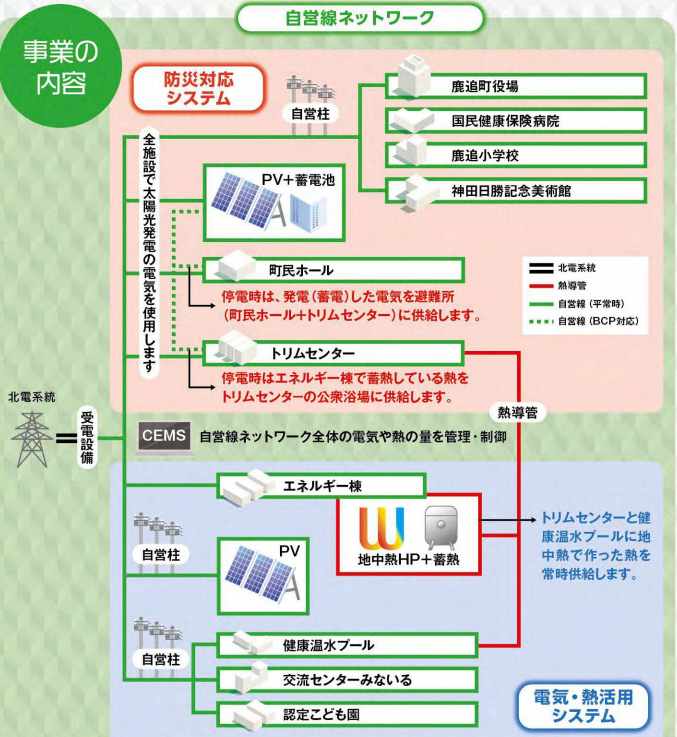
It consists of private transmission line network and an electricity and heat utilization system.
Overall diagram of a system for maximizing the introduction and utilization of renewable energy.
source: "Shikaoi private transmission line network" (Shikaoi Town, Hokkaido)
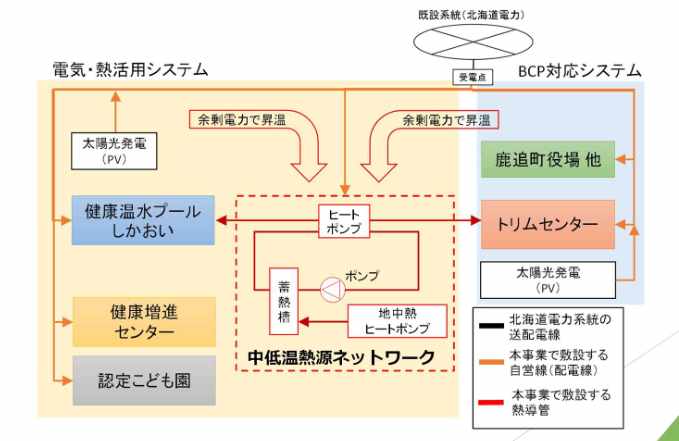
Details of the electricity and heat utilization system (using two heat pumps,
Using surplus electricity to power a geothermal heat pump,
(Used to heat the hot water in the heat storage layer)
source: renewable energy utilizing private transmission line network etc.
Maximum introduction and utilization project” March 19, 2021 (Shikaoi Town)
Ono's idea was to "store excess electricity by converting it into heat."
"At the Trim Center, which has a heated swimming pool and bathing facilities, we previously supplied hot water using a fossil fuel boiler, but we decided to replace this with a heat pump system that utilizes geothermal energy. Two heat pumps are connected in series; one efficiently uses geothermal energy to produce medium-to-low temperature hot water, and the second heat pump uses that hot water as a heat source to raise the temperature to around 70°C and supply that hot water to each facility. This is an 'electric and heat utilization system.' When the amount of electricity generated by solar power exceeds demand, it is first stored in a battery, but if there is still a surplus, the temperature setting of the water in the heat storage tank is raised from the usual 30°C to 40°C, and the second geothermal heat pump is activated. In other words, the surplus electricity is used to raise the temperature of the water, and the heat equivalent to an additional 10°C is stored. If 40°C water is used as the heat source, the first heat pump can produce 70°C hot water with less energy, so it becomes more efficient and kills two birds with one stone."
The idea of a two-stage heat pump that uses hot water as a thermal storage tank was unusual in Japan. While the concept of two-stage heating itself is not new, the system that integrates it into private transmission line network and uses surplus electricity generated by solar power to heat the thermal storage tank originated from Ono's proposal.
The energy management system controls the whole system.
By incorporating Ono's ideas, the basic structure of private transmission line network system incorporating renewable energy was established. However, meticulous control is essential for actual operation. The system efficiently uses electricity supplied by solar power generation, but it cannot meet the electricity demands of all nine facilities connected by the private grid. To do so would require a significant increase in renewable energy generation and a greater number of storage batteries, which is not realistic. Even if it were realized, electricity prices would skyrocket. It is more realistic to continue receiving electricity from the grid and incorporate renewable energy-derived electricity into it. This requires careful management to determine how to distribute the electricity more efficiently and economically, and for solar power generation, it is necessary to predict how the amount of electricity generated will change throughout the day. Based on this, meticulous management is essential to determine how to distribute the electricity to the facilities that use it, store any surplus in storage batteries, and if there is still a surplus, raise the temperature setting of the thermal storage tank and start operating the ground source heat pump.
The system had to consider a vast number of parameters, and the construction of a Community Energy Management System (CEMS) to manage them under an appropriate algorithm was a prerequisite for its operation. Without it, the devised electricity and heat utilization system would remain nothing more than a pipe dream. In this regard, Yamashita considered and presented the basics of the algorithm, and the design and construction companies developed the system based on that.
The operation of private transmission line network will increase revenue by approximately 10 million yen per year.
In April 2021, five years after its conception, the Shikaoi private transmission line network began operation. The system is running smoothly and is showing economic benefits. First, the basic electricity charges have decreased significantly. Previously, the nine facilities had individual contracts with the power company, but with the establishment private transmission line network, these were consolidated into a single demand. As a result, the total contracted power of the nine facilities, previously 759kW, became 450kW per contract (2021 figures), resulting in an annual reduction of approximately 7 million yen in basic charges alone. In addition, the reduction in electricity purchases due to solar power generation amounted to 15 million yen, and the reduction in heavy oil purchases for boilers amounted to approximately 4.7 million yen, resulting in a total increase in revenue of 26.35 million yen. Expenses, including maintenance costs, electricity consumption for the electric heat pump, and additional costs for the electrical Chief Engineer engineer hired for system management, totaled approximately 15.86 million yen, resulting in a net increase in revenue of approximately 10.48 million yen. Excluding subsidies from the Ministry of the Environment, the investment amounted to 113.5 million yen, which is expected to be recouped in approximately 10.8 years. Currently, Pacific Consultants continues to support the project, aiming for even more efficient operation by promoting the conversion of each facility connected by private lines into a Net Zero Energy Building (ZEB) *.
It won the Grand Prize at the Ministry of Economy, Trade and Industry's "Northern Region Energy Conservation and New Energy Grand Award".
New Energy Grand Award The “private transmission line network” project in Shikaoi Town received the Grand Prize in the “Energy Conservation in Northern Japan” category of the Hokkaido Bureau of Economy, Trade and Industry’s “Ministry of Economy, Trade and Industry (METI)” for fiscal year 2021, recognized as an “excellent example of a self-sufficient regional energy system that produces and consumes energy locally” (Lead Partner: Shikaoi Town; Partners: Pacific Consultants Co., Ltd., Ars Zeta Ltd., and Ito-gumi Construction Co., Ltd.).It also received the “Chairman's Award of the New Energy Foundation” at the fiscal year 2024 “New Energy Grand Award” (New Energy Foundation Awards) and the Solar Week 2023 Special Award from the Japan Photovoltaic Power Generation Association.
Looking back on the project, Ono says:
"We didn't have any particularly new elemental technologies. However, in terms of how to combine and utilize those technologies to solve problems, we were able to devise and implement something unprecedented in Japan. I think that challenging ourselves to do something nobody else has done and trying to create something that doesn't yet exist in the world is something unique to Pacific Consultants."
Yamashita, who spearheaded the project with the construction of private transmission line network and the basic plan for the EMS control program, said, "private transmission line network in Shikaoi Town is large in scale, unprecedented, and its impact on the grid was unknown, so there were many negative opinions. I believe that persistent negotiations, demonstrating that there were no problems one by one, led to this positive result. Currently, the social situation has changed from 'low carbon' to 'decarbonization' as planned, and the business environment has changed, with a certain degree of acceptance of grid constraints. The construction of private transmission line network is one of the promising methods in regional energy policy, but the optimal energy system differs from municipality to municipality. We will continue to consider thermal and electrical systems that contribute to solving the challenges of each region, and we want to continue taking on challenges rather than stopping just because no one has done it before."
The construction of a locally produced and consumed energy system that utilizes unique regional resources is attracting great attention as a locally initiated decarbonization initiative and as a way to create local industries. Pacific Consultants plans to further strengthen its support for the development of basic plans and their social implementation.