

In infrastructure development and large-scale development projects, PM/CM (Project Management/Construction Management), who manage projects from the perspective of supporting clients and project owners, is currently attracting significant attention. This is due to the increasing size and complexity of projects and the shortage of personnel capable of managing large-scale projects. There is also a growing trend to outsource these projects to highly specialized third parties. We spoke with Masashi KATO of the Project Management Division and Chikanori WATAI of the PM/CM Division at Pacific Consultants, who are in charge of PM/CM.
INDEX
- What is PM/CM?
- Why is the demand for PM/CM increasing?
- Disaster recovery work has once again demonstrated the necessity and value of PM/CM.
- What skills are required of PM/CM?
- What PACIFIC CONSULTANTS can do
What is PM/CM?
Project Management (PM) / Construction Management (CM) refers to a management method that comprehensively manages the entire project to ensure its success. It takes into account all elements of the project, such as time, scope, quality, safety, and procurement, and acts from the perspective of the client or business owner, coordinating with stakeholders, managing risks, and supporting decision-making from project planning to design, construction, and handover.
Projects such as infrastructure development projects promoted by national and local governments, urban redevelopment by private companies, and next-generation energy development tend to be large in scale and complex. Naturally, the project duration is long, and the stakeholders are complex and diverse. If there are any deficiencies in the progress, it can lead to budget overruns, wasteful spending, delays in the construction period, problems arising from insufficient coordination among stakeholders, inconsistencies in quality standards, and even delays in decision-making due to insufficient information sharing. For the smooth execution of such large-scale projects, PM/CM has become an indispensable management method.
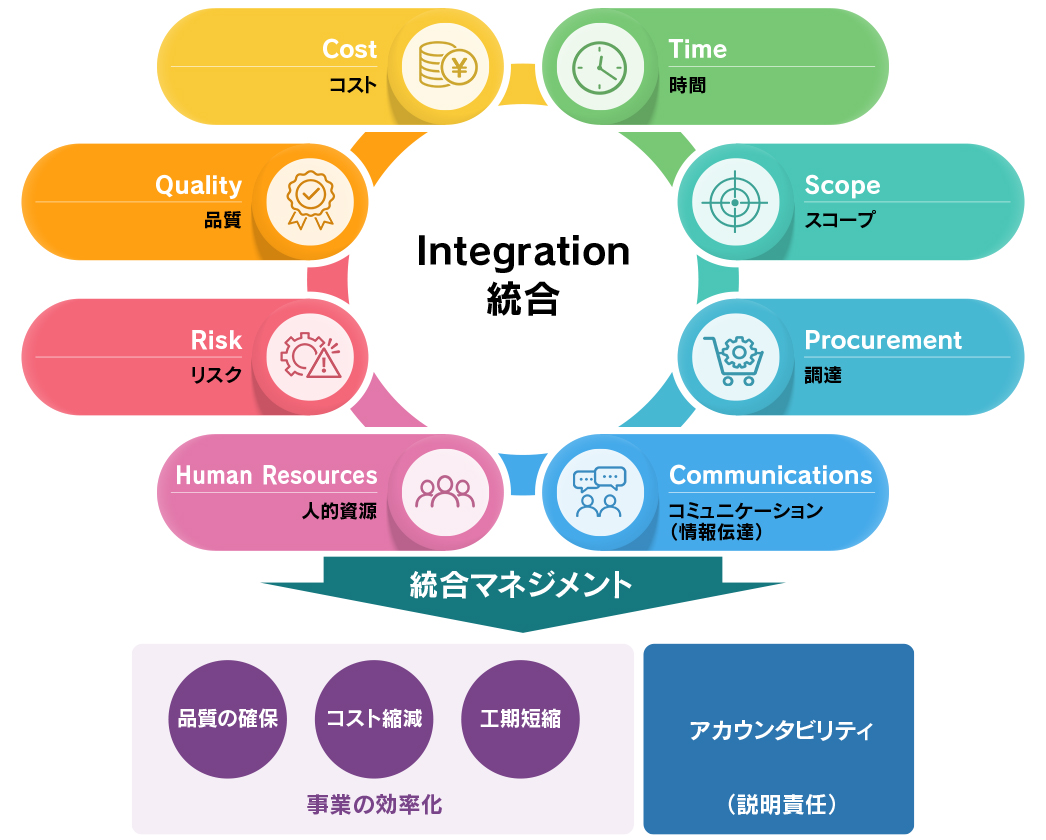
Created by our company based on existing materials.
source: "Vision for the Introduction of Project Management (PM) Methods to Public Works," June 1999 (Ministry of Land, Infrastructure, Transport and Tourism and Tourism (then the Ministry of Construction))
While PM and CM are often treated together, their roles are distinct. PM, acting on behalf of the client or business owner, primarily focuses on "executing the business plan," including supporting the business plan, estimating project costs, and creating operational plans, budgets, and schedules. In contrast, CM comprehensively manages the project throughout each stage—planning, design, and construction—with the aim of improving project efficiency, optimizing costs, and enhancing quality.
In public works projects, the standard practice is to separately contract for PM (Project Management), CM (Construction Management), and construction Executive Manager. In contrast, private sector projects utilize flexible contracting methods, such as integrated project contracts or separate contracts, depending on the client's needs. Therefore, the role of PM does not differ significantly between public and private sector projects. On the other hand, in public works projects, CM management is mostly limited to construction. In contrast, in private sector projects, the scope of management encompasses all aspects, including planning, design, and construction. Furthermore, cost management is essential in private sector projects, but is largely outside the scope of public works projects. It is crucial to understand the differences in the roles and scope of PM/CM in public and private sector projects before implementing management strategies.
A task similar to PM/CM is "construction supervision." Construction supervision involves tasks related to individual construction work that make up a construction project, such as confirming that construction specifications and design requirements are met and promoting the agreed-upon construction. In contrast, PM/CM is management performed from the perspective of the client or project owner who decides on the tasks, and construction supervision and PM/CM are quite different in nature.
Why is the demand for PM/CM increasing?
A project is a type of work with defined goals, such as deadlines and targets, encompassing not only construction projects including urban development but also software development and new product planning. Effective management is essential for project success. Ministry of Land, Infrastructure, Transport and Tourism, Transport and Tourism, which leads many construction projects, has been creating and publishing guidelines such as the "CM Utilization Guidelines" and the "Project Management Handbook" since the 2000s. PM/CM is by no means a new concept. So why is the demand for PM/CM increasing and the market expanding now? The reasons behind this are the increasing size and complexity of projects, and the shortage of personnel capable of managing them.
Current infrastructure development, large-scale urban redevelopment, and next-generation energy-related projects involve a complex interplay of numerous social issues, including considerations for the global environment and sustainability, as well as decarbonization, waste management, disaster prevention, business continuity planning (BCP), and community contribution. These projects require technologies from multiple fields. There are also many stakeholders, necessitating coordination among multiple parties such as clients, project owners, contractors, manufacturers, and local residents. This requires technical expertise, evidence gathering, and negotiation design. Management has become extremely complex.
On the other hand, there is a shortage of personnel to handle management. National government agencies are facing chronic labor shortages due to the increasing workload of construction management, maintenance, and disaster response for various infrastructure projects. Local governments are also experiencing a serious labor shortage due to personnel cuts and the retirement of technical staff, making coordination between related departments difficult. Furthermore, while sustainability is an essential theme for all projects, evaluating and implementing the latest technologies and know-how driven by the private sector in areas such as energy conservation, renewable energy utilization, environmental protection, and disaster prevention is also a challenge. Regarding PPPs, which are necessary for securing funding and ensuring stable operation, the project schemes are becoming increasingly complex, making them very difficult to understand and evaluate.
In private sector projects, for example, in large-scale urban redevelopment projects where multiple general contractors are involved in construction, the role of coordinator between the project owner and the general contractors, as well as between the general contractors on-site, is required. In the expanding next-generation energy sector, a wide range of technical knowledge is essential. In plant construction planning, it is necessary to grasp the entire picture, including process, machinery, civil engineering/architecture, electrical, and instrumentation, and to work alongside the project owner as a driving force in developing basic plans and business plans that include decarbonization and contributions to the local community, while coordinating with the project owner, general contractors/manufacturers, etc.
Projects that were traditionally managed solely between the project owner and the main contractor have become increasingly complex, making such management difficult. Despite this, project owners often lack personnel capable of overall project management, even if they have engineers specializing in specific fields. Against this backdrop, the trend of outsourcing PM/CM (Project Management/Construction Management) to ensure smooth project execution is gaining traction.
Disaster recovery work has once again demonstrated the necessity and value of PM/CM.
The effectiveness of outsourcing PM/CM (Project Management/Construction Management) became evident, for example, in public works projects during the reconstruction efforts following Great East Japan Earthquake. The project required the rapid completion of unprecedented large-scale infrastructure development, such as the construction of new levees integrated with urban development, and the restoration and construction of railways and roads. Facing a severe shortage of technical staff on the client side, the solution adopted was "Project Acceleration PPP" (Public-Private Partnership). This aimed for efficient project management by integrating the expertise of engineers from both the public and private sectors. In many projects, construction consultants played a leading role in PM/CM. Project Acceleration PPP yielded significant results, enabling the completion of large-scale infrastructure development projects, which were originally expected to take over 20 years, in just 10 years. Recognizing the value of PM/CM, similar methods were adopted in disaster recovery and reconstruction projects in Kumamoto and Noto. It has now become established as a new project management method.
What skills are required of PM/CM?
Providing PM/CM support from an external source is not easy. On the client and business side, there are decision-makers at different levels depending on their organization and position, and there are also many other stakeholders such as designers, contractors, and local residents. It is necessary to support decision-making from a perspective of overall optimization, ensuring fairness and transparency without favoring any particular stakeholder, and to build consensus. Promoting PPPs and PM/CM for project acceleration in post-earthquake reconstruction has yielded significant results and has also clarified what is necessary for those who are responsible for PM/CM to succeed.
The foundation of this is three capabilities: (1) broad expertise, (2) impartiality, and (3) policy consistency.
In addition to these, it is essential to always be attentive to the client's or business owner's wishes, identify and resolve issues that arise from the gap between the client's needs and the technical and management capabilities of the designers and contractors, and possess strong communication and interpretation skills. No matter how diverse the technical skills or management know-how one possesses, PM/CM cannot be performed without these fundamental skills. It is crucial to quickly identify bottlenecks, or areas that are likely to become bottlenecks if the project continues as is, through various insights, interviews, and discussions, and to discover the problems. Whether it is a problem with a specific technology, the process, or the budget, the ability to consider and implement ways to smoothly carry out the work is the most important aspect of PM/CM work.
Comprehensive construction consultants have historically provided a wide range of technical services, with infrastructure engineering at their core, and have played a significant role in disaster recovery efforts. Having learned the importance of these services through practical experience, they are highly anticipated to play a leading role in PM/CM (Project Management/Construction Management).
What PACIFIC CONSULTANTS can do
Pacific Consultants is involved in the reconstruction efforts following Great East Japan Earthquake. PPP for promoting the Kamaishi-Yamada section of the Sanriku Expressway "or" Construction Management (CM) work for the restoration and reconstruction project of the former Kitakami River estuary. We have been responsible for managing large-scale and complex projects, such as the above, contributing to the rapid promotion of recovery and reconstruction. In subsequent reconstruction projects following the Kumamoto Earthquake and Noto Peninsula Earthquake, we have also been responsible for PM/CM work, including the early restoration of national highways and community revitalization projects. Furthermore, in defense-related base development projects, we have been contracted to perform numerous PM/CM tasks, leveraging our comprehensive capabilities across various fields, including our company engineering, architecture, and facilities.
As expectations for PM/CM (Project Management/Construction Management) grow and the market expands, our company established a business Dept. specializing in PM/CM in 2022. Currently, we handle PM/CM in a wide range of areas, not only in large-scale disaster response, defense, and road sectors, but also in large-scale urban redevelopment and the next-generation energy sector.
We will continue to work alongside clients and business owners, understanding their needs and responding flexibly to realize their visions in the most optimal way. Leveraging Pacific Consultants' unique multifaceted technical expertise and ability to integrate it, we aim to play a role in "Producing the Future" through PM/CM.