

LABV (Local Asset Backed Vehicle) is attracting attention as a new way to utilize vacant land owned by local public organizations. In this model, each of the public and private sector invests to create a business entity that develops a complex of public and private revenue-generating facilities, with both parties sharing risks and benefits equally. We talked to Nobuyoshi TAKAGI and Tomoki ONISHI from the PPP Project Sec., PPP Management Dept., Social Innovation Div. of PACIFIC CONSULTANTS who are also providing support for its implementation.
INDEX
- What is LABV? How does it differ from conventional PFI?
- Features of LABV
- Attention points when implementing LABV
- PACIFIC CONSULTANTS' innitiatives to LABV
What is LABV? How does it differ from conventional PFI?
LABV stands for Local Asset Backed Vehicle, and it refers to a public-private joint venture. It is established when a local government contributes its owned vacant land and other assets as in-kind investments, and private business sector provides capital investment, and this kind of business method of the joint venture sequentially implements multiple development projects called the LABV method. It is a type of PPP (Public Private Partnership), the same as PFI (Private Finance Initiative), but what makes it significantly different from conventional PPP is the relationship between the local government and private business sector. In previous PPP, the local government was the client, and private business sector was the contractor. This client-contractor relationship is the basis of any business method, including PFI. However, in the LABV method (hereinafter, the joint venture itself will be collectively referred to as LABV), the public and private sectors enter into detailed contracts on an equal footing, and work together to advance the project while fairly sharing both business risks and benefits. There has never been a PPP initiative that is so equal and on equal footing.
Furthermore, while PFI projects are limited to specific public facilities, LABV projects allow for mixed-use developments combining revenue-generating facilities such as commercial facilities and office buildings. This high degree of flexibility is another characteristic of LABV. However, even with this high degree of flexibility, it doesn't mean that private business sectors can do whatever they want. Local government participates as equal investor in a LABV project, and both parties are required to proceed with the project in accordance with the regional vision and facility development plan stipulated in the contract.
Features of LABV
Until now, local governments that owned land that had become vacant land due to the reduction or consolidation of public works projects basically had three options: Continue to use the land for new public works projects, or lease the land to private sectors to generate rental income, or sell the land. There were also options such as constructing public facilities and leasing out a portion of the area, or constructing facilities and transferring the operating rights to private sectors for a long period while retaining ownership (concession system), but these were also basically projects of the local governments.
However, LABV is not a project undertaken solely by local government. Local government calls upon private business sector, saying, "We have lands. Don't you want to work together to create a project that makes effective use of these lands and benefits for residents, and generates revenue," and then implement it jointly.
Securing funding is difficult for local governments alone, and they often lack sufficient business know-how. By incorporating the planning capabilities and business management expertise of private sectors, they become possible to create projects that better meet residents' needs and contribute to the revitalization of the town. Furthermore, the fact that these projects can be realized solely through in-kind contributions of land, without incurring any further financial burden, is a significant advantage for local governments.
Furthermore, for private business sectors, while acquiring land from scratch and starting a business independently can be difficult, the LABV provides land that is already prepared, and the presence of local governments in the business entities allows them to leverage thier credibility. Both parties can also review the business as needed to mitigate risks, creating an environment that facilitates investment.
The central government has also focused on the potential of the LABV, and in the 2025 version of the "PPP/PFI Promotion Action Plan," it recommends that local public organizations actively utilize the LABV when they have challenges of "Owning multiple public lands for which their utilization plans have not yet been decided."
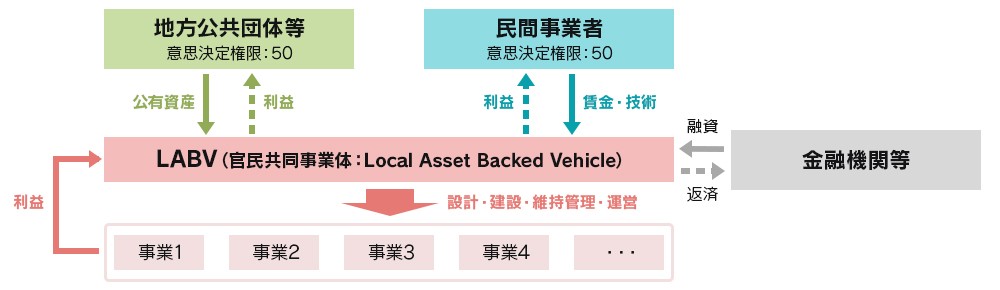
created by our company based on existing materials
If the vacant land is in a prime location in an urban area and has undeniable value, then it can be effectively utilized while continuing to own it and earning rental income. However, if the value is not particularly high, but you want to promote the local business for the benefit of residents and to create a vibrant town rather than limiting it to public facilities even if it takes risks, then the LABV is an effective business method.
Attention points when implementing LABV
However, there are several points to keep in mind when implementing it.
First, there's the high level of involvement from the local government. The local government and private business sectors each invest to establishment a single business company, and they operate the business while holding equal voting rights. If the business proves unprofitable, the local government could lose the public land it contributed as capital.
Furthermore, in PPPs, the basic specifications of a project, once decided, are not changed midway through. Generally, the project proceeds according to the initial specifications until the end of the project period. On the other hand, in LABV, it is necessary to flexibly review the project plan and adjust the balance of multiple projects in response to the emergence of new regional needs and changes in the business environment. Therefore, rather than "Leaving everything to the private sectors," it is necessary for local governments to take a proactive and continuous stance as stakeholders in project management.
From this perspective, the initial search for business partners by local governments is crucial, and this process must be carried out carefully and reliably.
At the stage of seeking partners, while land may exist, the specific direction of its utilization remains only a rough outline. However, it is necessary to select a private business sector and work together on a large-scale project over the long term. It is crucial to determine whether the partner is someone who shares the local government's vision for the region's future and can walk alongside it.
In this process, if the choices lean towards safety by prioritizing capital strength and business scale, the business plan may become uninspired and lack originality. However, since public land is being invested, excessive risk-taking is also not an option. In operating the business company after its launch, a balanced management approach is required, adhering to the initial vision, ensuring public benefit, and simultaneously generating profits for the company.
Because this initiative involves an unprecedented "Horizontal Relationship" between the public and private sectors, LABV has certain points to consider. However, at the same time, it presents a new option for building the future of a city, even while involving a certain degree of risk, and is expanding possibilities for local governments.
PACIFIC CONSULTANTS' innitiatives to LABV
While there are currently only two examples of LABV implementation in Japan, some local governments are beginning to consider its potential. PACIFIC CONSULTANTS has its own business department for promoting PPP/PFI and has been providing support for many years in cooperation with its urban development depertment and other departments. Regarding LABV, they have been supporting the "Kamimine Town Settlement Promotion Housing Development Project," which is being carried out as part of the "Kamimine Town Central Business District Revitalization Project" in Kamimine Town, Saga Prefecture.
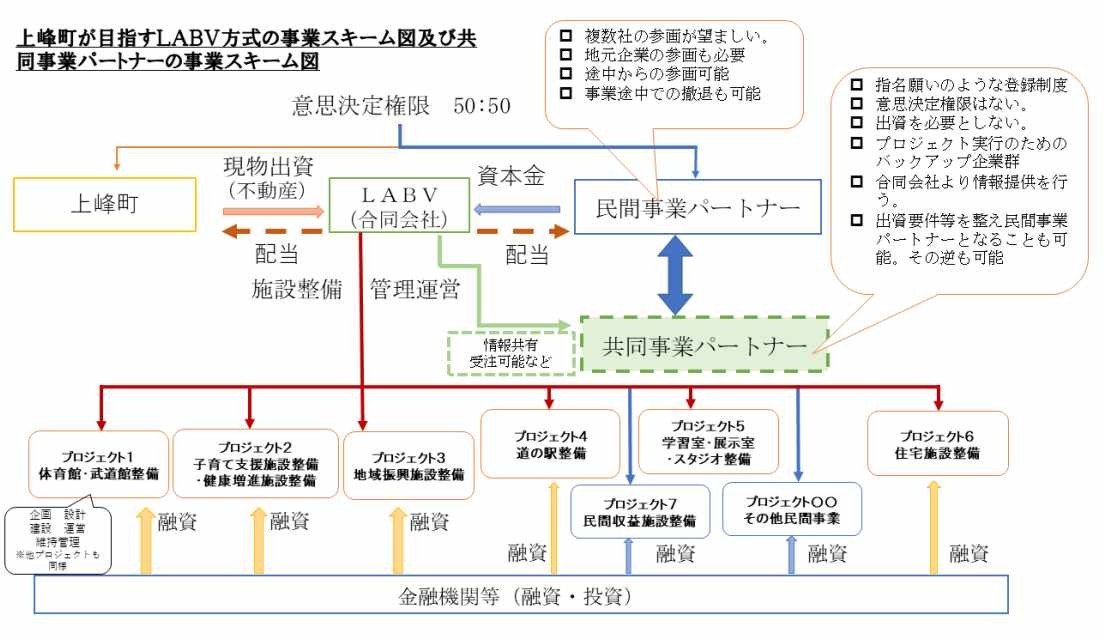
The project originated in 2019 when a large general merchandise store that had been in business for 24 years closed down. The store decided to donate approximately 60,000 square meters of land and buildings to Kamimine Town for free of charge. The town began considering how to utilize the land and in April 2020 decided to proceed with the Kamimine Town Central Business District Revitalization Project using the LABV method. Subsequently, they sought private business sectors partners, and in April 2021, Tsubaki Machizukuri Project Joint Venture (LABV) was established. This was funded by investments from 10 private companies. The town contributed real estate worth 500 million yen as an in-kind investment and holds a 50% stake as an executive partner.
This LABV project in Kamimine Town consists of various projects including a multi-purpose exchange facility, educational facilities, roadside station, and housing to encourage permanent residency (residential + commercial tenants). Our company was contracted to provide support services for the housing to encourage permanent residency project.
Initially, securing project funding proved difficult. However, we proposed establishment a Special Purpose Company (SPC) as a wholly owned subsidiary of LABV, separating it as a PFI (Concession) project, and creating a system that would make it easier to receive government subsidies and loans from financial institutions. This would make it easier to secure project funding. If LABV were to own the housing intended for promoting permanent residency, there would be problems with its financial performance compared to regular public housing due to the burden of property taxes and real estate income taxes. In this respect, combining it with a PFI project offers significant advantages.
Regarding this housing project to encourage permanent residency, a four-story building was completed by fiscal year 2025. The first floor houses commercial facilities, and the second to fourth floors are rental apartments (62 units in total), with residents already moving in. A major supermarket that had previously withdrawn from the area has returned to the commercial facilities, contributing to improved shopping convenience for residents and nearby residents.
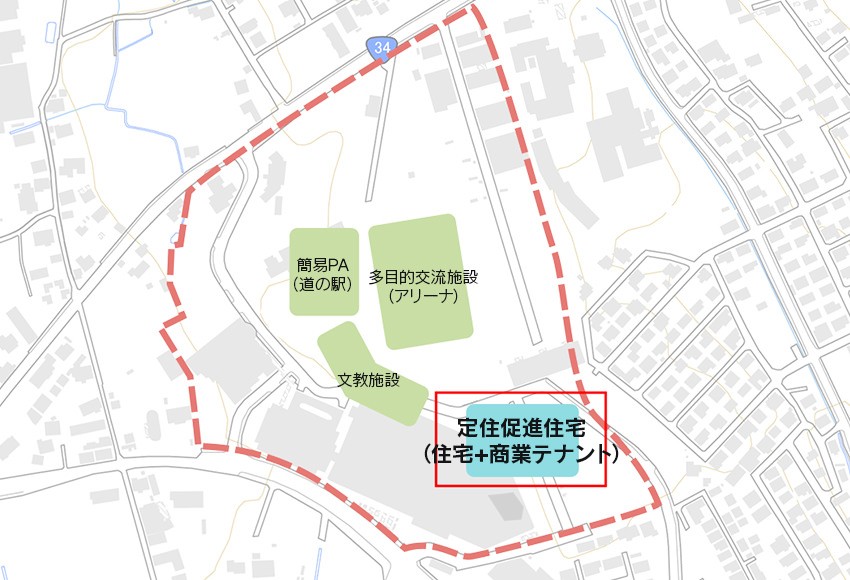
Created by our company based on existing materials.
Our company has a proven track record in PPP projects nationwide. Regarding the utilization of idle public land, including the promotion of LABV, we aim to contribute to creating sustainable and vibrant communities where everyone can live with peace of mind.