
The "July 2018 Heavy Rains" caused widespread damage across western Japan. In particular, the collapse of the Oda River levee in Mabi-cho, Kurashiki City, resulted in severe damage, including 51 deaths. The government decided to expedite the completion of the already-started project to relocate the confluence point with the Takahashi River by five years to ensure the safety of the river basin as quickly as possible. Numerous construction consultants and construction companies rallied together for this emergency project. PACIFIC CONSULTANTS also handled many of the tasks. We talked to Kenji KIMURA of the River Structure Sec., River Basin Structural Dept., Land Infrastructure Div., who oversaw the entire project as the project manager.
INDEX
- The Odagawa River basin had suffered repeated flood damage
- The completion target has been brought forward by five years
- Cutting through mountains to create new waterways
- Starting with what you can do, and thinking as you go
- Using the achievement results to our advantage in the future as a pioneer in flood controlling river basin
The Odagawa River basin had suffered repeated flood damage
The Takahashi River is one of the first-class rivers in western Okayama Prefecture, flowing from north to south before emptying into the Seto Inland Sea. Historically, it has irrigated rice paddies in the plains, and the Mizushima Industrial Zone was established at its estuary.
However, the Takahashi River was also known as a river that was difficult for flood control. It had two weaknesses. One was that the "Tatara Steelmaking" that was actively carried out in the upper reaches since the Edo period had caused sediment to accumulate in the lower reaches, raising the riverbed. Tatara Steelmaking uses a method called gravity separation, in which weathered granite soil layers are flowed into waterways to obtain iron sand as raw material. As a result, the riverbed in the lower reaches gradually rose, becoming a "ceiling river" that was higher than the surrounding plains, and a large area of zero-meter elevation spread around it.
Another weakness is the confluence with the Oda River, located about 15 km upstream from the estuary of river. The Oda River is one of the tributaries that flows into the Takahashi River from the west, but because its gradient is gentle and the water level at the confluence with the Takahashi River is high, a backwater phenomenon is likely to occur during floods, where water from the Takahashi River flows back into the Oda River, causing the water level of the Oda River to rise. In fact, Mabi Town, which is close to the confluence, has been hit by floods many times.
Therefore, in 1989, the government established the basic plan for construction work in the Takahashi River system, deciding to relocate the confluence of the Takahashi River and the Oda River approximately 4.6 km downstream to suppress backwater generation and significantly lower the water level. The "Takahashi River System River Improvement Plan," which included this relocation, was formulated in 2010, and after subsequent surveys such as environmental impact assessments, it was officially adopted as a new project in 2014, with construction commencing with the goal of completion in fiscal year 2028.
The completion target has been brought forward by five years
However, during the "July 2018 Heavy Rains" that occurred from late June to July 2018, the Oda River levee, which had been a cause for concern, collapsed. This resulted in devastating damage, with 51 deaths, approximately 4,600 buildings flooded, and a flooded area of 1,200 hectares. In some areas, the floodwaters reached depths exceeding 5 meters, and about 80% of the deceased were over 70 years old. Furthermore, it is believed that most of the victims perished inside houses that were not flooded, revealing that the flooding occurred on an unprecedented scale and that the water level rose rapidly in a short period of time.
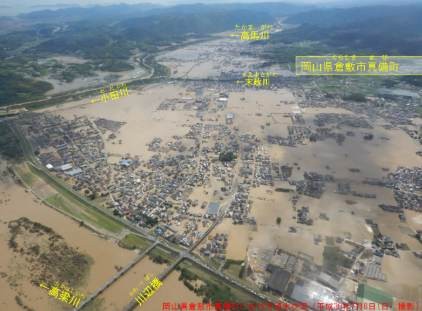
Source: "July 2018 Heavy Rains - Mabi-cho, Kurashiki City, Okayama Prefecture -" (Ministry of Agriculture, Forestry and Fisheries)
Source of damage figures: Cabinet Office Central Disaster Management Council, Disaster Prevention Measures Implementation Meeting, "On the Approach to Evacuation from Floods and Landslides Based on the July 2018 Heavy Rains" Reference Material
Following the damage, the government designated the Odagawa River confluence relocation project, which was originally scheduled for completion in fiscal year 2028, as a "Special Emergency Project for Severe River Disaster Countermeasures (commonly known as the 'Severe Disaster Project')." The completion date was brought forward by five years from 2028 to within fiscal year 2023, and construction was to be accelerated. The Severe Disaster Project is a project in which the government takes the lead in carrying out intensive river improvement work over approximately five years as a direct government project on rivers that have suffered extensive damage from floods or storm surges. It was an urgent measure to prevent future disasters.
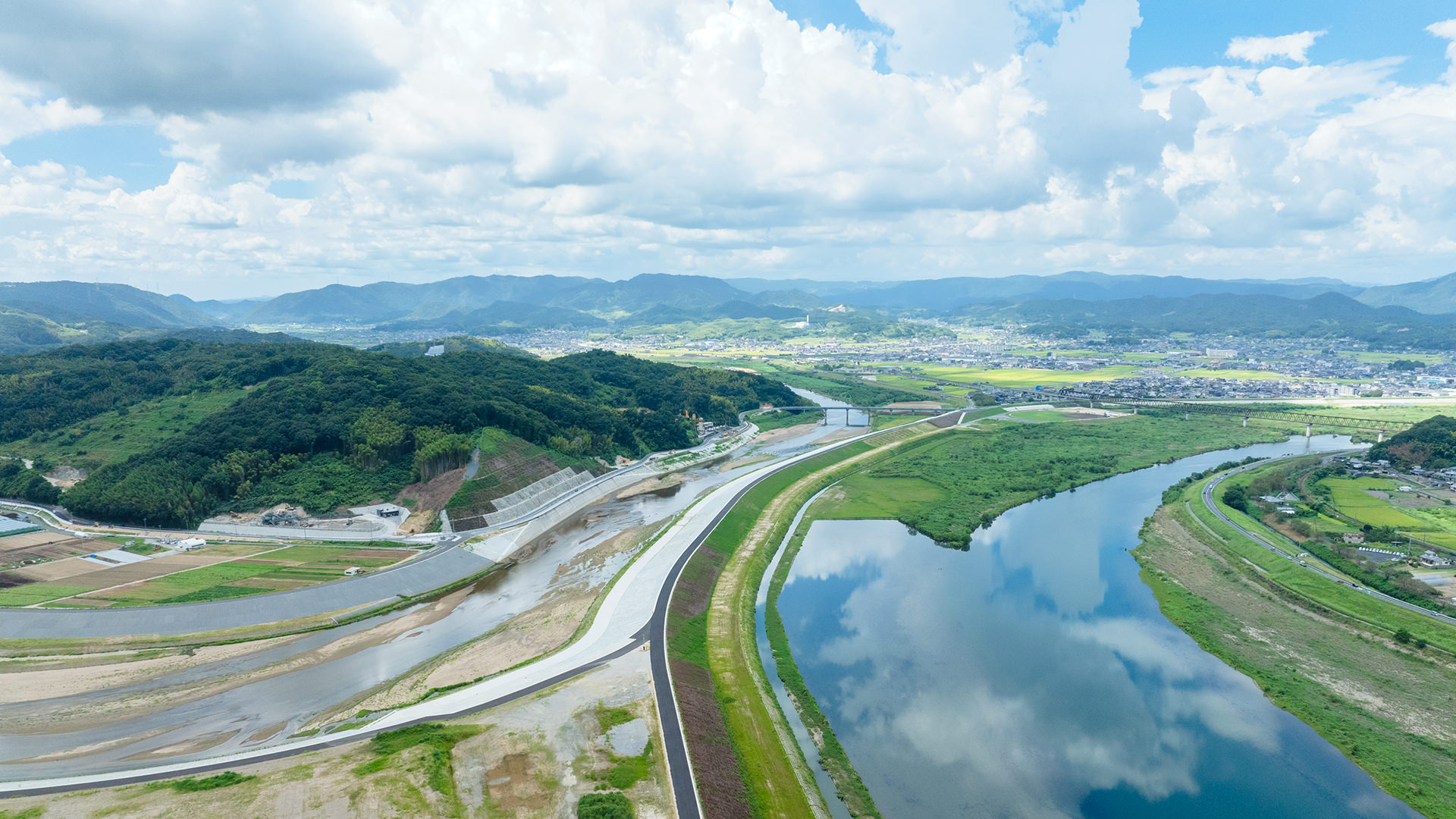
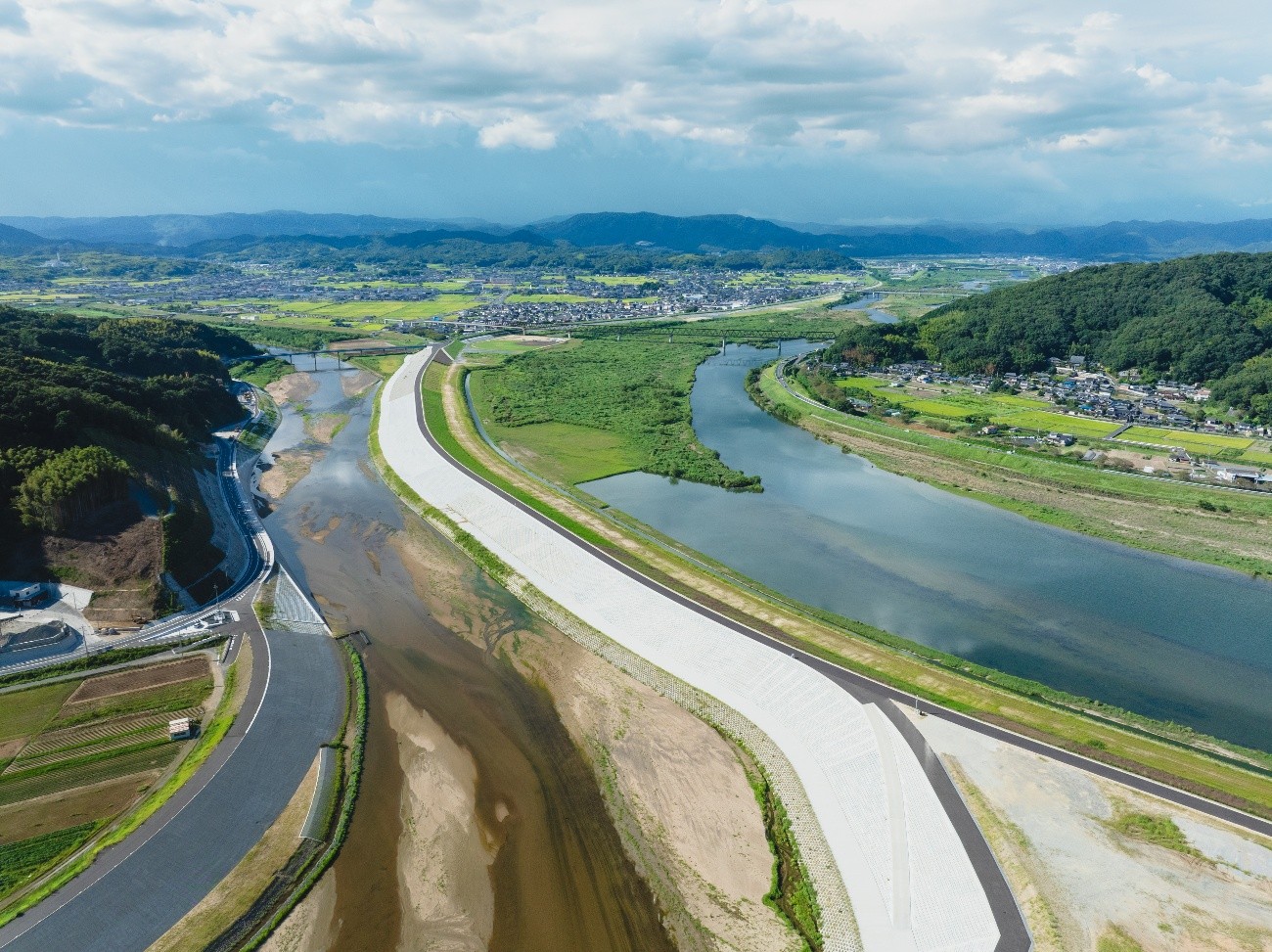
The specific details of the project are as originally planned: The current confluence point will be closed off by a newly constructed embankment, and a new confluence point will be established approximately 4.6 km downstream. The two points will be connected by a new waterway approximately 3.4 km long, which will include converting the Yanaihara Reservoir into a river channel. Two effects were expected. First, to reduce the impact of backwater on the Oda River and significantly lower the water level of the Oda River, thereby improving safety in Mabi Town. Second, to lower the water level by moving the Sakazu point on the Takahashi River, which was previously after the confluence with the Oda River, to before the confluence. The city of Kurashiki spreads out extensively behind the Sakazu point. Improving safety in that area was the aim.
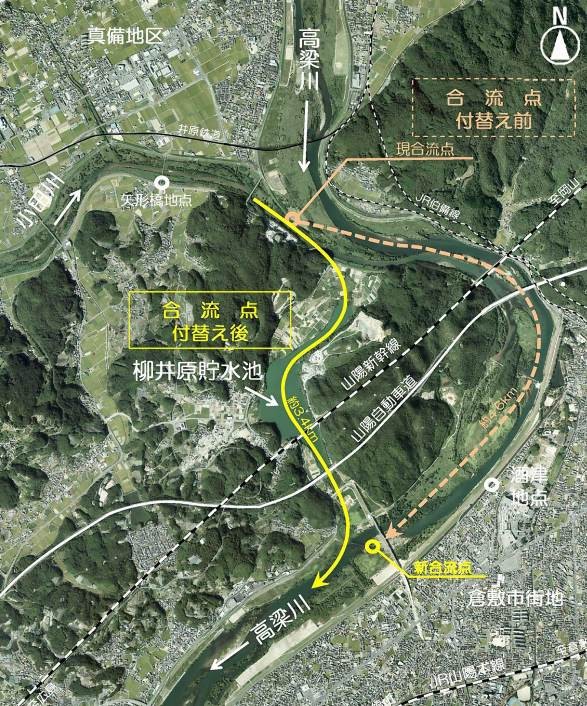
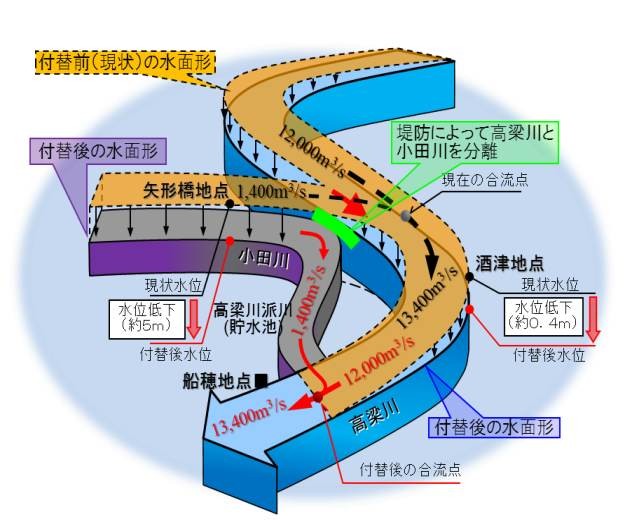
Source: "Overview of the Odagawa River Confluence Relocation Project" (March 2018, Okayama River Office, Chugoku Regional Development Bureau)
Cutting through mountains to create new waterways
Although the Yanaihara Reservoir, located along the route, will be utilized, a new channel will need to be created for approximately 3.4 km up to the confluence. In particular, the upstream section, which will close the current confluence and direct the water towards the Yanaihara Reservoir, must have a gentle curve to avoid reducing the flow capacity of the Oda River. To achieve this, it was necessary to excavate a portion of Minamiyama, which juts out along the river, to make the alignment gentler and to ensure sufficient river width. This was one of the most difficult construction parts of the project, and PACIFIC CONSULTANTS was in charge of this revised design.
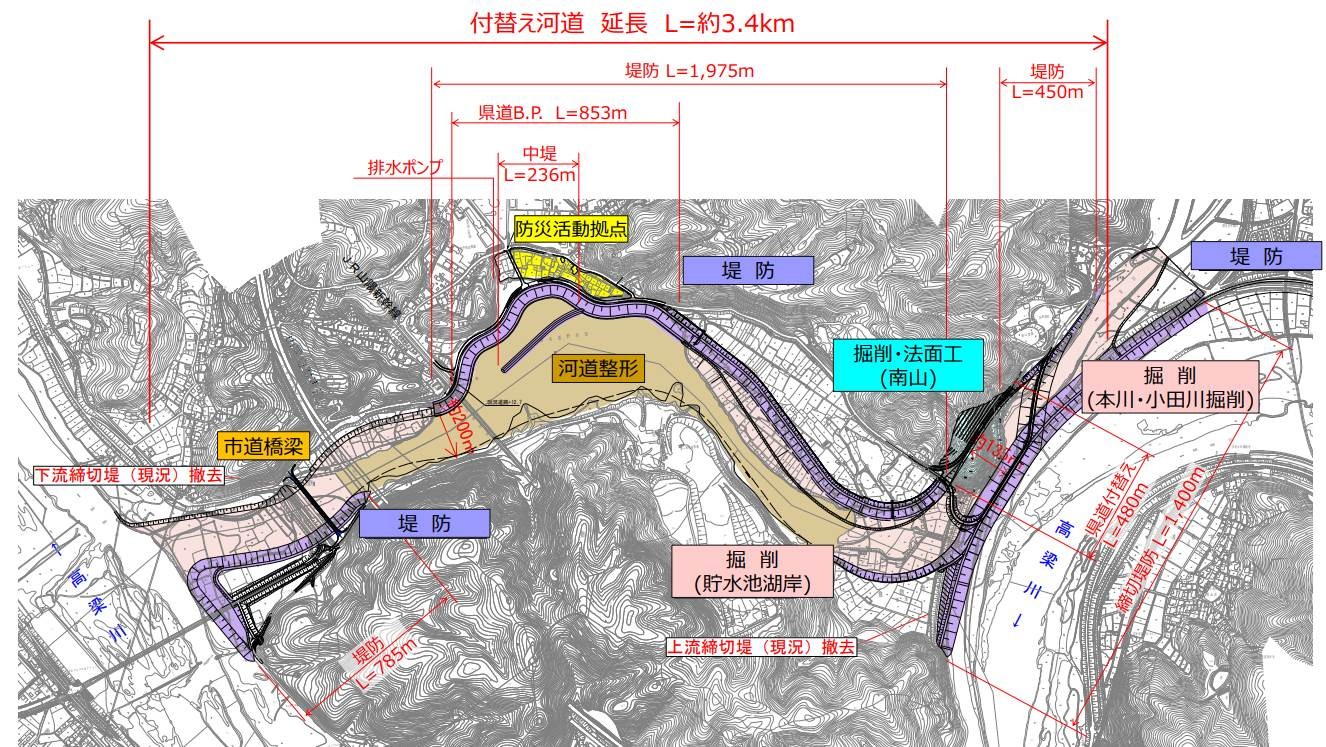
Source: "Overview of the Odagawa River Confluence Relocation Project" (March 2018, Okayama River Office, Chugoku Regional Development Bureau)
"Although the detailed design had been completed before the project was designated as a special emergency project, we re-examined the revetment structure based on the changed conditions, created design drawings and quantity calculations, and also re-examined the excavation and construction methods," said KIMURA.
In addition to the design related to the Minamiyama excavation, our company was also responsible for the design of various other types of construction work, including the closure embankment separating the former confluence of the Odagawa river and Takahashi river, the revised design of the revetment in the Sakazu area, and the overall coordination of the river channel design and road relocation design for the Yanaihara Reservoir.
Starting with what you can do, and thinking as you go
Bringing forward the completion date of the massive civil engineering project to relocate the Odagawa River confluence is no easy task. Civil engineering projects involving large-scale excavation and other work often encounter unexpected obstacles as they progress, and while delays in the expected completion date are possible, bringing it forward—not by a few months or a year, but by as much as five years—is extremely difficult. It required not just simply speeding up each stage, but a fundamental review of the project management system, construction methods, and construction procedures. Our company had been involved in this project for some time, but the approach has changed significantly since it became a special-purpose project. KIMURA recalls:
"With the effects of climate change becoming more severe, this project must be completed as quickly as possible to prevent further damage. Many companies, including major and local construction consulting firms, surveying companies, and construction companies, were involved. Our company, leaded by the River Sec. of Chugoku Branch Office, also received support from Kyushu Branch Office (now our Kyushu Headquarters) and Osaka Headquarters to carry out surveying and detailed design work."
At various points, including the confluence of the old and new lines, it was necessary to proceed with surveys, measurements, detailed design, construction, and construction supervision simultaneously. Instead of adhering to normal procedures, the approach was to consider what could be done immediately and start there. Contracts with the client were initially signed only for major items, and changes or additions to the contract were made as issues arose and the design was modified as the design and construction progressed. "For construction, we handed over the design drawings and other documents to the construction company as quickly as possible through the client, and proceeded with design and construction in parallel. This was so that if any issues or problems were found during construction, we could immediately go back to the design and make corrections, so that construction would not be stopped," said KIMURA.
Approximately 2.6 million cubic meters of excavation are being carried out to improve the new river channel. However, instead of transporting some of the excavated soil off-site, efforts were made to effectively utilize it for shaping the embankment and river channel on-site. This reduces the amount of work required for temporary storage and transportation of the excavated soil. Everyone involved in the construction project approached the task with a strong desire to increase efficiency and complete the project as quickly as possible, which led to the generation of various ideas and ultimately contributed to the project's completion in a short timeframe.
Using the achievement results to our advantage in the future as a pioneer in flood controlling river basin
The Odagawa River confluence relocation project, undertaken as a special emergency measure, was completed as scheduled in March 2024. In addition to this relocation project, hard measures such as raising the height of rivers and strengthening embankments, as well as river channel excavation to lower water levels during floods, were also carried out on the three rivers under Okayama Prefecture's management that flow into the Odagawa River (Suemasa River, Takama River, and Matani River), and these were also completed within fiscal year 2023. Furthermore, various soft measures were also carried out in parallel, such as strengthening efforts to make people take disasters for granted and improving real-time information that leads to evacuation actions. These were carried out as the Mabi Emergency Flood Control Project, centered on the Odagawa River Confluence Relocation Project, with cooperation from the national government, the prefecture, and the city, and the involvement of more than 1,500 private companies. KIMURA recalls.
"The Mabi Emergency Flood Control Project, which included the relocation of the Odagawa River confluence, served as a model for 'Flood controlling River Basin,' which involves preventing flood damage throughout the entire river basin, from the catchment area where rainwater flows into the river to the flood plain, and by integrating both hard and soft measures. While achieving a five-year reduction in construction time, it also left a significant legacy and numerous lessons for promoting new flood controlling river basin. I hope to pass on the efforts of the Mabi Project to the younger generation who will lead the next generation, and utilize them in the future."
With the increasing severity of torrential rain disasters due to climate change becoming more pronounced, building flood-resistant cities and ensuring rapid recovery in the event of a disaster are becoming increasingly important issues. The Odagawa River Confluence Relocation Project has provided valuable lessons and achievements for future river disaster prevention efforts.